CAT4 Test: Free Practice Questions & Expert Preparation
Prepare your child for the CAT4 Test with expert resources from preparation specialist Liron Katz. Explore free CAT4 practice test questions and realistic CAT4 practice tests, understand CAT4 scores, learn how the CAT4 is administered, and discover comprehensive CAT4 test preparation materials designed to build confidence before test day.
Explore free CAT4 practice questions now:
Verbal Analogies | Verbal Classification | Number Analogies | Number Series | Figure Matrices | Figure Classification | Figure Analysis | Figure Recognition
Or practice CAT4 exam questions by level/year:
Free CAT4 Sample Questions Levels X&Y (Years 2-3) |Free CAT4 Sample Questions Levels A&B (Years 4-5) | Free CAT4 Sample Questions Levels C&D (Years 6-7) | Free CAT4 Sample Questions Levels E&F (Years 8-9)


What Is the CAT4 Test?
The CAT4 is a reasoning ability assessment used by schools across the UK and by international schools worldwide. It plays a role in school admissions, including 11+ and selective entry, as well as predicting academic growth, determining placement for gifted programmes, and identifying potential across different educational backgrounds. Crucially, it provides a picture of how a child thinks rather than what they have been taught. Before sitting the exam, many families use CAT4 practice tests to help students become familiar with its format, timing, and the reasoning skills it assesses.
The CAT4 is:
- Computer based
- Strictly timed
- Designed to measure reasoning ability, not taught curriculum content.
It assesses four key reasoning areas (called batteries), each with two sub-tests:
Verbal Ability Reasoning
Verbal Classification
Verbal Analogies
Quantitative Reasoning
Number Analogies
Number Series
Non-Verbal Reasoning
Figure Classification
Figure Matrices
Spatial Ability Reasoning
Figure Analysis
Figure Recognition

Free CAT4 Test Practice Questions
These CAT4 practice test questions give students an opportunity to experience the same reasoning skills assessed on the real CAT4 test. Practicing these question types is one of the most effective ways to support CAT4 test preparation.
You can also practice CAT4 exam questions by level/year:
Free CAT4 Sample Questions Levels X&Y (Years 2-3) |Free CAT4 Sample Questions Levels A&B (Years 4-5) | Free CAT4 Sample Questions Levels C&D (Years 6-7) | Free CAT4 Sample Questions Levels E&F (Years 8-9)

What is the Verbal Reasoning Battery?
CAT4 practice tests typically include Verbal Analogies and Verbal Classification questions to help students become comfortable with language-based reasoning tasks.
Verbal Analogies Sample Question:
In Verbal Analogies questions, students identify the relationship between one pair of words and apply the same relationship to another pair.
Verbal Classification Sample Question
Verbal Classification questions ask students to identify how words are connected and choose another word that belongs to the same group.

What is the Quantitative Reasoning Battery?
A realistic CAT4 practice test should include Number Analogies and Number Series questions that mirror the style and difficulty of the real assessment.
Number Analogy Sample Question
Students must identify the mathematical relationship between number pairs and apply it to a missing value.
Number Series Sample Question
Students identify the rule governing a sequence of numbers.

What is the Non-Verbal Reasoning Battery?
Non-verbal questions are among the most challenging sections for many students, making CAT4 practice tests particularly valuable for developing pattern-recognition skills.
Figure Classification Sample Question
Students identify the visual rule connecting a group of shapes.
Figure Matrices Sample Question
In the Figure Matrix, you are given a grid (2x2 or 3x3. Students identify patterns across rows and columns to complete a missing figure.
What is the Spatial Ability Battery?
Regular CAT4 practice test exposure helps students improve confidence when tackling unfamiliar spatial reasoning questions under timed conditions.
Figure Analysis Sample Question
Figure Analysis questions show a square piece of paper being folded several times and then punched with holes or shapes. Students predict how folded paper will appear once unfolded.
Figure Recognition Sample Question
Figure Recognition questions show a specific target shape on the left and five complex designs on the right. Students identify a hidden target shape within a complex figure.
Spatial Ability - Figure Recognition Question
Which of the five designs contains the exact same size outline of the target, including each side in full.

The correct answer is D.
Let's Break This Down Step by Step
First, let's carefully examine the simple figure we're looking for. It's shaped like a staircase or an L-shape with two steps. The figure has a horizontal bottom section, then steps up once, and steps up again, creating a distinctive two-step pattern. This shape is our target, and we need to find it hidden somewhere inside one of the complex figures.
Now that we understand the relationship, we need to find out what wool is used to make. We're looking for something that wool serves as a material for, just like cement serves as a material for a building. Let's think about what wool is commonly used to create or construct.
Let's look at option A. This figure is a rectangle divided by diagonal lines. While it has some interesting patterns created by these diagonals, we can't find our two-step staircase shape anywhere within it. The diagonal lines break up the space in a way that doesn't allow our simple figure to exist as a complete, connected shape. We can eliminate option A.
Now let's check option B. This figure looks like an arrow or house shape pointing to the right, with a grid pattern inside it. While there are some step-like divisions within the grid, we can't locate our specific two-step staircase pattern. The internal divisions don't create the exact L-shape with two steps that we're looking for. Option B doesn't contain our simple figure, so we can set it aside.
Moving to option C, we see a rectangular grid with multiple squares arranged in rows. This creates many right angles and divisions, but when we trace through the possible shapes, we don't find our two-step staircase. The grid creates different patterns, but not the specific L-shaped figure we need. We can confidently eliminate option C. Now let's carefully look at option D.
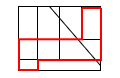
This figure is a rectangle with a diagonal line cutting across it and horizontal divisions creating a grid pattern. If we look at the bottom left portion of this figure, we can trace our two-step staircase! Starting from the bottom left corner, we can follow the outline that goes right, then up one step, then right again, then up another step. This matches our simple figure perfectly! Option D contains our target shape.
Even though we've found our answer, let's check option E to be thorough. This figure is a parallelogram (a slanted rectangle) with internal divisions. While it has some horizontal and vertical lines, the slanted outer edges and the internal pattern don't contain our two-step staircase shape. We can confirm that option E is not our answer.
Boost Your Child's CAT4 Score
TestPrep-Online's complete CAT4 Preparation Packs are a full course: a written study guide, video walkthroughs, and hundreds of practice questions with full explanations - starting from $59.

How Long Is the CAT4 Test, and How Is It Structured?
CAT4 test length and structure vary by level. For Levels A to G, the CAT4 takes around 72 minutes of test time across three sittings, made up of four batteries - Verbal, Quantitative, Non-Verbal, and Spatial Ability - each split into two short, strictly timed sections. Levels X, Y, and Pre-A follow a shorter, simpler format: one section per area, taking roughly 40 minutes in total across two sittings.
Whatever the level, once time runs out on a section, students cannot return to previous questions - making pacing as important as the reasoning itself.
|
Part 1 |
Figures & Verbal Reasoning |
25–30 Minutes |
|
Part 2 |
Numbers & Shapes |
20–30 Minutes |
|
— |
— |
— |
|
Total |
Two Parts |
45–60 Minutes |
|
CAT4 Section |
Number of Questions |
Test Time |
|
Part 1 |
|
|
|
Figure Classification |
24 Questions |
10 Minutes |
|
Figure Matrices |
24 Questions |
10 Minutes |
|
Part 2 |
|
|
|
Verbal Classification |
24 Questions |
8 Minutes |
|
Verbal Analogies |
24 Questions |
8 Minutes |
|
Number Analogies |
18 Questions |
10 Minutes |
|
Part 3 |
|
|
|
Number Series |
18 Questions |
8 Minutes |
|
Figure Analysis |
18 Questions |
9 Minutes |
|
Figure Recognition |
18 Questions |
9 Minutes |
|
— |
— |
— |
|
Total |
168 Questions |
~2 Hours |

CAT4 Test Levels Explained: Which Test Level Matches Your Child's Age?
|
CAT4 Level |
Age Range (Norms) |
England & Wales (Year) |
International Grade Equivalent |
|
Level X |
6:00 – 7:11 |
Year 2 |
Grade 1 |
|
Level Y |
7:01 – 8:11 |
Year 3 |
Grade 2 |
|
Level A |
7:06 – 9:11 |
Year 4 |
Grade 3 |
|
Level B |
8:06 – 10:11 |
Year 5 |
Grade 4 |
|
Level C |
9:06 – 11:11 |
Year 6 |
Grade 5 |
|
Level D |
10:06 – 12:11 |
Year 7 |
Grade 6 |
|
Level E |
11:06 – 13:11 |
Year 8 |
Grade 7 |
|
Level F |
12:06 – 15:11 |
Year 9 & 10 |
Grades 8 & 9 |
|
Level G |
14:06 – 17:00+ |
Year 11+ |
Grades 10 & 11 |
- Intentional Overlap: You will notice that age groups overlap between levels (for example, a 7-year-old could technically sit Level X or Level Y). This provides schools with flexibility to test a whole class together, even if some children have early or late birthdays.
- Global Standard: Because school systems use different labels (e.g., UK "Year 4" is the same age as US "Grade 3"), the lettered levels (X–G) act as a universal bridge for international schools.
- Structure Change: Levels X and Y are "Young Learner" versions, which are shorter (two parts, 43 minutes) to accommodate shorter attention spans. From Level A upwards, the test moves to a three-part format (72 minutes).
- School Discretion: Schools may choose a level slightly outside the "standard" mapping based on when in the year they are testing or the specific ability mix of a classroom.
About Our CAT4 PrepPacks (Prep Courses)
Each CAT4 PrepPack is a full course, not just a set of practice questions - a written study guide, video walkthroughs, and hundreds of practice questions with full explanations, all in one pack. GL Assessment builds each CAT4 level with overlapping difficulty - the easiest questions at one level closely resemble the hardest questions at the level below, and vice versa. That's why most PrepPacks combine two adjacent levels: practicing across both gives a fuller picture of the difficulty range a student may actually encounter, not just the midpoint.
CAT4 Preparation Course for Levels X-Y (Years 2-3)
Level X's hardest questions overlap with Level Y's easiest ones, so practicing both gives students preparing for Level X a preview of the tougher end of their range.
→ See the CAT4 Levels X-Y PrepPack Course · Or try free CAT4 X&Y sample questions
CAT4 Preparation Course for Levels A-B (Years 4-5)
Because Level A and Level B share overlapping difficulty at the edges, students preparing for either level benefit from seeing both - especially if their ability sits toward the top of Level A's range or the bottom of Level B's.
→ See the CAT4 Levels A-B PrepPack Course · Or try free CAT4 A&B sample questions
CAT4 Preparation Course for Levels C-D
The same overlap applies here: Level C's more demanding questions resemble Level D's easier ones, so the combined course covers the full transition rather than a hard cutoff between levels.
→ See the CAT4 Levels C-D PrepPack Course · Or try free CAT4 C&D sample questions
CAT4 Preparation Course for Levels E-F
Level E and Level F overlap the same way, making the combined course useful for students whose ability may extend beyond a single level's range.
→ See the CAT4 Levels E-F PrepPack Course · Or try free CAT4 E&F sample questions
CAT4 Preparation Course for Level G
Level G is the most advanced CAT4 level, with no higher level above it — so it remains a dedicated standalone course, focused entirely on senior-level reasoning.
→ See the CAT4 Level G PrepPack Course
Fairness is maintained despite these crossovers because the Standard Age Score (SAS) adjusts every result based on the child's exact age in years and months on the day of the test.
Want to see what our CAT4 tests looks like? Here is a mini version of our CAT4 Test:

How Our CAT4 Practice Tests Helps Students Succeed
Our CAT4 test preparation materials are designed to help students become familiar with the format, timing, and reasoning skills assessed on the CAT4 test. Through realistic CAT4 practice tests and targeted exercises, students gain the confidence needed to perform at their best.
We turn test-day stress into readiness. Our prep pack includes:
- Full-Length CAT4 Practice Tests: Give students a realistic preview of the CAT4 Test so they know exactly what to expect on test day.
- Timed Sub-Tests: Teach students to manage strict CAT4 time limits without rushing into mistakes.
- Step-by-Step Explanations: Clarify why each answer is correct, building transferable reasoning skills.
- Targeted Reasoning Drills: Strengthen specific verbal, non-verbal, quantitative, and spatial skills.
- Strategy Tips: Equip students with proven methods for tackling tricky question types.
- Progress Tracking: Show growth clearly and highlight where further practice is needed most.
Students who use our prep materials report feeling significantly more confident and prepared on test day, with many seeing score improvements of 10-15 points in their target areas.

Watch the CAT4 Test Explained in Under 5 Minutes
Watch the short video above to learn everything you need to know about the CAT4 exam.
Free CAT4 Test Preparation PDF (with answers)
The CAT4 demands rapid decision-making, mental agility, and unfamiliar spatial reasoning. Ensure your child is prepared for the fast timing and unique formats.
8-10 Minute Sub-tests: Learn to beat the clock.
Download our free CAT4 test preparation PDF to experience realistic CAT4 practice questions, learn common question formats, and begin preparing for the CAT4 test with confidence.
At the end of the CAT4 exam PDF, you can find the answer key with explanations.

Understanding CAT4 Test Scores for Parents
After completing a CAT4 practice test, many parents want to understand how CAT4 scores are reported and what the results mean for school placement and academic planning.
These boxes show the key components that make up your child’s CAT4 score.
Standard Age Score (SAS)
Compares your child’s performance to others of the same age. An SAS of 100 is average, while 120+ indicates strong performance that schools may use when considering enrichment opportunities.
National Percentile Rank (NPR)
Shows the percentage of students your child outperformed nationally. For example, an NPR of 80 means your child scored higher than 80% of peers their age.
Group Rank
Compares your child’s performance to classmates or peers in the same school, helping teachers spot learning needs quickly.
Stanine
A simple 1–9 scale used by schools to group students for instruction. Higher stanines can open doors to advanced programmes.

CAT4 Test: Student Profile and Next Steps
The Cognitive Abilities Test (CAT4) determines a student’s learning style by evaluating the balance between their verbal (language-based) and spatial (visual and pattern-based) reasoning skills. Based on these scores, students are categorized into one of seven profiles indicating a verbal bias, a spatial bias, or no bias, with strengths ranging from mild to extreme. To understand what these individual metrics mean for your child, view our guide on CAT4 scores explained.
After the test, schools typically share results within two to three weeks. Parents should review the report collaboratively with teachers to combine these cognitive insights with everyday classroom performance. This ensures a complete educational picture, allowing parents and educators to tailor learning strategies, celebrate strengths, and support the student's ongoing progress.
Get Started with Confidence
Ready to start with a CAT4 practice test? Give your child the advantage of experiencing realistic CAT4 practice tests, expert explanations, and targeted preparation before the real CAT4 Test.
Ask Liron

A language and linguistics expert with an MA in Language Teaching and over a decade of experience developing assessment-aligned practice across multiple subjects that mirrors the rigor of real edtech tests. Liron creates prep packs with clear, structured exercises that enhance learning, adapt to digital tools, and empower every student to perform their best on a wide range of assessments

Frequently Asked Questions About CAT4 Test Preparation
CAT4 (Cognitive Abilities Test, 4th Edition) is a reasoning ability assessment - sometimes called the CAT4 test, CAT4 assessment, or CAT4 testing - developed by GL Assessment and used by schools across the UK and internationally. Rather than testing curriculum knowledge, it measures how a child thinks and reasons across four batteries: Verbal, Quantitative, Non-Verbal, and Spatial Ability. Schools use CAT4 results for admissions, gifted programme placement, and broader academic planning.
CAT4 measures how your child thinks, not what they’ve memorized. It assesses reasoning skills across verbal, quantitative, non-verbal, and spatial areas to help schools understand learning potential and academic strengths.
Schools use CAT4 to predict academic progress, guide placement decisions, and identify gifted potential because it provides insight into a child’s learning style rather than just current classroom performance.
Yes. While the CAT4 measures reasoning ability rather than school knowledge, students can prepare by becoming familiar with the question formats, timing requirements, and reasoning skills used throughout the assessment.
The most effective CAT4 test preparation combines realistic CAT4 practice tests, targeted reasoning exercises, timed practice, and review of detailed explanations.
Practice tests help students become familiar with the CAT4 format, reduce anxiety, and improve time management. This often allows students to demonstrate their abilities more effectively during the actual CAT4 test.
Scores include Standard Age Scores (SAS) and National Percentile Ranks (NPR), which show how your child compares to others their age. These results help schools plan support, enrichment, or academic pathways.
Most students benefit from several weeks of structured CAT4 preparation, allowing them to become comfortable with all eight CAT4 sub-tests and improve their test-taking confidence.
High-quality CAT4 practice tests are designed to reflect the structure, timing, and reasoning skills assessed on the real CAT4 Test. While no practice test can replicate the exact questions used by schools, realistic CAT4 practice tests help students become familiar with the format and build confidence before test day.
Our Prep Pack provides full-length timed tests, detailed explanations, strategy tips, and progress tracking, giving your child structured, realistic practice that free samples alone cannot offer.
There's no single test date - CAT4 doesn't run on a fixed exam calendar the way some national exams do. GL Assessment (the test's publisher) leaves timing entirely up to each school; it can be administered any time of year. In some regions, local education authorities require schools to test within a specific window (for example, several school systems in the UAE mandate testing between late August and November). Elsewhere, including in the UK, it's entirely the school's own decision, and some schools offer multiple dates across the year rather than a single sitting. Check with your child's school for their specific approach
CAT4 and IQ tests both measure reasoning ability rather than taught curriculum knowledge, so they're often compared. However, CAT4 isn't a clinical IQ test - it's specifically designed for school use, focused on academic placement, admissions, and identifying learning needs, not diagnosis. Schools use it to understand how a child thinks and reasons, which supports teaching decisions rather than producing a single "intelligence score."
If your child finds certain CAT4 question types difficult, the most effective response is usually more targeted practice, not less. Familiarity with the format - timing, question style, how to approach unfamiliar reasoning puzzles - builds real confidence, and confidence itself often improves performance under timed conditions.
It also helps to work on staying calm under time pressure: encourage your child to move on from a question they're stuck on rather than dwelling on it, take a breath between sections, and remember that CAT4 measures reasoning style, not "smartness" - there's no single right kind of thinker. A mix of steady practice and simple stress-management habits (calm routines before test day, adequate sleep, not over-cramming the night before) tends to help far more than worrying about a single weak area.
Yes, CAT4 doesn't have a pass or fail, so there's no barrier to a child with dyslexia or another learning difference sitting it.
One important thing to know upfront: GL Assessment (the test's publisher) doesn't permit extra time as an accommodation, even for children with additional needs, because the timing itself is part of what the test measures and extra time would distort the comparison to age norms. However, a reader can typically support a child through the instructions for each section - just not the timed questions themselves.
There's also a genuinely useful side to this: because CAT4 separates reasoning into four distinct areas (Verbal, Quantitative, Non-Verbal, Spatial), it often reveals real strengths in non-verbal and spatial reasoning even when a child's verbal score is affected by dyslexia - schools use this profile to identify students who may need extra support that hasn't been picked up yet, rather than the test simply being a hurdle to clear.


