Prepare Your Child for the MAP Test 7th Grade
Updated July 2026 | Trusted by 10,000+ NWEA MAP Candidates
Give your 7th grader the confidence, skills, and strategy to excel on the NWEA MAP Growth Test with the 7th Grade Practice Pack, prepared by Ariav, a seasoned educator with years of experience guiding 7th graders to success. Every question, quiz, and test simulation is handpicked and designed by his team to help students strengthen advanced math and reading skills while mastering language conventions and test-taking techniques.
MAP 7th Grade Packs
Updated
- Total of 750+ practice questions
(across quizzes, full-length tests & simulations) - 3 full-length tests
- Math and RLA Quizzes
- 16 video lessons
- 7 Math study guides
- Retake all tests as often as needed


Try These 7th Grade MAP Practice Questions
We included all four sections here for you to explore! Your core 7th Grade PrepPack fully covers Math, Reading, and Language Usage, while Science is available as an add on.
7th Grade MAP Math: Data & Algebra
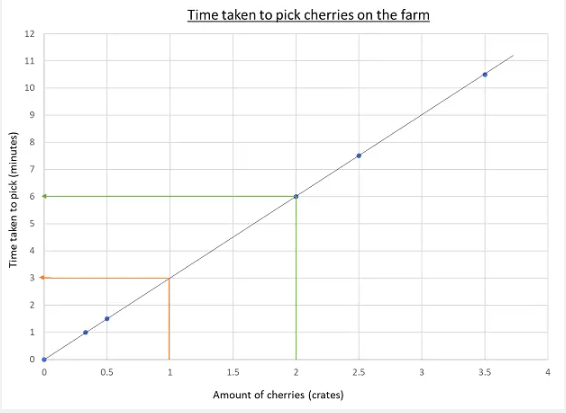
Use the graph below to answer the question.
What is the unit rate per crate?
The correct answer is (D).
Let's break this down step by step:
A unit rate is one of the most practical concepts in mathematics. The word "unit" always means "one," so a unit rate tells us how much of something happens per ONE of something else. In this problem, we need to find how many minutes it takes to pick ONE crate of cherries.
Looking at the graph in the image, we can see:
- The x-axis (horizontal axis) represents "Number of crates picked"
- The y-axis (vertical axis) represents "Time (minutes)"
- There is a straight line passing through several points, starting at the origin (0,0)
This graph shows a proportional relationship between the number of crates picked and the time in minutes. The more crates you pick, the more time it takes.
The question asks for the unit rate per crate. This means we need to find out how many minutes it takes to pick exactly ONE crate of cherries. We're looking for the time (in minutes) when the number of crates equals 1.
To find the unit rate, we need to look at what happens when x = 1 (one crate).
Start at the number 1 on the x-axis (the horizontal axis at the bottom). Draw an imaginary line straight up from this point until you hit the graphed line (as shown by the orange line in the reference image). Then, from that point on the graph, draw an imaginary line horizontally to the left until you reach the y-axis. Read the value on the y-axis.
When we do this, we see that when x = 1 crate, y = 3 minutes.
This tells us directly that it takes 3 minutes to pick 1 crate of cherries.
We can double-check our answer by using any other point on the graph and calculating the unit rate from it.
Looking at the graph, we can see another clear point. When x = 2 crates, y = 6 minutes (as shown by the green line in the reference image).
This means it takes 6 minutes to pick 2 crates. Now let's calculate the unit rate:
6 minutes for 2 crates can be written as: 6 minutes / 2 crates
To find the rate for 1 crate, we divide both the numerator and denominator by 2:
- 6 ÷ 2 = 3 minutes
- 2 ÷ 2 = 1 crate
So the unit rate is 3 minutes per 1 crate, or simply 3 minutes per crate.
The unit rate is 3 minutes per crate. This means that for every single crate of cherries picked, it takes 3 minutes.
Answer (A) is incorrect because 0.33 minutes per crate would mean it takes only about 20 seconds (one-third of a minute) to pick a crate of cherries, which is not what the graph shows. This answer might come from reading the graph incorrectly and dividing in the wrong direction (1 crate ÷ 3 minutes instead of 3 minutes ÷ 1 crate).
Answer (B) is incorrect because 1 minute per crate would mean that each crate takes exactly 1 minute to pick. If we look at the graph at x = 1, the y-value is clearly 3, not 1. Also, if the unit rate were 1 minute per crate, then 2 crates would take 2 minutes, but the graph shows 2 crates take 6 minutes.
Answer (C) is incorrect because 2.5 minutes per crate does not match the graph. If we check: at x = 2 crates, the graph shows y = 6 minutes. If the rate were 2.5 minutes per crate, then 2 crates would take 2 × 2.5 = 5 minutes, not 6 minutes. This answer doesn't align with any point on the graphed line.
Answer (D) is correct because when we read the graph at x = 1 crate, the corresponding y-value is 3 minutes. This gives us the unit rate of 3 minutes per crate. We can also verify this by taking any other point on the graph (such as 6 minutes for 2 crates) and dividing both values by the number of crates to get 3 minutes per 1 crate.
Answer (E) is incorrect because 3.5 minutes per crate is too high. Looking at the graph at x = 1 crate, the y-value is clearly at 3, not 3.5. If the rate were 3.5 minutes per crate, then 2 crates would take 7 minutes, but the graph clearly shows 2 crates take 6 minutes.

What is the NWEA MAP Test for 7th Grade?
- Measures Academic Growth: The NWEA MAP test for 7th grade measures academic progress in reading, math, and other subject areas throughout the year.
- What 7th Graders Are Tested On: Students are expected to analyze complex texts, solve algebraic and proportional reasoning problems, and support answers with clear reasoning.
- Computer Adaptive: The MAP test for 7th grade adjusts question difficulty based on performance to accurately measure growth and learning level.

Choose the Prep Pack That Fits Your Child’s Goals
Full MAP Practice for 7th Grade
The newly updated Full MAP Practice for 7th Grade is designed for students who are ready to take on the increased academic demands of middle school. By 7th grade, reading passages become more complex, math concepts require deeper reasoning, and students are expected to think more critically across subjects. This comprehensive pack provides realistic MAP-style practice that helps students strengthen key skills, improve accuracy, and gain confidence in their abilities. With targeted exercises and full-length practice tests, students can measure their progress and prepare effectively for upcoming MAP Growth assessments.
Best for: Students who want to sharpen their academic skills, track their growth, and achieve strong MAP Growth scores during a pivotal year of middle school.
Duration: 6-month access.

Family Membership
Designed for families with multiple children or ongoing test-prep needs. Choose practice across different tests, grades, and subjects, while keeping everything in one account where you can see your children’s scores, practice history, and progress.
Best for: Families looking for flexible, convenient, and cost-effective test prep
Duration: 12-month access
MAP Science Practice
Bridge the gap to advanced scientific analysis during the crucial middle school transition. You can easily add this specialized package to your cart for rigorous practice across Life, Physical, and Earth and Space sciences. Featuring evidence-based explanations and two realistic simulations calibrated to peak middle school complexity, it helps students master data synthesis and tackle the toughest adaptive questions.
- Best for: Middle schoolers aiming for top-tier honors placement, gifted tracks, or reaching the elite 240+ RIT score threshold.
- Duration: 6-month access for complete preparation.

Tutoring

When your child needs extra support, Ariav himself leads every tutoring session, ensuring expert guidance and real progress. With his proven one-on-one approach, each student receives tailored instruction that boosts skills, strategy, and confidence.
One-Session Package
Perfect for a focused confidence boost before test day. In this 60-minute session, your child works directly with Ariav to review real MAP-style questions, sharpen strategies, and overcome tricky concepts.
Best for: A quick, powerful prep session to build test-day confidence.
Duration: One 60-minute session
Three-Session Package
A structured, results-driven program guided by Ariav. Session one diagnoses strengths and challenges; sessions two and three build mastery through personalized teaching and targeted practice.
Best for: Students aiming for measurable growth and higher scores.
Duration: Three 60-minute sessions

Frequently Asked Questions
Seventh grade is a major academic turning point where students shift from basic arithmetic to advanced algebraic thinking, proportional reasoning (like the unit rate question shown above), and complex text analysis.
Prepared by Ariav and his team of middle school specialists, our pack directly targets these high-level skills. With 16 video lessons and 7 dedicated Math study guides, we break down intimidating, multi-step algebraic and data problems into clear, bite-sized strategies that build both conceptual mastery and test-day confidence.
If your child is aiming for top-tier scores, advanced tracks, or honors placement, the Extended Pack ($89) is highly recommended.
While the Essential Pack offers a solid baseline, the Extended Pack scales up your practice to 590+ targeted questions and 10 specialized Math quizzes.
Crucially, it unlocks 16 video lessons that teach your child how to think through the test strategically.
With 6 months of unlimited retakes, your child has the time needed to build deep retention, perfect their pacing, and successfully unlock the highest adaptive difficulty tiers of the exam.
As students prepare for high school, MAP Science shifts heavily away from rote memorization and toward complex data synthesis and evidence-based reasoning. Our MAP Science Grades 6–8 Pack ($19) provides two realistic simulations calibrated to peak middle school complexity across Life, Physical, and Earth/Space sciences. It is specifically designed for students who want to clear the elite 240+ RIT score threshold and secure placement in competitive, gifted, or advanced tracks.
Free online resources generally feature outdated, static questions that fail to replicate the sophisticated computer-adaptive logic of the actual NWEA exam. Our 7th Grade PrepPack is a comprehensive, premium curriculum. You receive up to 590+ realistic questions, 7 detailed math guides, 16 step-by-step video lessons, and full-length test simulations. Furthermore, your purchase is completely risk-free, backed by a money-back guarantee and 24/7 customer service.
You don't need to overwhelm your child's schedule to get results. Because our PrepPack is broken down into targeted quizzes alongside full-length tests, just 20 to 30 minutes of practice a few times a week can yield massive improvements. If your child hits a roadblock or needs a quick, high-impact booster to polish their test-taking strategies, you can easily pair the pack with Ariav’s 1-on-1 expert tutoring sessions to maximize growth efficiently.
Tutoring sessions are optional and available separately. They are not included with any Prep Pack or membership purchase


