Hi, I'm Zachi Binshtock, Lead SAT Instructor at TestPrep-Online with over 30 years of experience in standardized test preparation. I've helped thousands of students achieve their target SAT scores through a unique methodology that combines deep content knowledge with strategic test-taking techniques. My approach transforms the SAT from an intimidating challenge into a systematic process where students understand not just what to answer, but how the test thinks. This comprehensive guide will show you exactly how to master the digital SAT and achieve your best possible score.
What is the SAT? | Free Sample Questions | Why Prep Matters | How Our Prep Helps | Scores Explained | Why Schools Use SAT | Next Steps After SAT | FAQs
The SAT is a standardized test widely used for college admissions in the United States. In 2024, the College Board transformed the SAT into a shorter, fully digital adaptive test that better reflects the skills needed for college success.
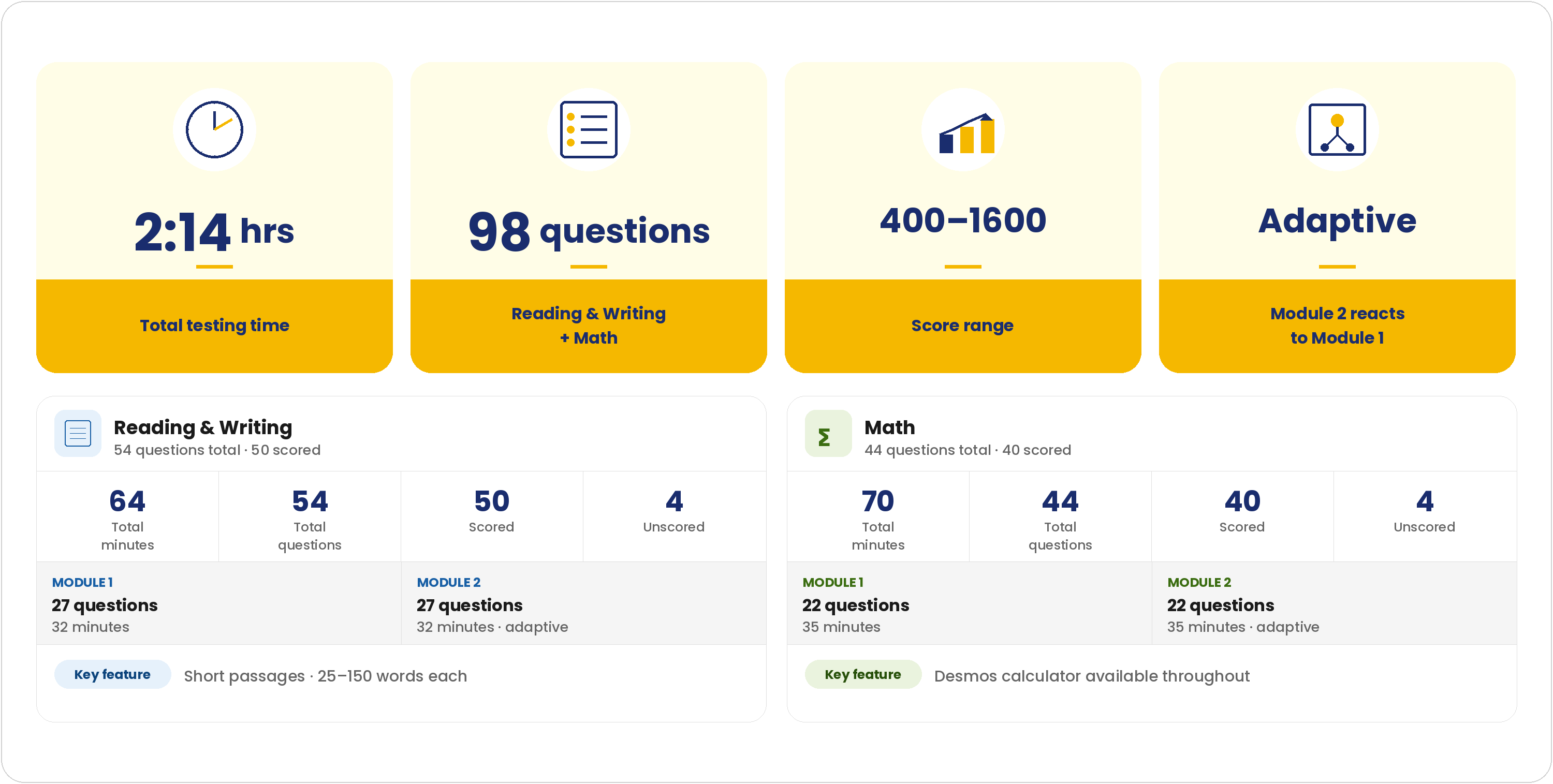
Test Duration
2:14
Hours total testing time
Total Questions
98
54 Reading & Writing + 44 Math
Score Range
400-1600
200-800 per section
Adaptive Format
2
Modules per section
| Section | Time | Questions | Module 1 | Module 2 | Key Features |
| Reading & Writing | 64 minutes | 54 total (50 scored) | 27 questions (32 min) | 27 questions (32 min) | Short passages (25-150 words) |
| Math | 70 minutes | 44 total (40 scored) | 22 questions (35 min) | 22 questions (35 min) | Desmos calculator throughout |
Master each domain with authentic SAT practice questions, detailed explanations, and helpful hints.
The ancient Mesopotamian civilization developed one of the world's first writing systems, cuneiform, around 3200 BCE. While scholars can now translate many cuneiform tablets, numerous texts remain undeciphered due to dialectal variations and incomplete records. Despite these limitations, historians have reconstructed detailed accounts of Mesopotamian trade networks, legal systems, and religious practices from the available translations, revealing a sophisticated society that influenced many later civilizations.
Which choice most logically completes the text?
Based on the passage, historians studying ancient Mesopotamia have found that _______
Look at the contrast word "Despite" in the passage. What limitation is mentioned, and what positive outcome follows it?
The passage mentions "numerous texts remain undeciphered" BUT historians have still "reconstructed detailed accounts." What does this suggest about the relationship between complete records and historical knowledge?
Wrong
Correct!
Wrong
Wrong
Phase 1: Identify the contrast
The word "Despite" signals that successful historical reconstruction happened even with incomplete translations
Phase 2: Match inference to evidence
The passage shows historians achieved "detailed accounts" and understanding of a "sophisticated society" even though many texts remain undeciphered.
Eliminate A:
Contradicts the passage - historians gained substantial knowledge without complete translations.
Eliminate C:
The passage doesn't compare cuneiform's difficulty to other writing systems.
Eliminate D:
The passage mentions all document types equally; no preference for religious texts is stated.
The development of the telescope revolutionized astronomy: Galileo's observations of Jupiter's moons provided evidence for the heliocentric model. His discovery showed that not all celestial bodies orbited Earth, _______ the prevailing geocentric worldview faced its first major empirical challenge, fundamentally changing humanity's understanding of its place in the cosmos.
Which choice completes the text so that it conforms to the conventions of Standard English?
Look at what comes before and after the blank. Is this connecting two complete sentences (independent clauses) or is it within a single sentence?
When "therefore" connects two independent clauses within the same sentence, it needs specific punctuation. Check if "the prevailing geocentric worldview faced..." could stand alone as a sentence.
Wrong
Wrong
Correct!
Wrong
Phase 1: Identify sentence structure
Both parts can stand alone: "His discovery showed..." (complete) and "the prevailing geocentric worldview faced..." (complete)
Phase 2: Apply punctuation rule
When "therefore" joins two independent clauses, use: [clause 1]; therefore, [clause 2] OR [clause 1], therefore [clause 2]. Since there's no semicolon before, we need a comma after.
Eliminate A:
Creates a run-on sentence - two independent clauses need punctuation.
Eliminate B:
A period would incorrectly create a sentence fragment starting with "the prevailing..."
Eliminate D:
A semicolon after "therefore" is incorrect punctuation.
Maya Lin, the architect who designed the Vietnam Veterans Memorial, created a minimalist work that invites personal reflection. With _______ two black granite walls inscribed with names meeting at an angle and descending into the earth, the memorial encourages visitors to engage with each name individually rather than viewing them as an abstract statistic.
Which choice completes the text so that it conforms to the conventions of Standard English?
What noun does this word refer back to? Look for the singular or plural noun that owns the "two black granite walls."
The word refers to "the memorial" (singular). Do you need a possessive (showing ownership) or a contraction?
Correct!
Wrong
Wrong
Wrong
Phase 1: Identify the antecedent
"The memorial" is the singular noun that possesses the walls.
Phase 2: Determine possession
We need to show that the walls belong to the memorial - this requires a possessive pronoun.
Eliminate B:
"It's" = "it is" (contraction), not possessive. Would create: "With it is two black granite walls..."
Eliminate C:
"Their" is plural possessive, but "memorial" is singular.
Eliminate D:
"They're" = "they are" (contraction), creates grammatical nonsense.
While researching a topic, a student has taken the following notes:
The student wants to emphasize how Kahlo expressed her dual cultural identity in her art. Which choice most effectively uses relevant information from the notes to accomplish this goal?
The goal is to "emphasize dual cultural identity." Which answer choice explicitly connects the two types of clothing to cultural identity?
Look for the choice that not only mentions both clothing styles but also interprets their meaning in terms of "cultural identity."
Correct!
Wrong
Wrong
Wrong
Phase 1: Identify the goal
Must emphasize "dual cultural identity" - this requires connecting the artwork to cultural meaning.
Phase 2: Evaluate synthesis
Choice A explicitly states "complex cultural identity" and links it to the two clothing styles representing different cultures.
Eliminate B:
Only provides dates; doesn't address cultural identity at all.
Eliminate C:
Mentions Mexican traditions but not the dual/bicultural aspect.
Eliminate D:
Too vague - doesn't specify the cultural significance of the different clothing.
Throughout history, scientific breakthroughs have often been made simultaneously by independent researchers. Charles Darwin and Alfred Russel Wallace separately developed the theory of evolution by natural selection in the 1850s, _______ Leibniz and Newton independently invented calculus in the 17th century.
Which choice completes the text with the most logical transition?
What is the relationship between the Darwin/Wallace example and the Leibniz/Newton example? Are they contrasting or supporting the same point?
Both examples show "independent researchers" making the same discovery. The transition should indicate this parallel relationship.
Wrong
Wrong
Correct!
Wrong
Phase 1: Analyze relationship
Both examples illustrate the same phenomenon: simultaneous independent discoveries.
Phase 2: Select transition type
We need a transition that shows similarity or adds another supporting example.
Eliminate A:
"However" signals contrast, but both examples support the same point.
Eliminate B:
"Specifically" suggests the second example is a more detailed version of the first, which it isn't.
Eliminate D:
"Instead" implies replacement or alternative, inappropriate for parallel examples.
In 2022, marine biologist Dr. Sarah Chen's research team _______ a new species of deep-sea coral in the Mariana Trench. Using remotely operated vehicles equipped with specialized cameras, the team documented the coral's unusual bioluminescent properties, which had never been observed in this family of organisms before. Their findings suggest that deep-ocean ecosystems may harbor far more biodiversity than previously estimated.
Which choice completes the text with the most logical and precise word or phrase?
The sentence mentions "a new species" and describes documenting properties "never been observed...before." What verb fits finding something new?
The context shows scientists finding and studying something previously unknown. Which verb means "to find something for the first time"?
Wrong
Correct!
Wrong
Wrong
Phase 1: Context clues
"New species" + "never been observed before" = finding something for the first time.
Phase 2: Logical flow
The sequence is: find new species → document properties → suggest implications.
Eliminate A:
"Dismissed" means rejected/ignored - opposite of studying and documenting.
Eliminate C:
"Concealed" means hid - contradicts the documentation and findings mentioned.
Eliminate D:
"Distributed" means spread out - doesn't fit with finding a species in a specific location.
2x + 3y = 22
4x = 5y
What is the solution (x, y) to the given system of equations?
Look at the second equation: 4x = 5y. Can you express x in terms of y? This will allow you to substitute into the first equation.
From 4x = 5y, we get x = 5y/4. Now substitute this expression for x into the first equation: 2(5y/4) + 3y = 22. Solve for y first, then find x.
Correct!
Wrong
Wrong
Wrong
Phase 1: Express x in terms of y
Reason: The second equation can be easily solved for x, which allows substitution into the first equation.
From 4x = 5y, dividing both sides by 4 yields x = 5y/4
Phase 2: Substitute into first equation
Reason: Substituting eliminates one variable, creating an equation with only y.
Substituting x = 5y/4 into 2x + 3y = 22 yields:
2(5y/4) + 3y = 22
Simplifying: 10y/4 + 3y = 22
5y/2 + 3y = 22
Phase 3: Solve for y
Reason: Combining like terms allows us to isolate y.
Converting 3y to halves: 5y/2 + 6y/2 = 22
Combining: 11y/2 = 22
Multiplying both sides by 2: 11y = 44
Dividing by 11: y = 4
Phase 4: Solve for x
Reason: Now that we know y, we can find x using the second equation.
From 4x = 5y and y = 4:
4x = 5(4) = 20
x = 5
Therefore, the solution is (x, y) = (5, 4)
Verification:
Reason: Always verify the solution in both original equations.
First equation: 2(5) + 3(4) = 10 + 12 = 22 ✓
Second equation: 4(5) = 20 and 5(4) = 20 ✓
Eliminate B:
Choice B reverses the values. Checking (4, 5):
First equation: 2(4) + 3(5) = 8 + 15 = 23 ≠ 22 ✗
Eliminate C:
Checking (10, 8):
First equation: 2(10) + 3(8) = 20 + 24 = 44 ≠ 22 ✗
Second equation: 4(10) = 40 and 5(8) = 40, but the first equation fails.
Eliminate D:
Checking (8, 10):
First equation: 2(8) + 3(10) = 16 + 30 = 46 ≠ 22 ✗
Which expression is equivalent to a8b5 / 3a3b where a > 0 and b > 0?
When dividing powers with the same base, subtract the exponents: am / an= m-n. Apply this rule separately for a and b.
For the variable a: 8 - 3 = 5, so you get a5
For the variable b: 5 - 1 = 4, so you get b4
Don't forget the coefficient 3 stays in the denominator!
Wrong
Correct!
Wrong
Wrong
Phase 1: Apply quotient rule to variable a
Reason: For positive values of a, am/an = am-n, where m and n are integers.
Since a > 0, this property can be applied: a8/a3 = a8-3 = a5
Phase 2: Apply quotient rule to variable b
Reason: The same property applies to b since b > 0.
b5/b1 = b5-1 = b4
Phase 3: Combine results
Reason: The coefficient 3 remains in the denominator as it has no matching term in the numerator.
The complete simplified expression is: a5b4/3
Eliminate A:
Incorrect. This option has b in the denominator with a negative exponent. When we divide b5 by b1, we get b4 in the numerator, not the denominator.
Eliminate C:
Incorrect. This option moves the 3 from the denominator to a coefficient in the numerator, which is mathematically incorrect. The 3 must remain in the denominator.
Eliminate D:
Incorrect. This option adds the exponents (8+3=11, 5+1=6) instead of subtracting them. Adding exponents is used for multiplication, not division. Also, the coefficient 3 is missing entirely.
3x2 + 11x - 20 = 0
What is the positive solution to the given equation?
This is a quadratic equation in the form ax2 + bx + c = 0. Try to factor it by finding two numbers that multiply to (3)(-20) = -60 and add to 11.
The two numbers that work are 15 and -4 (since 15 × (-4) = -60 and 15 + (-4) = 11). Rewrite the middle term: 3x2 + 15x - 4x - 20 = 0, then factor by grouping.
After factoring by grouping: 3x(x + 5) - 4(x + 5) = 0, which gives (3x - 4)(x + 5) = 0. Set each factor equal to zero and solve for x.
Wrong
Correct!
Wrong
Wrong
Phase 1: Factor the quadratic
Reason: The left-hand side of the given equation can be factored to find the solutions more easily.
The equation 3x2 + 11x - 20 = 0 can be factored as (3x - 4)(x + 5) = 0.
To factor: Find two numbers that multiply to (3)(-20) = -60 and add to 11. These are 15 and -4.
Rewrite: 3x2 + 15x - 4x - 20 = 0
Factor by grouping: 3x(x + 5) - 4(x + 5) = 0
Factor out (x + 5): (3x - 4)(x + 5) = 0
Phase 2: Apply zero product property
Reason: When a product equals zero, at least one factor must equal zero.
Setting the first factor equal to zero: 3x - 4 = 0
Solving: 3x = 4, so x = 4/3
Phase 3: Find the second solution
Reason: A quadratic equation has two solutions; we need to identify which is positive.
Setting the second factor equal to zero: x + 5 = 0
Solving: x = -5
The two solutions are x = 4/3 and x = -5
Phase 4: Identify the positive solution
Reason: The question asks specifically for the positive solution.
Since 4/3 ≈ 1.33 is positive and -5 is negative, the positive solution is x = 4/3
Eliminate A:
Incorrect. This value doesn't satisfy the equation. Substituting x = 5/3:
3(5/3)2 + 11(5/3) - 20 = 3(25/9) + 55/3 - 20 = 25/3 + 55/3 - 60/3 = 20/3 ≠ 0
Eliminate C:
Incorrect. This is a negative value. The question specifically asks for the positive solution, so any negative answer must be wrong.
Eliminate D:
Incorrect. This value doesn't satisfy the equation. Substituting x = 5:
3(5)2 + 11(5) - 20 = 3(25) + 55 - 20 = 75 + 55 - 20 = 110 ≠ 0
The product of two positive integers is 260. If the first integer is 7 greater than the second integer, what is the smaller of the two integers?
Let x represent the smaller integer. Then the larger integer is x + 7. Can you write an equation for their product?
The equation is: x(x + 7) = 260. Expand this to get a quadratic equation, then rearrange it to standard form: x2 + 7x - 260 = 0
Try to factor x2 + 7x - 260 = 0. You need two numbers that multiply to -260 and add to 7. Think about factor pairs of 260: (1, 260), (2, 130), (4, 65), (5, 52), (10, 26), (13, 20)... Which pair has a difference of 7?
Wrong
Correct!
Wrong
Wrong
Phase 1: Set up the equation
Reason: We need to translate the word problem into a mathematical equation.
Let x be the smaller integer. Then the larger integer is x + 7 (since it's 7 greater).
We know their product is 260: x(x + 7) = 260
Phase 2: Expand and rearrange
Reason: We need to convert this to standard quadratic form to solve it.
Expanding: x2 + 7x = 260
Subtracting 260 from both sides: x2 + 7x - 260 = 0
Phase 3: Factor the quadratic
Reason: Factoring allows us to find the solutions using the zero product property.
We need two numbers that multiply to -260 and add to 7.
Factor pairs of 260: (1, 260), (2, 130), (4, 65), (5, 52), (10, 26), (13, 20)
The pair 20 and -13 works: 20 × (-13) = -260 and 20 + (-13) = 7 ✓
Therefore: x2 + 7x - 260 = (x + 20)(x - 13) = 0
Verification: (x + 20)(x - 13) = x2 - 13x + 20x - 260 = x2 + 7x - 260 ✓
Phase 4: Apply zero product property
Reason: When a product equals zero, at least one factor must equal zero.
From (x + 20)(x - 13) = 0:
Either x + 20 = 0, which gives x = -20
Or x - 13 = 0, which gives x = 13
Phase 5: Select the positive solution
Reason: The problem states we have two positive integers, so we reject negative solutions.
Since x must be positive (we're told both integers are positive), x = 13.
The two integers are 13 and 20 (since 13 + 7 = 20).
Verification: 13 × 20 = 260 ✓
Eliminate A:
If the smaller integer were 12, the larger would be 19.
Product: 12 × 19 = 228 ≠ 260 ✗
Eliminate C:
If the smaller integer were 19, the larger would be 26.
Product: 19 × 26 = 494 ≠ 260 ✗
Eliminate D:
If the smaller integer were 26, the larger would be 33.
Product: 26 × 33 = 858 ≠ 260 ✗
The SAT is a stimulating mental workout that engages students in different types of thinking and problem-solving. With the right preparation, they can approach its unique features with skill and confidence.
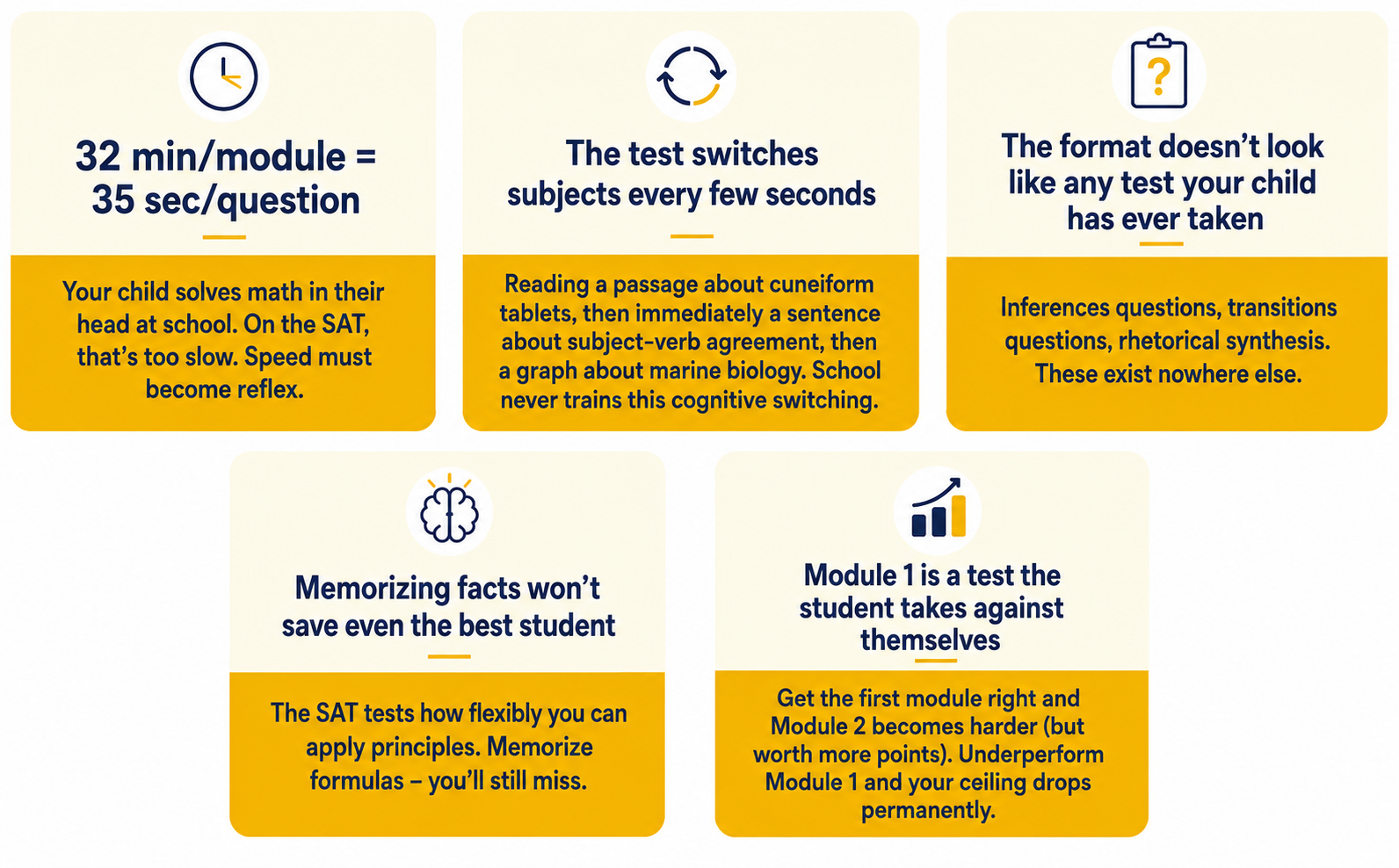
The SAT is different from most classroom tests:
Revolutionary AI-Powered Digital Learning
Our course leverages cutting-edge artificial intelligence to provide a personalized learning experience that adapts in real-time to each student's unique strengths and weaknesses. This isn't just digital content—it's an intelligent tutoring system that learns from every answer you give.
Full-Length Practice Tests
Realistic preview of the SAT, so students know exactly what to expect on test day.
Timed Sub-Tests
Teach students to manage strict SAT time limits without rushing into mistakes.
Step-by-Step Explanations
Clarify why each answer is correct, building transferable reasoning skills.
Targeted Skill Drills
Strengthen specific verbal, mathematical, and analytical skills by domain.
Strategy Tips
Proven methods for tackling tricky question types and managing time effectively.
Progress Tracking
Show growth clearly and highlight where further practice is needed most.
| Score Range | Percentile | Performance Level | College Readiness |
| 1550-1600 | 99+ | Exceptional | Ivy League competitive |
| 1450-1540 | 95-98 | Excellent | Top tier universities |
| 1350-1440 | 85-94 | Very Good | Selective colleges |
| 1200-1340 | 70-84 | Good | Most 4-year colleges |
| 1050-1190 | 45-69 | Average | Many state universities |
| Below 1050 | <45 | Below Average | Consider test-optional schools |
The SAT provides colleges with:
Score Release
Scores available 2-3 weeks after test date in your College Board account
Send Scores
Send scores to up to 4 colleges for free; additional sends cost $12 each
Retake Decision
Most students improve on retakes; you can take the SAT multiple times
Score Choice
Many colleges allow you to send only your best scores
Application
Include scores in college applications; check each school's requirements
Scholarships
Apply for merit scholarships based on your SAT performance
Most students take the SAT in spring of junior year or fall of senior year. We recommend taking it first in March or May of junior year, allowing time for a retake if needed. Start preparing 2-3 months before your test date.
You can take the SAT as many times as you want. Most students take it 2-3 times. Research shows scores typically improve on retakes, especially with focused preparation between attempts. Many colleges use "superscoring," considering your best section scores across all test dates.
A "good" score depends on your target schools. The national average is around 1050. For competitive colleges, aim for 1350+. For Ivy League schools, 1500+ is competitive. Research the middle 50% score range for your target schools to set realistic goals.
The digital SAT is shorter (2 hours 14 minutes vs 3 hours), adaptive (difficulty adjusts based on performance), allows calculator use throughout the Math section, features shorter reading passages, and provides faster score delivery. The content and scoring scale remain the same.
No, many colleges are now test-optional or test-blind. However, strong SAT scores can still strengthen your application and qualify you for merit scholarships. Always check each college's current testing requirements, as policies change frequently.
Money back guarantee
Since 1992, TestPrep-Online has helped individuals prepare for all kinds of tests. From entrance exams into gifted programs, to assessment tests, and graduate assessment and placement tests, TestPrep-Online can help you prepare and pass.