Free CAT4 Level X & Y Sample Questions and Answers
Hi, I’m Liron Katz, Welcome to your complete guide to free CAT4 Level X & Y sample questions, answers, and preparation resources for young learners aged 6–8. Learn exactly how the test works and discover how short, structured practice sessions can build your child’s confidence and early reasoning skills.

What are CAT4 Level X and Y
The CAT4 (Cognitive Abilities Test Fourth Edition), developed by GL Assessment, is used by schools to understand how children think, reason, and solve problems.
Unlike school exams in English or Maths, CAT4 does not test memorised knowledge. Instead, it measures how a child learns using puzzles and patterns.
- Level X is designed for Year 2 (ages 6–7)
- Level Y is designed for Year 3 (ages 7–8)
These early levels focus on building a clear picture of a child’s reasoning strengths across four key areas.

Free CAT4 Sample Questions (Ages 6–8: Levels X & Y)
The CAT4 Level X–Y test is divided into four reasoning batteries:
- Verbal Reasoning (Words)
- Quantitative Reasoning (Numbers)
- Non-Verbal Reasoning (Figures)
- Spatial Ability (Shapes)
Each section measures a different type of thinking skill. Because Levels X and Y are specifically tailored for younger learners, the questions below reflect this exact age-appropriate style.

CAT4 Verbal Reasoning Battery (Words)
This section measures how well a child understands word meaning, categories, and relationships.

CAT4 Quantitative Reasoning Battery (Numbers)
This section measures early number sense, sequencing, and pattern recognition.

CAT4 Non-Verbal Reasoning Battery (Figures)
This section measures how well children identify patterns using shapes instead of words.

CAT4 Spatial Ability Battery (Shapes)
This section measures how well children can mentally rotate and visualize shapes.
CAT4 Level X-Y Figure Recognition Sample Question
Find the shape that matches the target design.
Choose the design which contains the target shape in the exact same size, orientation (direction and size) and accurate lengths, including each side in full.

The correct answer is B.
Let's break this down step by step.
At the top of the question, there is a single shape shown on its own. This is the target shape, and the job is to find it hiding inside one of the five answer options. Before looking at the answers, spend time really looking at the target shape.
Notice the exact proportions: where the step sits, how wide it is, and how long the vertical part is. Every detail matters.
This type of question has very strict rules. The target shape must appear in the answer option in exactly the same size, the same orientation, meaning it must face the same direction and not be rotated or flipped, and with all sides at the exact same length. It cannot be shrunk, stretched, turned, or mirrored. Think of it like looking for a puzzle piece: it has to fit perfectly, not almost perfectly.
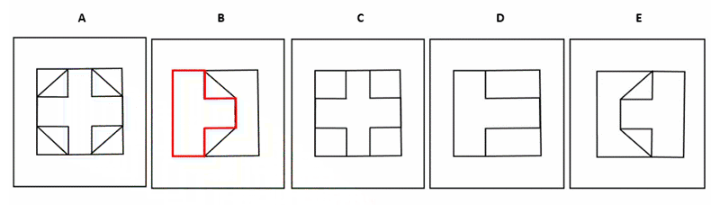
Now look at the five answer options. Each one shows a square design made up of various lines and shapes. The target shape is hiding somewhere inside one of these designs, drawn using the existing lines. Your task is to trace the outline of the target shape within the larger design without adding any new lines.
Look at option B. Inside the square design, focus on the left and upper portion of the figure. You will notice a shape formed by the lines that matches the target exactly: a tall vertical portion running down the left side, with a rectangular step extending to the right near the top. The size matches, the direction matches, and all the line lengths are consistent with the original target shape. The explanation image highlights this shape in red to show exactly where it sits within the design, confirming that the target shape is present in full, with no modifications.
Confirm your answer.
Once you have found the target shape inside option B, check it one more time against the original. Is it the same size? Yes. Is it facing the same direction? Yes. Are all the sides complete and accurate in length? Yes. This confirms that B is the correct answer.

CAT4Level X-Y Tips From Liron
- Keep practice sessions short (10–15 minutes)
- Focus on patterns, not memorisation
- Encourage guessing if unsure (no penalty)
- Teach children to identify the rule before looking at answers
- Practice calm, focused thinking rather than speed alone

What Do CAT4 Level X–Y Results Actually Tell You?
Many parents are surprised to learn that CAT4 doesn't test what a child has learned in school. Instead, it measures how they think and reason.
Schools use CAT4 results to gain insight into a student's learning potential, problem-solving ability, and preferred learning style. The results can help schools:
- Identify students with high academic potential
- Spot children who may benefit from additional support
- Inform placement and admissions decisions
- Build a clearer picture of how a child learns
Because CAT4 focuses on reasoning skills rather than curriculum knowledge, many children encounter question types they have never seen before. This is one reason why practicing with realistic CAT4 questions can make a significant difference in confidence and performance.

Understanding CAT4 Scores
CAT4 results include several scores that help schools understand a child's reasoning abilities and learning potential.
The main measures are:
- Standard Age Score (SAS)
- National Percentile Rank (NPR)
- Stanines (ST)
For a full explanation of CAT4 scores and what they mean for your child, see our dedicated CAT4 Scores guide.

How Schools Use CAT4 Level X & Y Results
CAT4 Level X & Y assessments are typically taken by younger primary-age students. Schools use these results to understand how students are likely to approach more advanced learning and academic challenges.
For example:
- Strong verbal thinkers often excel in subjects that require reading, comprehension, and written communication.
- Strong quantitative thinkers may perform well in mathematics, science, and logical problem-solving tasks.
- Strong non-verbal thinkers frequently demonstrate excellent pattern-recognition and abstract reasoning skills.
- Strong spatial thinkers often benefit from diagrams, visual models, design-based activities, and STEM subjects.
These insights help teachers tailor learning support, identify academic strengths, and ensure students are appropriately challenged as they progress through school.
Understanding these strengths allows schools to provide more targeted support and opportunities.

Why Practice Before CAT4 Level X–Y?
Although CAT4 is not a test that can be "studied for" in the traditional sense, children who are familiar with the question styles often feel more confident and less anxious on test day.
Practice helps students:
Understand unfamiliar CAT4 question formats
Develop reasoning strategies
Improve timing and concentration
Build confidence before the assessment
Reduce test-day stress
Looking for More CAT4 Level X–Y Practice?
Our CAT4 Level X–Y Prep Pack includes:
- Hundreds of realistic CAT4-style questions
- Practice across all four CAT4 batteries
- Detailed answer explanations
- Step-by-step solving strategies
- Timed practice tests
- Instant online access
Ask Liron

A language and linguistics expert with an MA in Language Teaching and over a decade of experience developing assessment-aligned practice across multiple subjects that mirrors the rigor of real edtech tests. Liron creates prep packs with clear, structured exercises that enhance learning, adapt to digital tools, and empower every student to perform their best on a wide range of assessments

CAT4 Level X–Y FAQs
CAT4 Level X–Y is part of the Cognitive Abilities Test Fourth Edition (CAT4). It is designed for older students and measures reasoning abilities across four areas: Verbal Reasoning, Quantitative Reasoning, Non-Verbal Reasoning, and Spatial Ability. The assessment helps schools understand a student's learning potential and preferred learning style.
Yes. While CAT4 does not assess school knowledge or curriculum content, students can become familiar with the question formats and reasoning skills used in the assessment. CAT4 Level X–Y practice questions help children develop confidence, improve timing, and reduce test-day anxiety.
The free CAT4 Level X–Y sample questions on this page are designed to reflect the style and reasoning skills commonly found in CAT4 assessments. However, the actual test contains a much wider range of question types and difficulty levels, which is why many families choose a comprehensive CAT4 Prep Pack for additional practice.
The average Standard Age Score (SAS) on CAT4 is 100. Scores above 100 indicate above-average performance compared to students of the same age, while scores below 100 indicate below-average performance. Schools also use National Percentile Ranks (NPRs) and Stanines to interpret results.
The exact number of questions can vary, but CAT4 Level X–Y includes multiple short sections across the four reasoning batteries. Students are required to answer questions under timed conditions, making familiarity with CAT4-style questions and pacing strategies particularly helpful.
A quality CAT4 Level X–Y Prep Pack typically includes realistic CAT4 practice questions, full-length practice tests, answer explanations, reasoning strategies, and targeted exercises for Verbal, Quantitative, Non-Verbal, and Spatial Reasoning. These resources help students gain experience with the question types they are likely to encounter on test day.
Taking a CAT4 practice test can help students understand the test format, become familiar with timed questions, and build confidence before the assessment. Many parents use free CAT4 sample questions first and then progress to a full CAT4 Prep Pack for more comprehensive preparation.


