What is the PSAT 10 and NMSQT? Explanations + Free Examples
Updated June 2026
The PSAT (Preliminary SAT) is a standardized test provided by the College Board, taken by high school students in 10th and 11th grade. For 11th grade students who take the PSAT Test, the test score weighs high because it serves as an initial screening for 1.3 million pupils aiming for the National Merit Scholarship qualification (NMSQT). Our expert Isaac explains the format of the test, the scoring system, and gives examples from our PSAT Practice Pack. Click to read about:
PSAT Format | PSAT Scoring | PSAT Example Questions | PSAT NMSQT | PSAT vs SAT

The PSAT Test 2026 - What is the Format?
- Since 2023, the PSAT is digital only
- Administered by the College Board in your local high school (homeschooled children usually apply to take the test in a high school near them), as opposed to the SAT, which can be taken during School Day in your local high school, or at a testing center
- The PSAT is usually taken in October
- Cost: $18, although some schools cover this charge
The PSAT is:
- An adaptive test, meaning that the result of the first part of each section affects the difficulty of the next part, and the questions are grouped into categories reaching from easy to hard. The more questions you answer correctly, the harder the level gets and the more questions you answer correctly, the better you score.
- Makes it worthwhile practicing and coming well prepared for the test. The more familiar you are with the type of questions you will get, the more confident you will feel, which will also, in addition to teaching knowledge, lead to a higher chance of a high score, which is explained below.
The test is split up into two main sections:
- Reading & Writing (two sections with 4 main topics)
- Math (2 sections with 4 main topics)
Number of questions for each section:
| Section: | Length: | Number of Questions: |
| Reading & Writing | 2 x 32 minutes | 54 questions (multiple choice) |
| Math | 2 x 35 minutes | 44 questions (multiple choice + student led questions) |
| Total | 134 minutes | 98 questions |

Free PSAT Test Example Questions
PSAT Reading and Writing
Example Question - Craft & Structure
Music theorists have observed that certain harmonic intervals are inherently more ______ the human ear than others. For instance, most listeners perceive the consonant interval of a perfect fifth as more stable and agreeable than the dissonant interval of a tritone.
Which choice completes the text with the most logical and precise word or phrase?
Example Question - Information & Ideas
The nonprofit organization "Poetry in Motion" places poems in advertising spaces on public transit systems in cities across the country. The poems range from classic works by historical poets to new pieces by local writers. In addition to displaying the poems, the organization hosts free workshops where commuters can learn to write their own poetry, inspired by their daily travels.
Which choice best states the main idea of the text?
Example Question - Standard English Conventions
Painted in the early 16th century, the Mona Lisa is arguably the most famous painting in the world. Housed in the Louvre Museum, it is a masterpiece ______ the Italian Renaissance.
Which choice completes the text so that it conforms to the conventions of Standard English?
Example Question - Verbal Expression of Ideas
Yoko Ono's 1964 performance piece Cut Piece was designed to explore themes of vulnerability and audience participation by having viewers cut away pieces of her clothing. ______ the performance achieved this artistic goal, creating intense moments of discomfort that forced audiences to confront their role in objectification and their responsibility as participants rather than passive observers.
Which choice completes the text with the most logical transition?
 PSAT Practice Test Reading Tip – Read the Question First:
While the texts may not be too long in the PSAT/NMSQT, it is still highly recommended to begin each question with the task required. If the task requires an overall description of the text, continue to read the text, and find a recurring theme, then continue to the answer choices. If the task refers to specific parts of the text – emphasize that part, and you can not only save valuable time but also be more accurate and keener to the answer.
 PSAT Practice Test Writing Tip - Verbally Speak the Sentence:
This tip may seem weird but trust us- it is one of the most useful tips for writing questions – especially ones that require logical completion. Try to complete the sentence using any of the options provided – and while you may wind up with more than one possible answer, in most cases, you will easily disqualify at least one answer, increasing your chances of answering correctly – especially since there's no negative scoring.
PSAT Math
The PSAT Math also measures the student’s ability in 4 topics:
- Algebra
- Advanced Math
- Problem-Solving and Data Analysis
- Geometry and Trigonometry
This part of the PSAT test consists of both multiple-choice and student led questions.
Get a taste of our math preparation for the PSAT with a sample question in advanced math!
Example Question - Advanced Math
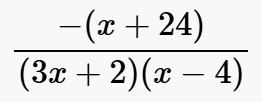
Which expression is equivalent to this?
Pick the correct answer below:
Conservative method — detailed steps:
1. Common denominator (goal: combine): (3x + 2) (x - 4)
2. Build the combined numerator: 5(x - 4) - 2(3x + 2)
3. Distribute: 5x - 20 - 6x - 4
4. Combine like terms: -x - 24
5. Final form:
Wrong‑option notes:
- B) Uses 5 - 2 = 3 for the numerator (naive subtraction of numerators).
- C) Sign error on the constant term writes -x + 24 instead of -x - 24 inside the parentheses.
- D) Drops parentheses, so only 24 is divided by the denominator (structure error).
PSAT Math Tip - Practice to Simplify:
In the PSAT/NMSQT math section, you will encounter challenging questions, some of which may be time-consuming and require multiple steps of calculations to complete. Since time is of the essence – you must be able to identify questions that can be simply answered – such as question 2. You could perform a complete quadratic formula which will take much longer. However, by thorough practice, you can identify easily that there's a simpler method – such as factoring the equation.

How PSAT Scoring Works
The scores on the PSAT range from 320-1520. A good score is one over 1200, but aiming for 1400+ is reaching for excellent results. Scoring high on the PSAT is important for anyone who is planning on taking the SAT later, and, specifically for 11th grade students wanting to be accepted on to the National Merit Scholarship Program. Here is a table showing the PSAT scoring range:
| Section: | Scoring Range: |
| Reading & Writing (RW) - 2 sections | 160-760 |
| Math (M) - 2 sections | 160-760 |
| Total PSAT Scoring Range | 320–1520 |
Benchmark scores for the PSAT Test for 10th grade is 430 for Reading & Writing and 480 for math. For 11th grade, the benchmarks are 460 for Reading & Writing and 510 for maths.
There is a complex scoring system to take into account for the PSAT, and it can be explained like this:
| Scoring Step: | Explanation: |
| Raw Score | Students earn points for correct answers. There is no penalty for incorrect answers. |
| Scaled Score | Raw scores are converted to scaled scores to account for differences in test difficulty. |
| Adaptive Testing | Performance on the first module affects the difficulty of the second module in each section. |
| Percentiles | Students receive percentile rankings showing how they compare to other test takers nationwide. |
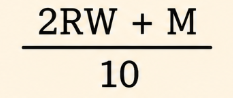
In terms of the eligibility and grant for the NMSQT, the calculation is made via the Selection Index Score, which ranges from 48-228. The formula to calculate this PSAT scoring element looks like this:

What is the National Merit Scholarship Qualification?
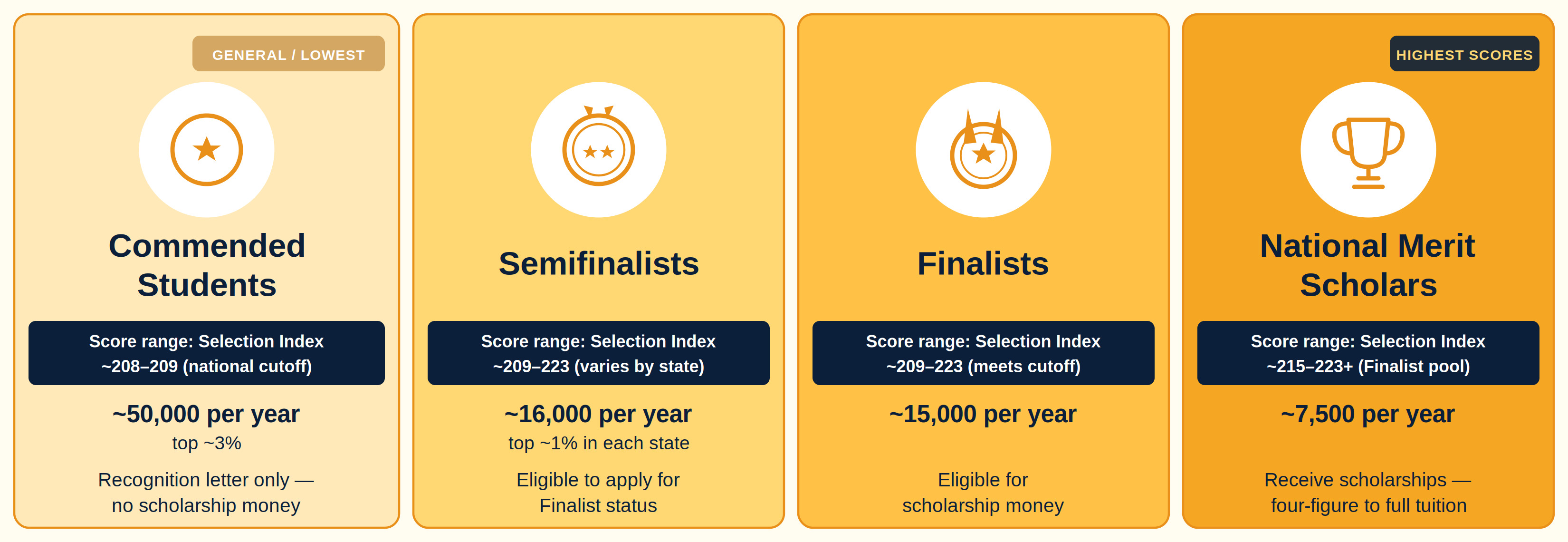
For students in 11th grade, the PSAT isn't just practice, it also serves as the qualifying exam for the National Merit Scholarship Program. Students who score in the top percentiles of their state earn Commended or Semifinalist status, which can open doors to scholarships worth thousands of dollars.
The level achieved by the top scorers in PSAT 11th Grade/NMSQT is equivalent to those that score a high score also on the SAT, and therefore have a chance at the best schools. Preparing seriously for the PSAT doubles as meaningful groundwork for the test that colleges will actually see on your application.
The National Merit Track - What You're Actually Aiming For

PSAT vs SAT
The PSAT is a pre-test for the SAT. The format of the test and the questions are similar, but the PSAT test is on a lower level, as the test is taken in 10th and 11th grade, as opposed to in the 11th and 12th grade for the SAT. For anyone wanting to get into a good college, it is important to score well on the PSAT.
- A PSAT score of 1000+ suggests you are on track for college readiness.
- A PSAT score of 1200+ may predict strong SAT performance.
- A PSAT score of 1400+ often predicts the potential for highly competitive SAT scores.
Have you taken the PSAT and need to improve your chances on the SAT, fill in the gaps here

Isaac Binshtock is a psychometric test developer and PSAT/SAT expert with over 30 years of experience in standardized testing, curriculum design, and instruction. He has developed full SAT programs, trained instructors, and helped thousands of students improve scores through strategic, data-driven preparation that builds both skills and confidence for college success.

FAQ
The PSAT (Preliminary SAT/National Merit Scholarship Qualifying Test) is a standardized test created by the College Board. It helps students practice for the SAT while also qualifying eligible juniors for the National Merit Scholarship Program.
The PSAT includes questions in Reading, Writing, and Math sections. Each subject is split into 4 main categories and 2 modules each. The test consists of a total of 98 questions that have to be completed in 134 minutes.
The PSAT score ranges from 320 to 1520, with separate section scores for Math and Reading & Writing. Each section is scored on a scale of 160–760. There is no penalty for incorrect answers, so it is usually beneficial to answer every question.
A “good” PSAT score depends on your goals and grade level, but scores around 1210–1220 typically place students in the top 10% of test takers. Students aiming for National Merit recognition generally need especially strong scores. An excellent score is one of 1400 and above. We help bridging the gap between your PSAT score and your SAT evaluation.
Yes — for 11th grade students, the PSAT doubles as the National Merit Scholarship Qualifying Test (NMSQT). Your eligibility is determined by your Selection Index Score, calculated from your Reading & Writing and Math section scores. Students who score in the top percentiles of their state can earn Commended or Semifinalist status, which may lead to scholarships worth thousands of dollars. Note that only scores from the junior-year PSAT (not 8th, 9th, or 10th grade) count toward National Merit consideration.
The PSAT is slightly shorter and generally easier than the SAT. It is designed as a practice version of the SAT and is mainly taken by high school sophomores and juniors to prepare for future college admissions testing.
The best way to prepare is through timed practice tests, reviewing math and grammar concepts, improving reading comprehension skills, and analyzing mistakes after each practice session. Familiarity with the test format can significantly improve both speed and confidence on test day.


