Raven's Progressive Matrices (APM & SPM) Test Preparation: Free Sample Questions and Guide for Students and Parents
The Raven’s Progressive Matrices Test (or RPM) is a well-established, nonverbal assessment designed to measure someone's ability to recognize patterns, think logically, and solve problems without relying on language, math skills, or prior knowledge. Within this family of assessments, the Raven’s Advanced Progressive Matrices is specifically designed for students with higher-level reasoning skills and is often used to identify gifted students. Together, the APM and SPM tests help educators and psychologists understand how a student approaches complex problem-solving.



Free Raven's SPM & APM Sample Questions
In the Raven's Progressive Matrices Assessment, each question presents a matrix with one piece missing. Students must identify the underlying rules or relationships within the pattern and select the correct missing piece from multiple options. The matrices increase in difficulty and involve recognizing sequences, symmetry, analogies, or spatial transformations. The sample questions below illustrate the types of visual reasoning skills assessed in both the SPM and APM versions.
Raven Free Sample Question 1

When answering a Raven’s matrix question, look for how the shapes change across rows and columns. Focus on patterns such as arrows being added, removed, or rotated, and check whether the same rule applies both horizontally and vertically. The correct answer should follow all the visible rules at the same time.
Raven Free Sample Question 2
Raven Free Sample Question 3
Raven Free Sample Question 4
Raven Free Sample Question 5
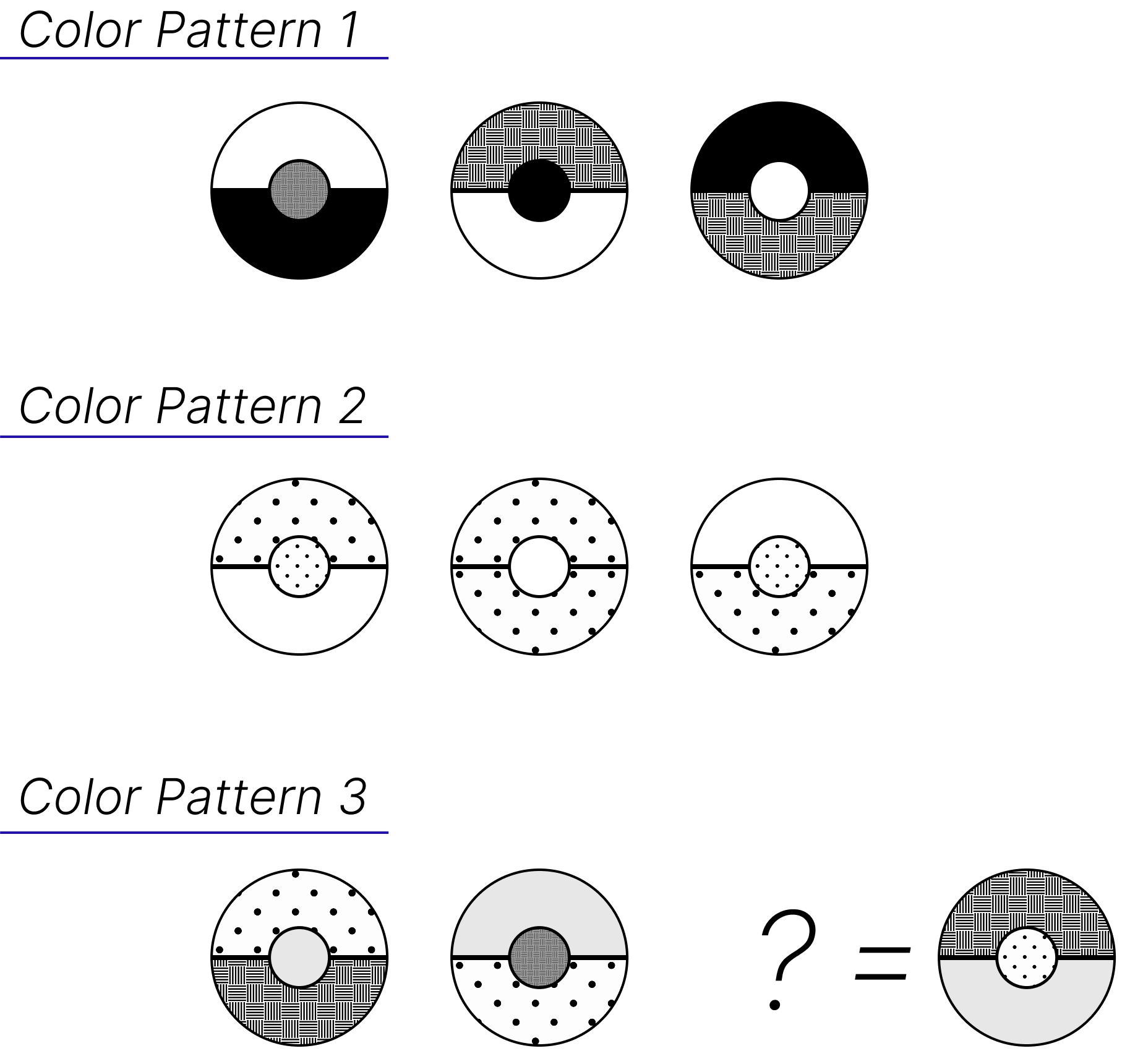
All figures in the matrix are made from the same basic shape: a circle with two halves and an inner circle. The solution lies in identifying three distinct color patterns.
Each row and column contains three figures, and each figure consists of three parts:
- One figure has a black part, a patterned gray part, and a white part.
- Another figure has two polka-dotted parts and one white part.
- The third figure has a gray part, a patterned gray part, and a polka-dotted part.
The color arrangement changes from row to row, with each figure appearing once in the matrix, and each of the figures’ three parts being colored differently across the rows.
To determine the missing figure, we can observe that the color configuration missing from the last row is the one that includes a gray part, a patterned gray part, and a polka-dotted part. The only configuration missing in the matrix is one where the gray part is at the bottom, the patterned gray part is at the top, and the polka-dotted part is in the middle.
Thus, the correct answer is the figure with this specific color arrangement.

What Is the Raven’s Progressive Matrices Test
The Raven’s Progressive Matrices Test is a nonverbal intelligence test created in 1936 by British psychologist John C. Raven. It was designed to measure general intelligence. Since the test uses abstract shapes and visual patterns instead of words, it was originally made to be fair for people from different cultural and educational backgrounds.
Today, the Raven’s Progressive Matrices Test is still widely used to assess reasoning ability and cognitive skills in schools, psychological evaluations, and research settings. It is often used to help identify learning strengths, giftedness, or cognitive challenges. The test is currently published and administered by Pearson Assessments, a major educational assessment company that develops standardized tests used around the world. Pearson ensures the test is updated, properly standardized, and used responsibly in educational and professional contexts.
The Raven’s Progressive Matrices Test has several different versions to accurately assess reasoning abilities across different ages and ability levels. Each version is designed to match the developmental stage and cognitive complexity of the individual taking the assessment.
| Raven’s Assessment Name | Age Group | What It Is Used For |
| Standard Progressive Matrices (SPM) | Adolescents and adults | Assesses general intelligence and abstract reasoning; commonly used in schools, psychological evaluations, and research |
| Advanced Progressive Matrices (APM) | Older adolescents and adults with above-average ability | Designed to measure higher-level reasoning and problem-solving skills; often used for gifted testing, advanced academic selection, or professional assessment |
| Raven’s 2 Progressive Matrices | Ages 4–90+ | A modern, updated version used for a wide age range; administered digitally or on paper to assess general cognitive ability |
| Coloured Progressive Matrices (CPM) *Our Raven's Prep Pack does not include practice for the CPM test. |
Children ages 5–11, older adults, or individuals with learning difficulties | Measures basic reasoning and problem-solving ability using simpler, colorful patterns; often used in early education and special education settings |
*Our Raven's Prep Pack includes preparation for both SPM and APM assessments, covering a wide range of difficulty levels.

Raven’s Advanced Progressive Matrices Test Overview
Test Structure and Question Format
The Raven’s Advanced Progressive Matrices (APM) is a nonverbal, multiple-choice test made up of 48 total questions, divided into two sets.
Set I
Consists of 12 introductory questions that are easier and are used to familiarize the test taker with the format and types of patterns used in the test.
Set II
Contains 36 more challenging questions that progressively increase in difficulty and are designed to measure advanced abstract reasoning and problem-solving ability.
Each question presents a matrix of abstract shapes with one piece missing, and test takers must choose the correct missing piece from several answer options. The questions increase in difficulty as the test progresses, often requiring the identification of multiple logical rules at the same time.
The patterns in Raven’s Advanced Progressive Matrices are based on 5 logical rules:
- Progression: Shapes change step-by-step across a row or column, such as in size, number, or shading. The task is to identify how the pattern develops.
- Rotation or Movement: Shapes rotate or move position across the matrix. The test taker must recognize the direction and amount of movement.
- Addition or Subtraction of Elements: Parts of shapes are added or removed as the pattern progresses, requiring the test taker to see how elements combine or disappear.
- Symmetry and Mirroring: Shapes are reflected horizontally, vertically, or diagonally. The relationship between mirrored shapes must be identified.
- Combination of Multiple Rules: Harder questions use two or more rules at once, such as rotation and addition, requiring deeper logical reasoning.
Ace the Raven’s Progressive Matrices Test
Consistent and timed practice with Raven’s Matrices can significantly improve your child's performance. The test is challenging, and without knowing the key strategies and practicing enough, it’s hard to reach a top score.
Our complete Raven’s Matrices Assessment PrepPack gives you everything you need to master the test:
- Interactive study guide
- 20+ practice tests
- Progress tracking and thorough explanations
About Anat

Anat Malul is a multi-talented test developer with expertise across a wide range of subjects and age groups. Her diverse background allows her to create engaging and effective assessments for learners from kindergarten to adulthood. Anat's experience as both a psychometric test teacher and a subject matter instructor informs her approach to test development.

Frequently Asked Questions
It’s a non-verbal intelligence test that measures abstract reasoning and fluid intelligence by having you complete patterns in visual matrices.
There are three main forms: Colored Progressive Matrices (CPM) for children and elderly, Standard Progressive Matrices (SPM) for general use, and Advanced Progressive Matrices (APM) for above-average reasoning.
It assesses pattern recognition, logical reasoning, and problem-solving skills rather than learned knowledge.
Yes, it’s widely used as a measure of fluid intelligence, a key part of IQ.
Yes — items are arranged so that cognitive complexity increases throughout the test.
Practicing similar problems helps you recognize patterns faster and improves performance.
USA: Gifted & Specialized High Schools
- New York: Hunter College High School, Stuyvesant High School, Bronx Science.
- Virginia: Thomas Jefferson High School for Science and Technology (TJHSST).
- Florida: Pine View School (Gifted).
- Nevada: The Davidson Academy.
- General: District-wide Gifted & Talented (G&T) screenings (Grades 3–8).
UK: 11+ Grammar & Independent Schools
- The gold standard for Non-Verbal Reasoning (NVR) sections.
- Top Private Schools: Eton College, St Paul’s School, Westminster School, Sevenoaks School.
- Top Grammar Schools: Queen Elizabeth’s School (Barnet), The Henrietta Barnett School, Tiffin School.
- Assessments: ISEB Pre-Test, GL Assessment, and CAT4 (Figure Matrices).
Global: International Excellence
- Used worldwide for unbiased student assessment.
- Singapore: Gifted Education Programme (GEP) & Raffles Institution.
- Australia: NSW Selective High Schools & James Ruse Agricultural High School.
- Canada: University of Toronto Schools (UTS) & Upper Canada College.


