8th Grade MAP Test Practice Pack
Updated 2025 | Trusted by 10,000+ NWEA MAP Candidates
Help your 8th grader build the confidence, skills, and strategy needed to succeed on the NWEA MAP Growth Test with the 8th Grade Practice Pack, personally crafted by Ariav, a dedicated educator with extensive experience preparing 8th graders for academic excellence. Each question, quiz, and practice test is carefully selected and created by Ariav to sharpen critical thinking, refine advanced problem-solving abilities, and strengthen reading comprehension at the highest middle school level.
MAP 8th Grade Packs
- Total of 590+ questions
(across quizzes, full-length tests & simulations) - 3 full-length tests
- Math and RLA Quizzes
- 16 video lessons
- 7 Math study guides
- Retake all tests as often as needed


What is the NWEA MAP Test for 8th Grade
- Measures Academic Growth: The NWEA MAP test for 8th grade tracks academic progress in reading, math, and related subjects as students prepare for high school.
- What 8th Graders Are Tested On: Students are assessed on advanced comprehension skills, pre-algebra concepts, and the ability to connect ideas across multiple topics.
- Computer Adaptive: The MAP test for 8th grade adapts in real time to responses, measuring growth and readiness for high school-level learning.

Compare Our 8th Grade MAP Growth Prep Options
|
Essential Pack |
Extended Pack |
Family Membership |
|
380+ questions across 3 full-length tests 6 Math Quizzes 12 RLA Quizzes 7 Math Study Guides
3-month license |
590+ questions across 3 full-length tests 10 Math quizzes 12 RLA quizzes 7 Math Study Guides 16 video lessons 6-month license |
Unlimited access to all PrepPack simulations, tests, and quizzes
12-month license |

Try These 8th Grade MAP Practice Questions
Look through all four sections below to see how they work! Math, Reading, and Language Usage are built right into your 8th Grade PrepPack, with Science available as an add on.
8th Grade MAP Math: Algebra Word Problem Strategy
Inside a baseball cap, there are a total of nine practice baseballs. They are different colors: four are blue, three are white, and two are orange.
A player randomly selects three baseballs from the cap one at a time without replacement.
The correct answer is (C).
Let's Break This Down Step by Step
There are 9 baseballs total:
- 4 blue
- 5 non-blue (3 white + 2 orange)
We want the probability that none of the three selected baseballs are blue, meaning all three must come from the 5 non-blue baseballs.
Because the selections are made without replacement, both the total number of balls and the number of non-blue balls change after each draw.
Step 2: First draw
There are 5 non-blue balls out of 9 total, so the chance the first ball is non-blue is 5/9:
P(non-blue on 1st pick)=5/9
If the first ball was non-blue, there are now 4 non-blue left and 8 total left:
P(non-blue on 2nd pick)=4/8
After two non-blue are removed:
Non-blue left = 3
Total left = 7
P(non-blue on 3rd pick) 3/7

Global Climate Change
A climate research team has been measuring the area of the Arctic Ocean covered by sea ice at the end of every summer. The bar graph below shows the average September sea ice extent every five years from 1985 to 2025.
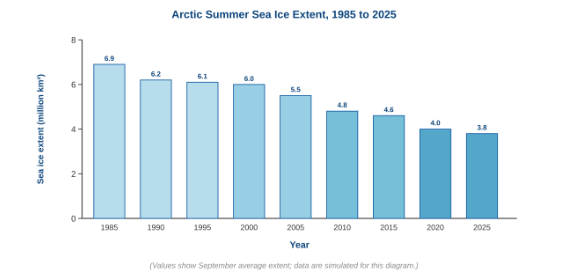
Scientists have also observed that sea ice is bright white and reflects most of the Sun's light back into space. Open ocean water, by contrast, is dark and absorbs most of the Sun's light, warming the water and the air above it.
As more sea ice melts each summer, what is the most likely effect on Arctic warming in the decades that follow?

Choose the Prep Pack That Fits Your Child’s Goals

Essential Prep Pack
This pack builds strong foundations in 8th-grade academic skills while helping students gain confidence with real MAP-style questions. It includes concise, focused practice for students who prefer a structured, goal-oriented plan that fits into a busy schedule.
Best for: Students preparing for the upcoming MAP test or needing reinforcement in key areas.
Duration: 3-month access for complete prep.
Extended Prep Pack
The Extended Pack for 8th grade is designed for students preparing for their final MAP tests before high school. It includes everything in the Essential Pack, with extended access for deeper, more consistent practice. With more teacher-curated quizzes, video lessons, and more complex challenges, your child builds advanced skills, strengthens test readiness, and works toward top RIT scores with confidence.
Also includes: Access to our MAP Science Prep Pack (Grades 6–8), supporting high-level scientific reasoning, data analysis, and real test-style application.
Best for: Students aiming for mastery, competitive scores, or in-depth review.
Duration: 6-month access for comprehensive preparation.

Family Membership
Get every grade level, every subject, all year long. This membership unlocks complete access to our full library of MAP Growth practice materials—from early reading through advanced algebra and language usage.
Best for: Families supporting multiple students or long-term learning goals.
Duration: 12-month access for ongoing success.
MAP Science Practice
Bridge the gap to advanced scientific analysis during the crucial middle school transition. You can easily add this specialized package to your cart for rigorous practice across Life, Physical, and Earth and Space sciences. Featuring evidence-based explanations and two realistic simulations calibrated to peak middle school complexity, it helps students master data synthesis and tackle the toughest adaptive questions.
- Best for: Middle schoolers aiming for top-tier honors placement, gifted tracks, or reaching the elite 240+ RIT score threshold.
- Duration: 6-month access for complete preparation.

Tutoring

Our tutoring sessions are led by Ariav, an experienced MAP Growth educator specializing in middle school test preparation. Each session is tailored to your child’s specific needs, helping them uncover patterns, refine reasoning, and build confidence before test day.
One-Session Package
Ideal for a focused boost before the test. Your child will work one-on-one with Ariav to analyze sample questions, strengthen weaker areas, and apply smarter test strategies.
Best for: Students needing quick improvement or targeted feedback.
Duration: One 60-minute session.
Three-Session Package
A complete, three-hour tutoring program designed by Ariav to deliver lasting results. The first session pinpoints strengths and areas for growth; the next two focus on strategy, endurance, and applying knowledge across reading, language, and math.
Best for: Students aiming for measurable score gains and full concept mastery.
Duration: Three 60-minute sessions.

FAQs
Eighth-grade MAP Growth scores are critical because many school districts use them as a primary benchmark for high school tracking, honors enrollment, and Advanced Placement (AP) path selection. High RIT scores demonstrate that your student is ready for advanced coursework rather than standard introductory classes. Personally crafted by Ariav, this Prep Pack is specifically geared toward maximizing these scores, ensuring your child can comfortably showcase the advanced, multi-step critical thinking high school recruiters and placement committees look for.
Eighth graders face a rigorous jump into formal pre-algebra, complex probability (like the sequential selection question shown above), and sophisticated literary analysis.
Our pack handles this increase in difficulty through a comprehensive learning system. With 16 targeted video lessons and 7 focused Math study guides, Ariav and his team break down complex concepts into actionable test-taking strategies. This ensures your child isn't just memorizing formulas, but actually mastering the logic required to unlock the highest adaptive difficulty tiers of the test.
If your child needs top-tier placement scores, the Extended Pack ($89) offers the deep, rigorous preparation necessary to succeed:
Maximized Material: It expands the question pool from 380+ to 590+ highly relevant questions and adds extra math quizzes.
Strategic Teaching: It unlocks 16 video lessons that teach your child how to think through the most deceptive adaptive question formats.
6 Months of Freedom: With full retake access over half a year, your student can build the test-taking stamina, pacing control, and deep concept retention required to confidently push past the high-level thresholds of the 8th-grade exam.
Free online resources typically feature basic, static multiple-choice questions that do not replicate the sophisticated, computer-adaptive framework of the actual NWEA assessment. Our extended 8th Grade PrepPack provides a complete educational ecosystem: 590+ expert-curated questions, 7 detailed math study guides, 16 concept video lessons, and full-length adaptive-style simulations. Your investment is completely secure, structured to save you time, and backed by a money-back guarantee alongside 24/7 customer service.
Because the PrepPack is divided into bite-sized, targeted quizzes alongside full-length tests, it easily fits into a hectic 8th-grade schedule. Practicing just 20 to 30 minutes a few times a week will significantly increase your child's confidence and reduce testing anxiety.
If they hit a roadblock with advanced topics or want an elite edge for honors placement, you can seamlessly pair the pack with Ariav's 1-on-1 expert tutoring sessions. Ariav specializes in turning high-stakes middle school test prep into an empowering, confidence-boosting experience.
Tutoring sessions are optional and available separately. They are not included with any Prep Pack or membership purchase


