CAT4(认知能力测试)是一种以推理能力为基础的评估工具,学校通过它来了解您的孩子如何学习,以及他们在学业上最有可能取得成功的领域。
我是 Liron Katz,一名 CAT4 备考专家,多年来一直致力于开发有针对性的学习材料,帮助学生在这项测试中发挥最佳水平。
本页面为您提供自信备考所需的一切内容,包括:
• CAT4 风格的练习题及清晰解析
• 测试结构和能力领域的简明概述
• 分数解析以及学校如何使用 CAT4 成绩
• 实用指导和面向家长的建议
立即探索免费的 CAT4 练习题:
Verbal Analogies | Verbal Classification | Number Analogies | Number Series | Figure Matrices | Figure Classification | Figure Analysis
以下是来自 CAT4 八个分测验的示例题目。这些题目选自不同年级水平。
言语推理测评(Verbal Reasoning Battery)用于评估学生理解和运用语言技能的能力,这些技能对于阅读理解、清晰写作以及遵循复杂指令至关重要。在 CAT4 测试中,这些能力通过两种题型进行评估:
在言语类比题中,题目会给出一对具有特定关系的单词。接着,会提供第二组中的第一个单词。你需要选择一个单词来完成第二组,使其与第一组具有相同的关系。
每道题提供五个选项,但只有一个是正确答案。听起来有点难?别担心,我们会一步步为你讲解。
The first pair of words go together in a certain way. Choose the word that goes together with the third word in the same way.
cement→ building : wool →
Wrong
Correct!
Wrong
Wrong
Wrong
The correct answer is B
Let's Break This Down Step by Step
Let's start by looking at the connection between cement and building. What's the relationship here? Well, cement is a material that's used to construct or make a building. It's one of the key ingredients that goes into creating the final product. So our relationship is: cement is a material used to make a building.
Now that we understand the relationship, we need to find out what wool is used to make. We're looking for something that wool serves as a material for, just like cement serves as a material for a building. Let's think about what wool is commonly used to create or construct.
Let's go through each option to see which one fits our relationship best:
A. Sheep - This doesn't work because the relationship is backwards! A sheep produces wool from its body, but wool isn't used to make a sheep. The sheep comes first, then the wool, so this reverses our relationship.
B. Sweater - This is a great match! Wool is a material that's commonly used to make a sweater, just like cement is a material used to make a building. The relationship stays consistent: material to finished product.
C. Silk - This doesn't fit because wool isn't used to make silk. Silk and wool are both types of fabric materials, but they're separate things. Silk comes from silkworms, not from wool!
D. Shoes - While it's possible that some shoes might have wool in them, wool isn't commonly or primarily used to make shoes. This isn't the typical or expected relationship we'd think of.
E. Hair - Wool and hair might look similar, but wool isn't used to make hair. They're both natural fibers, but one doesn't create the other.
Sweater is the perfect answer because it maintains the exact same relationship as our original pair. Cement is a material used to construct a building, and wool is a material used to construct a sweater. Both show a material being used to create a finished product. The analogy is complete and consistent, making sweater the answer that fits just right!
在言语分类题中,题目会给出三个属于同一类别或具有共同特征的单词。你需要找出它们之间的联系,并从选项中选择一个同样属于该类别的单词。
一开始可能会觉得有些困惑,但一旦掌握了判断方法,就会变得容易得多。
Choose the word that belongs in the same group as the first three words.
Author Scribe Poet
Correct!
Wrong
Wrong
Wrong
Wrong
The correct answer is A (Journalist).
Let's Break This Down Step by Step
Let's look closely at our three given words: author, scribe, and poet. What connects all of these together? Think about what each of these people does. An author writes books, a scribe writes down information or copies texts, and a poet writes poems. The common thread here is that all three of these professions involve writing as their primary activity. They're all jobs where writing is at the very heart of what they do!
Now that we've identified the pattern, we need to find another profession that fits this same category. We're searching for a job where writing is the main focus of the work, just like it is for an author, scribe, and poet.
Let's examine each option to see which one belongs in our writing-based group:
A. Journalist - This is an excellent fit! A journalist's main job is to write articles, reports, and news stories. Writing is the core of what journalists do every single day. This profession absolutely belongs with author, scribe, and poet.
B. Actor - While actors might read scripts and sometimes help develop dialogue, their primary job is performing and acting, not writing. Acting is about bringing words to life through performance rather than creating or writing them down.
C. Doctor - Doctors do write prescriptions and medical notes, but writing isn't their main purpose. Their primary job is diagnosing illnesses and treating patients. The writing they do is just a small part of their medical work.
D. Architect - Architects do draw plans and write specifications, but their main focus is designing buildings and structures. The creative work is more about spatial design and engineering than it is about writing.
E. Mechanic - Mechanics work with their hands to repair vehicles and machinery. While they might write up repair reports, their primary skill is fixing things mechanically, not writing.
Journalist is the perfect choice because it shares the same essential characteristic as author, scribe, and poet. All four of these professions center around writing as their fundamental activity. A journalist writes to inform people about news and events, just as an author writes to tell stories, a scribe writes to record information, and a poet writes to express ideas and emotions. They all belong to the same group of writing-based professions!
数量推理测评(Quantitative Reasoning Battery)用于评估学生识别数字规律和逻辑关系的能力,这些技能是数学和科学中解决问题的基础。在 CAT4 测试中,这些能力通过两种题型进行评估:
在数字类比题中,题目会给出两组遵循相同数学规律的数字。你需要找出这个规律,并将其应用到第三组中,以找出缺失的数字。这个规律可能涉及加法、减法、乘法、除法,或这些运算的组合。
Choose the number that completes the third pair so that it demonstrates the same relationship as the first two pairs.
[13 → 52] [25 → 100] [16 → ?]
Wrong
Wrong
Correct!
Wrong
Wrong
The correct answer is (C) 64.
Let's Break This Down Step by Step:
In number analogy questions, we're looking for a consistent relationship or rule that connects the first number to the second number in each pair. Our job is to figure out what mathematical operation is being applied, and then use that same rule to find the missing number.
Let's look at the first pair: 13 → 52
Ask yourself: What happens to 13 to get 52?
Let's try some common operations:
If we add: 13 + 39 = 52 (but 39 seems random)
If we multiply: 13 × 4 = 52 (this works perfectly!)
So it looks like we're multiplying by 4. But let's check the second pair to confirm our rule.
Now let's look at the second pair: 25 → 100
Apply the same rule we discovered:
25 × 4 = 100
Excellent! This confirms that the relationship is consistent. The rule is: multiply the first number by 4 to get the second number.
Now we can confidently apply this rule to the third pair: 16 → ?
Using our rule:
16 × 4 = 64
So the missing number should be 64.
Let's look at the answer choices:
20 (This would be 16 + 4, not 16 × 4)
55 (This doesn't follow any clear pattern from 16)
64 (This is 16 × 4, perfect!)
66 (This doesn't match our rule)
91 (This is too large and doesn't fit the pattern)
The answer is 64 because it perfectly follows the same rule we identified in both previous pairs. Each number on the left is multiplied by 4 to produce the number on the right: 13 × 4 = 52, 25 × 4 = 100, and 16 × 4 = 64. The pattern is consistent, clear, and logical, making 64 the correct answer!
在数字数列题中,题目会给出一组遵循特定数学规律的数字序列。你需要找出其中的规律(例如交替运算或递进变化),以确定数列中的下一个数字。
What number comes next in the series?
31, 44, 37, 50, 43, 56, 49, 62, 55, ?
Wrong
Wrong
Correct!
Wrong
Wrong
The correct answer is (C) 68.
Let's Break This Down Step by Step:
In number series questions, we need to find the pattern or rule that connects the numbers in the sequence. Once we discover the pattern, we can use it to figure out what the missing number should be. The key is to look at how each number changes to become the next number.
Let's examine the beginning of the series: 31, 44, 37, 50, 43...
From 31 to 44: We add 13 (31 + 13 = 44)
From 44 to 37: We subtract 7 (44 - 7 = 37)
From 37 to 50: We add 13 (37 + 13 = 50)
From 50 to 43: We subtract 7 (50 - 7 = 43)
Great! We can see a pattern forming: add 13, then subtract 7, then add 13 again, then subtract 7 again. This alternating pattern is the key to solving the problem.
Let's check that this pattern holds true for the rest of the numbers: 43, 56, 49, 62, 55
From 43 to 56: Add 13 (43 + 13 = 56) - Yes!
From 56 to 49: Subtract 7 (56 - 7 = 49) - Yes!
From 49 to 62: Add 13 (49 + 13 = 62) - Yes!
From 62 to 55: Subtract 7 (62 - 7 = 55) - Yes!
Perfect! The pattern is consistent throughout the entire series: +13, -7, +13, -7, +13, -7, +13, -7, +13...
Now we need to figure out what happens after 55. Let's count the operations:
1st step: +13 (31 to 44) 2nd step: -7 (44 to 37) 3rd step: +13 (37 to 50) 4th step: -7 (50 to 43) 5th step: +13 (43 to 56) 6th step: -7 (56 to 49) 7th step: +13 (49 to 62) 8th step: -7 (62 to 55) 9th step: Should be +13
Since we just subtracted 7 to get to 55, the next step in our alternating pattern should be to add 13.
Now we apply the pattern to find the answer:
55 + 13 = 68
So the missing number is 68.
Now we apply the pattern to find the answer:
55 + 13 = 68
So the missing number is 68.
Let's review the answer choices:
61 (This would be 55 + 6, which doesn't match our pattern)
59 (This would be 55 + 4, which doesn't follow the rule)
68 (This is 55 + 13, exactly what our pattern predicts!)
70 (This would be 55 + 15, which is close but not correct)
64 (This would be 55 + 9, which doesn't match the pattern)
Confirm the Answer
The answer is 68 because it perfectly follows the alternating pattern we identified throughout the entire series. The pattern is +13, -7, +13, -7, repeating consistently. Since the last operation was subtracting 7 to get from 62 to 55, the next operation must be adding 13, which gives us 55 + 13 = 68. This completes the pattern beautifully and logically!
非言语推理测评(Non-Verbal Reasoning Battery)用于评估学生识别图形和视觉信息中的规律与关系的能力,这些技能对于数学、编程以及解读图表都非常重要。在 CAT4 测试中,这些能力通过两种题型进行评估:
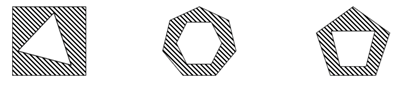
在图形分类题中,你会看到三个具有共同视觉特征或规律的图形。你需要找出它们之间的联系,并选择一个符合相同规律的选项,使其加入这一组。
Choose the option that fits together with the three given images.
Wrong
Wrong
Wrong
Wrong
Correct!
The correct answer is E.
Let's Break This Down Step by Step
First, let's look carefully at what all three figures at the top have in common. Each one shows two shapes: an outer shape that is filled with diagonal line patterns, and an inner shape that is plain white. This combination of a patterned outer shape and a plain inner shape is something we need to find in our answer choices.
Now, let's count the number of sides on both the outer and inner shapes in each of the three figures. In the first figure, the outer shape is a square with 4 sides, and the inner shape is a triangle with 3 sides. In the second figure, the outer shape is a hexagon with 6 sides, and the inner shape is a pentagon with 5 sides. In the third figure, the outer shape is a pentagon with 5 sides, and the inner shape is a square with 4 sides. Do you notice a pattern here?
Great job if you spotted it! In every single figure, the inner shape has exactly one fewer side than the outer shape. The square has 4 sides and the triangle has 3, the hexagon has 6 sides and the pentagon has 5, and the pentagon has 5 sides and the square has 4. This is the key rule that connects all three figures together.
Option A shows a plain outer rectangle with a patterned inner pentagon. This doesn't match our pattern because the outer shape should be patterned and the inner shape should be plain, not the other way around. So option A doesn't fit.
Option B shows a patterned outer square with a plain inner triangle. The arrangement looks right, but let's count the sides. The square has 4 sides and the triangle has 3 sides, so the inner shape does have one fewer side. Wait, that seems correct! However, looking more closely, the inner shape in option B is actually a quadrilateral (4 sides), not a triangle. Since both shapes have the same number of sides, this breaks our rule. Option B doesn't work.
Option C shows a patterned outer triangle with a plain inner parallelogram. Let's count: the triangle has 3 sides and the parallelogram has 4 sides. This means the inner shape has more sides than the outer shape, which is the opposite of what we need. Option C doesn't follow the pattern.
Option D shows a plain outer hexagon with a patterned inner pentagon. Just like option A, this has the pattern reversed with the inner shape being patterned instead of the outer shape. This doesn't match our rule, so option D is not correct.
Option E shows a patterned outer hexagon with a plain inner pentagon. The outer shape is patterned with diagonal lines and the inner shape is plain white, which matches perfectly! Now let's count the sides: the hexagon has 6 sides and the pentagon has 5 sides, so the inner shape has exactly one fewer side than the outer shape. Option E follows both rules beautifully and is exactly like the three figures at the top, making it the correct answer!
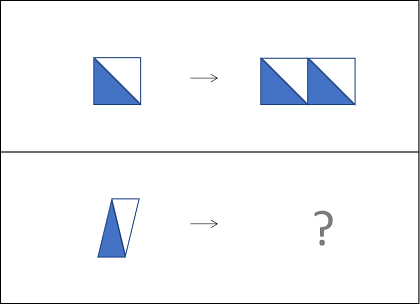
在图形矩阵题中,你会看到一个网格(2×2 或 3×3),其中图形会按照特定规律在每一行或每一列中发生变化。这些变化可能包括旋转、翻转或部分元素的移动。你需要找出其中的逻辑规律,选出能够补全矩阵的缺失图形。
Choose the answer choice that follows the pattern and completes the matrix.
Wrong
Wrong
Correct!
Wrong
Wrong
The correct answer is C.
Let's Break This Down Step by Step
In figure matrices questions, we need to find the relationship between figures in the top row and then apply that same relationship to the bottom row. The top row shows us the rule, and we use that rule to find the missing figure in the bottom row. Let's start by examining what happens in the top row.
Look at the top row carefully. On the left side, we have a single square containing one blue triangle with its base at the bottom. On the right side, we see a rectangle containing two blue triangles, both with their bases at the bottom. The transformation is clear: the figure on the left is doubled to create the figure on the right. This is our rule!
Now let's look at the bottom row. On the left side, we have a parallelogram shape containing two triangles. The first triangle is blue and has its base on the bottom, while the second triangle is white and has its base on the top. These two triangles are positioned side by side within the parallelogram.
Since we discovered that the rule is to double the figure, we need to take what we see in the bottom left and double it. This means we should have two blue triangles with their bases on the bottom and two white triangles with their bases on the top, all arranged together in the resulting figure.
Option A shows a parallelogram with triangles, but let's check their orientation. The blue triangles have their bases on the top instead of on the bottom, and the white triangles have their bases on the bottom instead of on the top. This is the opposite of what we need, so option A doesn't follow our pattern correctly.
Option B shows only one blue triangle and one white triangle. This means the figure was not doubled at all, which breaks our rule right away. Additionally, the blue triangle has its base on the top and the white triangle has its base on the bottom, which is reversed from what we need. Option B doesn't work for multiple reasons.
Option C shows a rectangle containing four triangles arranged properly. There are two blue triangles, both with their bases on the bottom, and two white triangles, both with their bases on the top. This matches our rule perfectly! The original figure has been doubled, and all the orientations are correct. This looks like our answer!
Option D shows four triangles in the correct positions, but there's a problem. All four triangles are white, with no blue triangles at all. Since our original figure in the bottom left had blue triangles, our doubled figure must also have blue triangles. Option D doesn't maintain the colors correctly.
Option E shows the right number of triangles with the correct colors and orientations, but the doubled figure is separated into two distinct groups with a gap between them. In the top row, when the figure was doubled, the two triangles stayed together in one continuous rectangle. The same should happen in the bottom row, so option E doesn't match the pattern of keeping the doubled figure unified.
空间能力测评(Spatial Ability Battery)用于评估学生在头脑中想象和操作图形的能力,这些技能对于几何学习、设计任务以及理解技术概念都非常重要。在 CAT4 测试中,这些能力通过两种题型进行评估:
在图形分析题中,你会看到一张正方形纸被多次折叠,然后在纸上打孔或剪出形状。选项中展示的是纸张完全展开后的样子。你需要根据对称规则,选择一个正确显示展开后孔洞位置的图案。
Choose the answer choice that shows the final product of the unfolded punched-in paper.

Correct!
Wrong
Wrong
Wrong
Wrong
The correct answer is A.
Let's Break This Down Step by Step
First, we need to carefully trace through what happens to the paper. The paper starts as a flat rectangle. Then it gets folded in half lengthwise (the long way), creating two layers. After that, it gets folded in half widthwise (the short way), now creating four layers total. This folding sequence is really important because it determines where the holes will appear when we unfold!
Now a heart-shaped hole is punched through all the folded layers. Since the paper is folded into four layers, this single punch will create four heart-shaped holes once we unfold everything. This is the key insight: one punch through folded paper creates multiple holes in a symmetrical pattern.
Let's unfold the paper step by step, just like we would in real life. When we unfold the widthwise fold (the second fold we made), the paper opens up and we now see two heart-shaped holes. These two hearts are positioned horizontally next to each other because of how the widthwise fold works.
Now we unfold the lengthwise fold (the first fold we made). When we do this, those two hearts we saw become four hearts total. The two hearts we already had get mirrored vertically, creating two more hearts below them. This gives us a total of four hearts arranged in a rectangular pattern.
Because of the folding sequence (lengthwise first, then widthwise), the symmetry works in a specific way. The second heart must be a vertical mirror of the first heart (from the widthwise fold). Then, when we unfold lengthwise, the bottom two hearts must be horizontal mirrors of the top two hearts. This creates a very specific symmetrical arrangement.
Looking at option E, we can see it only has three hearts visible on the paper. Since we punched through four layers, we must have four hearts when fully unfolded. Option E doesn't match this requirement, so we can confidently eliminate it.
Now let's look at options B, C, and D. Each of these shows four hearts, which is good, but the arrangement doesn't match our folding pattern. In option B, the hearts are all oriented the same way in the same positions, but the symmetry doesn't match our fold pattern. Option C shows hearts with incorrect rotations that don't reflect the mirroring from our folds. Option D also has hearts arranged symmetrically, but again, the pattern doesn't match the specific lengthwise-then-widthwise folding we performed.
Option A shows exactly what we predicted: four hearts arranged in a 2x2 grid pattern, with the proper mirroring from our folding sequence. The top two hearts mirror each other vertically (from the widthwise fold), and the bottom two hearts are horizontal mirrors of the top two hearts (from the lengthwise fold). The hearts are all oriented as spade-shaped hearts pointing downward, which perfectly matches how a single punch through our folded paper would appear when completely unfolded. This is definitely our answer!
TestPrep-Online 的完整 CAT4 备考套装包括:
教程、CAT4 模拟测试以及专家建议,价格 $69 起。
CAT4 是由 GL Assessment 开发的一种广泛使用的推理能力评估测试。学校使用它来辅助分班决策,并了解学生随着时间推移的思维方式和学习特点。该测试在英国及国际学校中均有使用。
CAT4 具有以下特点:
• 机考形式
• 严格限时
• 旨在评估推理能力,而非已教授的课程内容
它评估四个关键的推理领域(称为“测评组”),每个领域包含两个分测验:
Verbal Classification
Verbal Analogies
Number Analogies
Number Series
Figure Classification
Figure Matrices
Figure Analysis
Figure Recognition
CAT4 由多个简短且严格限时的部分组成。时间结束后,学生无法返回之前的题目,因此良好的时间管理能力以及对考试形式的熟悉程度至关重要。
|
Part 1 |
Figures & Verbal Reasoning |
25–30 Minutes |
|
Part 2 |
Numbers & Shapes |
20–30 Minutes |
|
— |
— |
— |
|
Total |
Two Parts |
45–60 Minutes |
|
CAT4 Section |
Number of Questions |
Test Time |
|
Part 1 |
|
|
|
Figure Classification |
24 Questions |
10 Minutes |
|
Figure Matrices |
24 Questions |
10 Minutes |
|
Part 2 |
|
|
|
Verbal Classification |
24 Questions |
8 Minutes |
|
Verbal Analogies |
24 Questions |
8 Minutes |
|
Number Analogies |
18 Questions |
10 Minutes |
|
Part 3 |
|
|
|
Number Series |
18 Questions |
8 Minutes |
|
Figure Analysis |
18 Questions |
9 Minutes |
|
Figure Recognition |
18 Questions |
9 Minutes |
|
— |
— |
— |
|
Total |
168 Questions |
~2 Hours |
CAT4 成绩有助于:
• 预测学业发展潜力
• 确定分班安排及是否符合资优项目资格
• 识别来自不同教育背景学生的潜能
但家长常常不知道的是,CAT4 反映的是孩子的思维方式,而不是他们已经学过的知识内容。
CAT4 是一种具有启发性的思维训练,也是一项具有挑战性的测试,它让学生参与到不同类型的思考和问题解决中。通过充分的准备,学生可以更有技巧、更有信心地应对其独特特点。
由于它与大多数课堂测试不同,部分内容可能需要一些时间来适应。常见特点包括:
CAT4 评估的是孩子的思维方式,而不仅仅是他们记住了多少知识。对于在家学习的学生来说,它是一项强有力的工具,可以帮助了解优势所在、指导教学方向,并规划学业成长。
即使是在学业上表现优异的在家学习学生也能从中受益,因为 CAT4 侧重于思维能力,而非课堂内容。这为家长提供了可操作的见解,以便进行更有针对性的个性化教学。
CAT4 可与 MAP Growth、i-Ready、Star Assessments、SAT 和 CogAT 等评估工具相结合,构成全面的在家学习评估体系。当这些测试结果综合分析时,家长可以更清楚地了解思维能力如何与学业表现及长期发展相匹配。
这些方框显示了构成您孩子 CAT4 成绩的关键组成部分。
标准年龄分数(SAS)
用于将您孩子的表现与同龄学生进行比较。SAS 100 为平均水平,而 120 分及以上表示表现优秀,学校在考虑提供拓展或资优机会时可能会参考这一分数。
全国百分位排名(NPR)
显示您的孩子在全国范围内超过了多少比例的同龄学生。例如,NPR 为 80 表示您的孩子的成绩高于 80% 的同龄人。
组内排名
将您孩子的表现与同班同学或同校学生进行比较,帮助教师更快识别学习需求。
九分等级(Stanine)
一种 1–9 的简易评分等级,学校常用来进行分组教学。较高的九分等级可能有助于进入高级课程或资优项目。
CAT4 还会根据四个推理领域的表现模式生成学生画像。
该画像反映的是孩子基于认知优势最可能采用的学习方式,而不是他们当前在课堂上的表现。
在这一模型中,言语推理和空间推理被视为一个连续体的两端,数量推理和非言语推理位于两者之间。根据九分等级(Stanine)及整体表现,学生会被归入七种画像类型之一,以帮助识别其自然的学习偏好。
这些画像显示孩子是更倾向于通过语言学习,还是通过视觉和规律学习。
偏向程度从轻度到极强不等,用来表示这种学习偏好的强弱程度。
许多家长都会想知道考试结束后接下来会发生什么。好消息是:您将在将 CAT4 成绩转化为对孩子有意义的支持过程中发挥积极作用。以下是您的行动指南:
等待成绩公布: 大多数学校会在两到三周内分享 CAT4 成绩,并可能安排会议,讨论结果对孩子学习规划的意义。
共同查看报告: 与孩子的老师一起审阅报告,并询问成绩将如何与课堂表现、其他评估结果以及孩子的兴趣相结合。
确保全面了解: 这种合作方式有助于确保支持方案、拓展机会或分班安排能够全面反映孩子的能力。
善用结果洞察: 肯定孩子的优势,在家中引导学习,并与教师合作制定策略,帮助孩子自信、持续地进步。
我们将考试当天的压力转化为充分的准备。我们的备考套装包括:
使用我们备考资料的学生普遍反馈,在考试当天更加自信、准备更充分,许多人在目标领域的成绩提升了 10–15 分。
想看看我们的 CAT4 测试是什么样的吗?这里有一份迷你版 CAT4 测试供您体验:
一位语言与语言学专家,拥有语言教学硕士学位,并拥有十多年开发与评估标准对齐练习材料的经验,涵盖多个学科,严格程度媲美真实的教育科技类考试。
Liron 设计的备考资料包含清晰且结构化的练习内容,既能提升学习效果,又能适应数字化工具,帮助每一位学生在各类评估考试中发挥最佳水平。
CAT4 measures how your child thinks, not what they’ve memorized. It assesses reasoning skills across verbal, quantitative, non-verbal, and spatial areas to help schools understand learning potential and academic strengths.
Schools use CAT4 to predict academic progress, guide placement decisions, and identify gifted potential because it provides insight into a child’s learning style rather than just current classroom performance.
Yes. While CAT4 isn’t curriculum-based, familiarity with question formats and timing significantly improves confidence, speed, and accuracy, helping students perform closer to their true ability level.
Absolutely. CAT4 is designed to be fair across school systems and learning experiences, making it especially valuable for students from international, independent, or non-traditional educational settings.
The test is computer-based and strictly timed, with short sub-tests lasting about 8–10 minutes each. Students cannot return to previous questions, which makes time management and practice essential.
Scores include Standard Age Scores (SAS) and National Percentile Ranks (NPR), which show how your child compares to others their age. These results help schools plan support, enrichment, or academic pathways.
The student profile shows whether your child has a verbal, spatial, or balanced learning preference, helping teachers and parents tailor teaching methods and learning strategies more effectively.
Our Prep Pack provides full-length timed tests, detailed explanations, strategy tips, and progress tracking, giving your child structured, realistic practice that free samples alone cannot offer.
Money back guarantee
Since 1992, TestPrep-Online has helped individuals prepare for all kinds of tests. From entrance exams into gifted programs, to assessment tests, and graduate assessment and placement tests, TestPrep-Online can help you prepare and pass.