Free CAT4 Level G Sample Questions for Year 11 and Above (2026)
By Liron Katz, Assessment Specialist
CAT4 Level G is the version of GL Assessment's Cognitive Abilities Test taken by students in Year 11 and above. Schools and sixth forms use the results alongside other information to identify students’ reasoning strengths, inform academic targets, and support subject and post-16 choices.
Below, you’ll find free CAT4 Level G practice questions covering all eight question types, each with a step-by-step explanation, plus expert tips, a guide to CAT4 scores, and answers to common questions from parents and students.
What Is CAT4 Level G | CAT4 Level G Test Format and Timing | CAT4 Level G Scores | Level G Sample Questions | Preparation Tips |CAT4 Leavel G Mini Test | FAQs

What Is CAT4 Level G?
CAT4 Level G is the highest level of GL Assessment's Cognitive Abilities Test, Fourth Edition (CAT4). It measures verbal, quantitative, non-verbal and spatial reasoning through eight subtests, completed in three parts with 72 minutes of timed questions in total.
The question types are the same as in Levels A to F, but Level G questions are designed for older students and are more demanding. They may involve more complex relationships, multiple rules and several steps of reasoning before reaching the answer. CAT4 reports also include GCSE, A Level and IB indicators, which give schools a picture of expected achievement in national examinations. These are indicators of potential, not predictions.
CAT4 Level G Test Format and Timings
The eight subtests are taken in three parts, and each one has its own fixed time limit, shown below. The timed questions total 72 minutes, not including instructions, examples, practice questions or breaks. All questions are multiple choice.
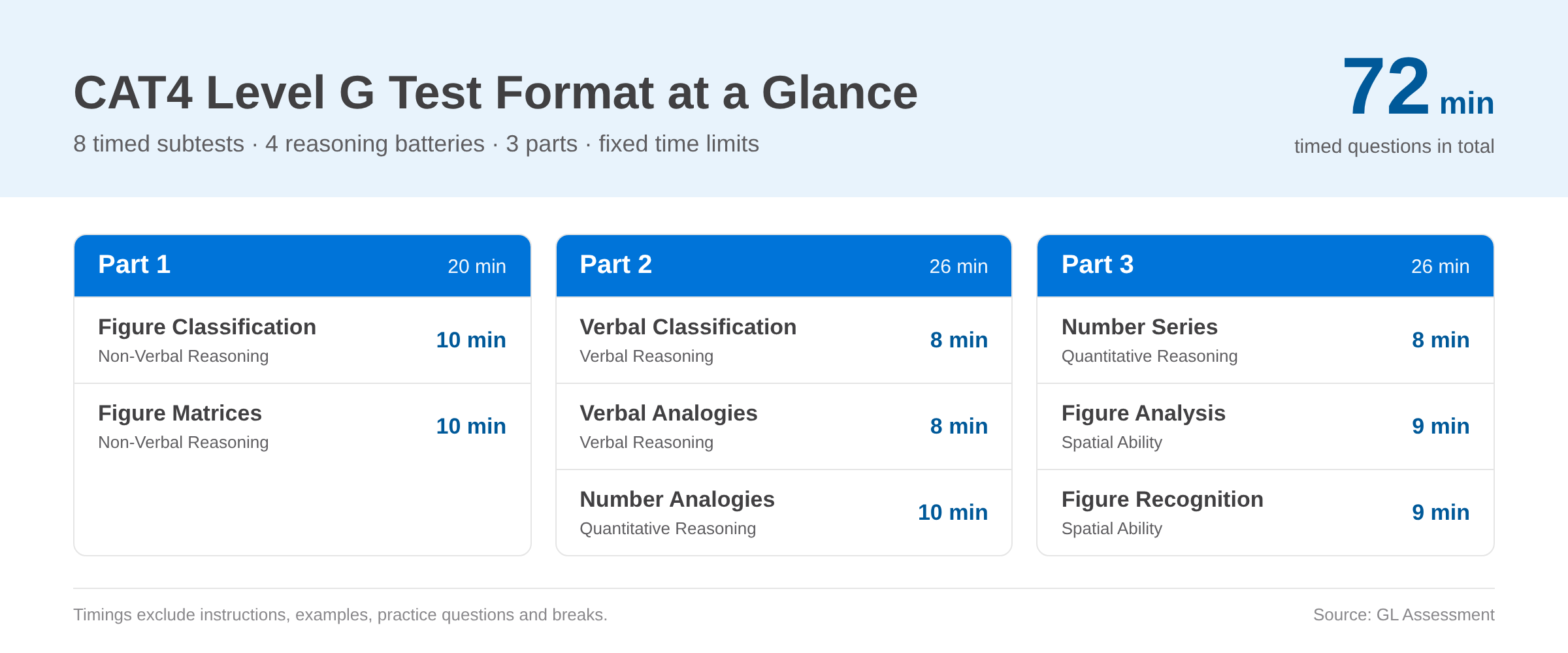
Free CAT4 Level G Practice Questions by Reasoning Battery
Verbal Reasoning Battery
Skills Tested: Thinking with words and language, precise vocabulary and relationships between concepts.
Verbal Classification Sample Question:
In Verbal Classification, students identify the word that shares a common category or defining feature with a group of related words.
Let’s try one together:
Quantitative Reasoning Battery
Skills Tested: Thinking with numbers and sequences
Number Series Sample Question
Identify the rule and determine the next number in the sequence.
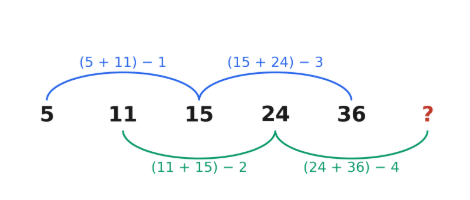
5 11 15 24 36 ?
The correct answer is 56.
This series is a variation of the Fibonacci series. Each term is the sum of the two terms before it, minus a number that goes up by one at each step:
Step 1: Add the first two terms and subtract 1. (5 + 11) − 1 = 15
Step 2: Add the next two terms and subtract 2. (11 + 15) − 2 = 24
Step 3: Add the next two terms and subtract 3. (15 + 24) − 3 = 36
Step 4: Follow the pattern. Add the last two terms and subtract 4. (24 + 36) − 4 = 56
Therefore, the missing number is 56.
Non-Verbal Reasoning Battery
Skills Tested: Thinking with shapes and patterns
Spatial Ability Reasoning Battery
Skills Tested: Thinking in 3D and visualization
Figure Recognition Question
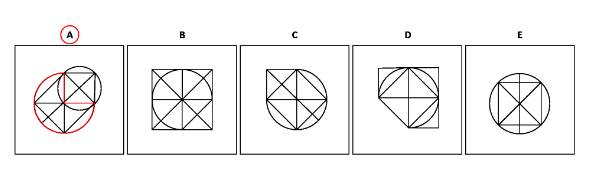
Which of the five designs contains the exact same size outline of the target, including each side in full.

The correct answer is E.
In this Figure Recognition question, we need to find the exact shape shown at the top hidden inside one of the answer figures. Extra lines can cross through or extend beyond the shape, so we need to focus only on the lines that form the target.
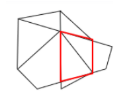
The target is an isosceles trapezoid. Look for its key features:
- It has two vertical, parallel sides.
- The left side is longer than the right side, so the shape narrows towards the right.
- The top and bottom sides slant towards each other.
- The angles, size, and proportions must match the target.
The correct answer must contain all four sides in the correct positions. A shape that is only similar, larger, or facing the opposite direction does not count.
Option 5 contains several vertical lines. The leftmost and middle vertical lines are too far apart to make the target shape.
However, look at the middle and rightmost vertical lines. They are the correct distance apart, and the diagonal lines crossing them form the required top and bottom sides.
Together, these four line segments form the exact target shape.
Option A contains several vertical lines and some diagonals at similar angles. On the right side, the lines almost form the target, but one of the required sides is missing, so the complete shape is not present.
Option B is incorrect because it does not contain a diagonal at the correct angle to form the bottom side of the target.
Option C has two vertical parallel lines, but they are too far apart to match the proportions of the target.
Option D contains a similar isosceles trapezoid, but it is larger than the target shape, so it is not an exact match.
Tip: Start by looking for the two vertical sides at the correct distance apart. This can help you rule out options quickly. Then check the slanting sides and the exact size and proportions. A shape can have the right general form but still be too large, as in option D.
Therefore, the correct answer is E.
Reday to try more? CAT4 Level G Full Course. Practise. Improve. Succeed.

CAT4 Level G Tips: How to Think Like a Top Scorer
Level G doesn’t introduce new question types. Students see the same eight formats used in earlier CAT4 levels. What changes is the level of reasoning required. Questions may involve more than one step, less obvious relationships, or several pieces of information that need to be considered together.
The good news is that this rewards method, not speed or luck. Strong performance comes from approaching each question systematically, checking the rule carefully, and knowing what to look for in each question type. Here are the habits to learn first, followed by specific advice for each part of the test.
Three Habits That Work on Every Question
- Work out the rule before checking the answers. Answer options are designed to distract you. First identify the relationship or pattern in the question, then look for the option that follows it. This helps you avoid choosing an answer simply because it looks familiar.
- Check that your rule works throughout the question. A pattern that works for only one part of the question may not be the complete rule. Test your idea against all the information provided before choosing your answer.
- Use elimination when you’re unsure. Look for options that break part of the rule, for example, the correct shape at the wrong size or the correct relationship applied in the wrong way. Ruling out clearly incorrect answers makes the remaining choices easier to compare.
Verbal Reasoning Battery: Read Like a Detective
- Look for the full relationship. At Level G, the connection between words may be less obvious or involve more than one feature. Consider meaning, degree, function, and other possible relationships, and make sure your answer fits the complete pattern.
- Consider more than one meaning. A familiar word may be used in a less familiar way. If the relationship does not immediately make sense, consider alternative meanings and use the other words in the question as clues.
- Be precise about the relationship. Two words being related is not enough. Ask exactly how they are related. For example, are they synonyms, opposites, members of the same category, or does one describe a degree, function, or consequence of the other? The more precisely you can describe the relationship, the easier it is to reject answers that are only partly correct.
Quantitative Reasoning Battery: Slow Down to Speed Up
- Expect more than the obvious operation in Number Analogies. At Level G, don’t stop at the first simple relationship you find. The rule may combine two or more steps or use operations such as squaring, square roots, halving, multiplication and division. A rule that works for the first example may still be incomplete, so always test it on the second example before applying it to the question.
- Look for a pattern behind the pattern in Number Series. Level G series may not follow one obvious operation from beginning to end. If the first pattern you try does not work, check whether the gaps between numbers follow their own pattern, whether alternate terms form two separate sequences, or whether the rule changes or combines operations. Don’t choose the next number until your rule explains the whole series.
Non-Verbal Reasoning Battery: One Change at a Time
- Track one feature at a time. Level G questions require you to keep track of several visual features at once. Break the figure down and follow one feature at a time, such as position, shading, number, orientation or shape. Then put the pieces together to identify the complete rule.
- Make sure every part of the rule fits. At Level G, spotting one correct relationship is not enough. Check how the different features work together and make sure your answer follows all parts of the pattern, not just the most noticeable one.
Spatial Ability Battery: Picture It, Then Check It
- In Figure Analysis, unfold the paper one fold at a time. Level G questions involve several folds, so trying to picture the final result all at once can quickly become confusing. Reverse the folds one at a time, in the opposite order from which they were made. At each step, reflect the cuts or holes across the fold line and check their position and orientation before moving to the next fold.
- In Figure Recognition, break the target shape into distinctive parts. Level G designs contain many overlapping lines, so searching for the whole target at once can make it difficult to see. Start with its most distinctive features, such as an unusual angle, a particular pair of lines, or a recognisable corner, and trace the rest of the shape from there. Ignore surrounding lines that are not part of the target.

Understanding CAT4 Level G Scores
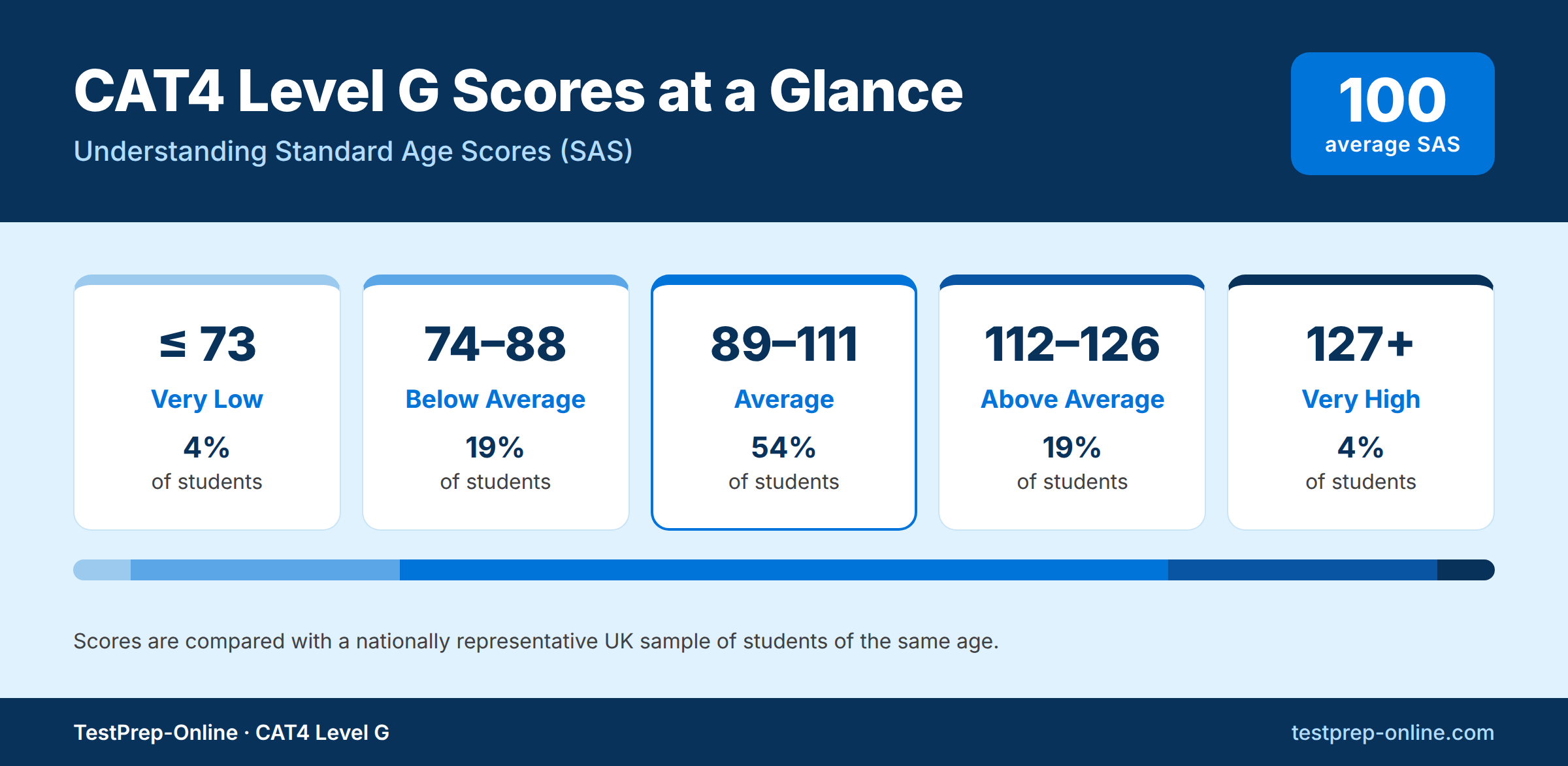
CAT4 Level G uses the same Standard Age Score (SAS) scale as the other CAT4 levels. The average SAS is 100, and scores are adjusted for the student's exact age, so performance is compared fairly with other students of the same age. This means an SAS of 100 represents average performance for the student's age, even though Level G contains more demanding questions than earlier levels.
Want to understand SAS, percentiles, stanines and what counts as a good CAT4 score? Read our complete CAT4 Scores Guide.
Give Your Child the Tools to Walk Into School Assessments Feeling Calm, Confident, and Ready to Succeed.
Ask Liron

A language and linguistics expert with an MA in Language Teaching and over a decade of experience developing assessment-aligned practice across multiple subjects that mirrors the rigor of real edtech tests. Liron creates prep packs with clear, structured exercises that enhance learning, adapt to digital tools, and empower every student to perform their best on a wide range of assessments

CAT4 Level G FAQs
CAT4 Level G is designed for students with a norm age of 14 years 6 months to 17 years and above. In the UK, it is typically used from Year 11 onwards (roughly Grade 10 and above in American-style systems), including students in sixth form or college. International schools also use CAT4 Level G with older secondary students, with the equivalent year or grade depending on the school’s curriculum and education system.
Yes. You can take our free CAT4 Level G practice test and work through the eight sample questions on this page, each with a step-by-step explanation. For more practice, see the CAT4 Level G PrepPack.
A Standard Age Score (SAS) of 100 is the average for a student's age. Scores from 89–111 are within the average range, 112–126 are above average, and 127 or higher are very high. What counts as a “good” score also depends on the student's individual profile and how the school uses CAT4 results. For a full explanation of SAS, percentiles and stanines, see our CAT4 Scores Guide.
Yes. CAT4 is not a curriculum-based test, but students can prepare by becoming familiar with the eight question types and practising the reasoning skills they require. At Level G, practice is particularly useful for learning how to approach more complex verbal relationships, multi-step numerical rules and detailed visual patterns efficiently and accurately. Our CAT4 Level G PrepPack is designed for exactly this kind of practice.
Yes. Level G is more demanding than Level F, although both use the same eight question types. Level G questions require a higher level of reasoning, with more complex verbal relationships, numerical rules and visual patterns designed for older students. Students who are already familiar with CAT4 will recognise the formats, but should expect the questions themselves to require more careful analysis.
Sixth forms can use CAT4 Level G results alongside other academic information to inform target setting, identify students who may need additional support or greater challenge, and support subject and course choices. The results can also help teachers understand each student's relative strengths across verbal, quantitative, non-verbal and spatial reasoning.
CAT4 scores are primarily used by schools and colleges rather than universities. They are not normally part of a UK university application. However, schools may use CAT4 results alongside other information when setting academic targets and supporting subject choices, which can be relevant to a student's pathway towards university.
Not on their own. CAT4 results provide indicators of potential performance; they are not ceilings on what a student can achieve. Schools consider CAT4 alongside other academic information when advising students about subjects, courses and academic pathways.
No. GL Assessment does not publish past CAT4 papers, so any “past paper” found online is unofficial. The best alternative is practice material that matches the real test’s format and difficulty, such as the free sample questions on this page and our [CAT4 Level G PrepPack].
The reason was that “cat4 level g past papers” gets about 260 impressions a year and no page covered it.


