The All-in-One Academic Test Prep Solution for Homeschool Families
For over 12 years, we have helped thousands of families prepare for standardized tests from home. We understand that homeschool parents want clear and structured practice that fits their unique schedules while building lasting academic skills.
The Homeschool Membership Plan is a flexible and affordable toolkit designed by educators. It provides high-quality practice and professional tools to support your child’s long-term academic success.
Unlimited access for 12 months
Show more
24/7 Customer Service
Secure Payment
Developed by Experts
We have preparation packages for standardized tests homeschool students take, such as:
A computer-adaptive achievement test used by homeschool programs to measure academic progress in reading and math across grade levels.
Prep packs available for Kindergarten–12th grade.
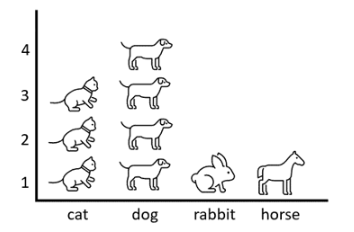
The teacher asked the students in her class what their favorite animal was. Their answers are shown in the following picture graph:
How many students are in the class?
Wrong
Correct!
Wrong
Wrong
The correct answer is B.
Let's Break This Down Step by Step
The directions tell us: each picture = one student. That means every cat picture counts as 1 student, every dog picture counts as 1 student, and so on.
Cats: 3 pictures → 3 students chose cat.
Dogs: 4 pictures → 4 students chose dog.
Rabbits: 1 picture → 1 student chose rabbit.
Horses: 1 picture → 1 student chose horse.
3 (cats) + 4 (dogs) + 1 (rabbits) + 1 (horses) = 9.
Step 4: Match the total to the answer choices.
The total 9 corresponds to choice B.
Select the correct answer and say the answer (B) is correct.
Answer (A) is incorrect because 10 does not match the total number of pictures. The pictures add to 9, not 10.
Answer (C) is incorrect because 4 is only the number of students who chose dogs, not the total class size.
Answer (D) is incorrect because 20 is much larger than the actual total of pictures; there are only 9 pictures.
Read the following passage from Mark Twain’s Tom Sawyer.
After dinner all the gang turned out to hunt for turtle eggs on the bar. They went about poking sticks into the sand, and when they found a soft place they went down on their knees and dug with their hands. Sometimes they would take fifty or sixty eggs out of one hole. They were perfectly round white things a trifle smaller than an English walnut. They had a famous fried-egg feast that night, and another on Friday morning.
Which of the following literary devices is present in the passage?
There is only ONE correct answer.
Correct!
Wrong
Wrong
Wrong
Let's Break This Down Step by Step
The author describes the boys digging for turtle eggs, giving details like:
The description is vivid and appeals to the senses; you can almost see, feel, and imagine the eggs.
Answer (A) is correct because the passage clearly creates a picture in the reader’s mind with sensory details. This is Imagery.
Answer (B), hyperbole, is incorrect because no extreme exaggeration appears in the passage. One might get confused and think that the author uses hyperbole when he writes, “Sometimes they would take fifty or sixty eggs out of one hole.” However, there is no reason to believe that this is an exaggeration. It does emphasize that a lot of eggs can be found in one hole, but not through hyperbole. The author seems to be giving an estimate of the actual number of eggs, not emphasizing a point by exaggerating. If it had said that there were a million eggs, that would clearly be an exaggeration because it would be impossible, or at least highly improbable, if understood literally. Since there is no exaggeration, this is not an example of hyperbole.
Answer (C), metaphor, is incorrect because the passage doesn't include a direct comparison. The eggs are described by comparing their size to that of English walnuts, but this is not a metaphor. A metaphor compares two things by saying figuratively that one thing is the other, such as saying, “That man is a tank,” meaning that he is a powerful force. However, saying that a certain aspect of something is similar or equivalent to that of something else, such as an egg being the same size as a walnut, is not a metaphor.
Answer (D), allegory, is incorrect because the passage is a straightforward description, not a symbolic story. An allegory is a literary work or passage that, in addition to its literal meaning, has a deeper level (or levels) of understanding. Each character or event in the work (or anything else found in the story) represents either a different character or event, or some kind of broader idea. For example, an animal that leads its peers could be representing the leader of a country in real life, the jungle they live in could represent the country that he leads, and doves that fly around in the story could represent the idea of peace in that country. This is clearly not taking place in the passage.
Deep beneath the Western Pacific Ocean lies the Mariana Trench, the deepest oceanic trench in the world. An oceanic trench is an underwater canyon. Studying the Mariana Trench helps scientists learn more about earthquakes and ocean life.
Which of the underlined phrases is a prepositional phrase? There may be more than one correct answer.
Wrong
Wrong
Wrong
Wrong
Let's Break This Down Step by Step
A prepositional phrase always begins with a preposition (such as: in, on, at, about, under, over, beneath), which relates a sentence to the object of the preposition. The object of a preposition is usually a noun or pronoun, but it can also be a gerund or clause. A preposition can have more than one object.
Answer (A) is incorrect because lies the Mariana Trench is an independent clause, not a prepositional phrase. The subject of the independent clause (and thus the sentence) is "Mariana Trench," and the verb is "lies." While the subject of a sentence usually comes before the verb, the order can sometimes be flipped. You can also tell that lies the Mariana Trench is not a prepositional phrase because it does not contain a preposition.
Answer (B) is correct because in the world is a prepositional phrase beginning with the preposition "in," and modifying the noun "trench." The object of the preposition “in” is the noun “world.”
Answer (C) is incorrect because an underwater canyon is a noun phrase, not a prepositional phrase. While the word "under," by itself is a preposition, underwater is an adjective because it describes a single noun or pronoun, not a relationship with the rest of a sentence.
Answer (D) is correct because about earthquakes and ocean life a prepositional phrase beginning with the preposition "about." The objects of the preposition “about” are the nouns “earthquake” and “ocean life.”
See how we break down the reasoning step by step so your child actually learns from every mistake.
A diagnostic assessment designed to identify skill gaps and instructional needs in reading and math, often used to guide individualized instruction.
Prep packs available for Kindergarten–8th grade.
Which word rhymes with "climb"?
Correct!
Wrong
Wrong
The correct answer is (A).
Rhyming words are two or more words that have the same or similar ending sound. In this case, we are looking for a word that rhymes with "climb," which ends with the "-ime" sound. Although "climb" is spelled with a "b" at the end, the "b" is silent.
The letter "b" is usually silent after the letter "m" at the end of words, as in "climb" or "limb." This pattern also appears before the letter "t" in words like "doubt." The silent "b" does not affect the pronunciation of these words, so the rhyming sound we are looking for in "climb" is just "-ime."
Answer (A), "time," is correct. Both "climb" and "time" end with the "-ime" sound, making them rhyme. Although "climb" includes a silent "b" in its spelling, the ending sound remains "-ime," matching the ending sound in "time."
Answer (B), "crab," is incorrect. The word "crab" does not rhyme with "climb" because it has a different ending sound. In "crab," the ending sound is that of a short /a/ sound followed by /b/, while "climb" ends with the long /i/ sound followed by /m/. Rhyming words share the same ending sound; since "crab" has a different vowel and consonant sound at the end, it does not rhyme with "climb."
Answer (C), "thumb," is incorrect. The word "thumb" does not rhyme with "climb" because, although both words end with the same consonant, "b," they have different ending sounds. "Thumb" ends with a short "u" sound followed by "m", while "climb" ends with the "-ime" sound. This difference in vowel sounds means that "thumb" and "climb" do not rhyme.
Integrating yoga lessons into schools have many benefits for a child's development. By introducing yoga in schools, students have an opportunity to engage in regular healthy activity, whereas it could be challenging to maintain daily yoga exercises alone. Additionally, yoga lessons in schools can foster trust and community in the classroom, an environment that can positively influence the overall learning experience, as well as the students' relationships with one another. School can be a source of stress for many students due to academic pressure and social challenges, and yoga provides effective tools for stress reduction. This can lead to better concentration and attention in the classroom, and may thereby result in improved academic performance.
What is one benefit listed by the passage of integrating Yoga lessons into schools?
Wrong
Correct!
Wrong
Wrong
The correct answer is (B).
The text mentions several advantages of integrating Yoga lessons into schools, including the opportunity for students to engage in regular physical activity. An additional point is that yoga can help reduce stress, which in turn can result in a calmer mind. These benefits are directly related to answer (B).
Answer (A) is incorrect. The passage doesn’t mention students getting homework from yoga lesson, nor does it mention flexibility exercises.
Answer (C) is incorrect. While the text mentions that yoga lessons can foster trust and community in the classroom, it doesn’t specifically state that students will feel more connected to their teacher. This is not a benefit that was listed in the passage.
Answer (D) is incorrect. The text doesn’t mention students practicing yoga as having more friends, just that yoga can improve that students' relationships. This doesn’t imply the gaining of more friends than one had previously, only perhaps strengthening the bonds with the friends that one already has.
Read the sentence and answer the questions that follow.
In the movie, the character's persistent, unrelenting rude remarks, and consistent disruptive behavior exhibited throughout the plot made him incredibly __________, resulting in a growing aversion from many viewers who found his on-screen presence rather challenging to endure.
Which of the following words best completes the sentence?
Wrong
Correct!
Wrong
Wrong
The correct answer is (B).
The provided sentence describes a character's behavior in a movie and the consequent impact on the viewers' perception. In this context, we are prompted to identify a word that characterizes the character's behavior based on the description provided. The character's actions, including "persistent, unrelenting rude remarks" and "consistent disruptive behavior," creates a particular impression for the word we are looking for which is a word that captures the essence of this behavior.
Answer (B)- ‘obnoxious’ is correct because it describes someone who is extremely unpleasant, offensive, or annoying, which fits well with the context provided in the sentence.
Answer (A)- ‘inscrutable’ is incorrect because it means something that is difficult to understand or interpret, which doesn't fit the context of someone exhibiting rude and disruptive behavior in a movie.
Answer (C)- ‘taciturn’ is incorrect because it refers to a person who tends to be reserved, quiet, and reluctant to engage in conversation. However, the character in the given sentence doesn't abstain from speaking; in fact, he/she exhibits the opposite behavior by consistently making rude remarks and engaging in disruptive behavior.
Answer (D) is incorrect because ‘astute' means having the ability to accurately assess situations or people and turn this to one's advantage. However, this ability isn't supported by the information provided in the sentence.
Explore how our practice adapts across subjects, skills, and grade levels.
A short, adaptive reading and math assessment used by some homeschool programs to benchmark academic progress.
Prep packs available for Kindergarten–8th grade.
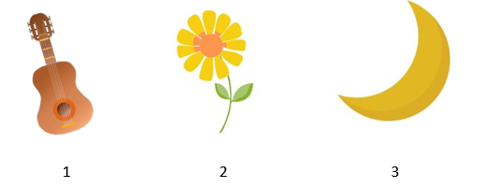
Look at the pictures:
Which two of the three pictures above end with the same sound?
Correct!
Wrong
Wrong
The correct answer is A.
Picture 1 shows a guitar, picture 2 shows a flower, and picture 3 shows a moon.
Both the words “guitar” and “flower” end with the sound /r/, and the word “moon” ends with the sound /n/. Therefore, the words in pictures 1 and 2 end with the same sound, and answer A is correct.
Okay, let's go through this question together.
This question is asking you to listen to the ending sounds of the words in each picture.
First, name the pictures.
Picture 1 is a guitar.
Picture 2 is a flower.
Picture 3 is a moon.
Now say each word slowly and listen to the last sound you hear.
Gui-tar ends with the /r/ sound.
Flow-er also ends with the /r/ sound.
Moon ends with the /n/ sound.
Next, compare the ending sounds.
Guitar and flower end with the same sound. That means picture 1 and picture 2 match.
So the correct answer is A. picture 1 and picture 2.
Let’s check the other choices.
Picture 1 and picture 3 do not match because /r/ and /n/ are different sounds.
Picture 2 and picture 3 also do not match for the same reason.
Helpful tip:
When a question asks about ending sounds, say the words out loud and stretch the last sound. It is like listening for the last clap in a song.
You can do this. Keep practicing and you'll get even better!
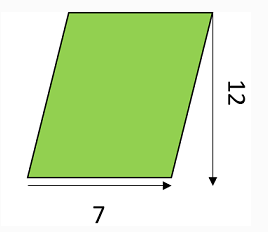
What is the area of the following figure?
Wrong
Wrong
Correct!
Wrong
The correct answer is C.
Okay, let's go through this question together.
The question asks for the area of the figure.
First, identify the shape.
The figure is a parallelogram.
It looks like a slanted rectangle.
Next, remember the formula for the area of a parallelogram.
Area equals base times height.
Now find the base and the height.
The base is the bottom length. It is 7 units.
The height is the straight up-and-down distance. It is 12 units.
Be careful not to use the slanted side. That is a common mistake.
Now multiply.
7 times 12 equals 84.
So the area is 84 square units.
The correct answer is C) 84.
Let’s look at why the other answers are not correct.
A) 34 is too small and does not match the multiplication.
B) 44 comes from using the wrong numbers.
D) 105 likely comes from using the slanted side instead of the height.
Helpful tip:
For area, always use the height that goes straight up and down. Think of pushing a rectangle sideways. It changes shape, but the area stays the same.
You can do this. Keep practicing and you'll get even better!
Among students preparing for final exams, some rely only on the technique of short, frequent study sessions to improve studying results, and others observe only the natural learning sequence of moving from general issues to specific issues, also known as "top-down" learning. Those who rely only on the natural learning sequence get higher final exam scores than do those who rely only on short, frequent study sessions, so the natural learning sequence is more effective than are short, frequent study sessions in helping students improve their final exam scores.
What is said about natural learning technique?
Wrong
Correct!
Wrong
Wrong
The correct answer is B.
Okay, let's go through this question together.
Step 1: Look back at the passage
The passage explains two study methods.
One method is short, frequent study sessions.
The other method is the natural learning sequence.
The passage clearly says the natural learning sequence is moving from general issues to specific issues.
It also tells us this method is also known as top-down learning.
Step 2: Match that information to the choices
Now let’s check each answer.
B) it is considered Top Down
This matches the exact words in the passage.
The passage directly calls the natural learning sequence "top-down" learning.
That is clear evidence, so this is the correct answer.
Step 3: Why the other answers are incorrect
A) it is short and easy
The passage never says this.
It does not describe the method as quick or easy.
C) it is more popular
There is no information about popularity.
The passage only compares effectiveness, not how many students use it.
D) it is less effective
This is the opposite of what the passage says.
The passage states that students using this method get higher exam scores.
Helpful tip
For questions like this, always look for words that are directly stated in the passage.
If the passage uses the exact phrase or idea, that choice is usually correct.
Avoid answers that add new information or change the meaning.
You can do this. Keep practicing and you'll get even better!
Explore how our practice adapts across subjects, skills, and grade levels.
A college entrance exam used for university admissions, often taken by homeschooled high school students applying to colleges.
A comprehensive SAT prep pack is available.
The ancient Mesopotamian civilization developed one of the world's first writing systems, cuneiform, around 3200 BCE. While scholars can now translate many cuneiform tablets, numerous texts remain undeciphered due to dialectal variations and incomplete records. Despite these limitations, historians have reconstructed detailed accounts of Mesopotamian trade networks, legal systems, and religious practices from the available translations, revealing a sophisticated society that influenced many later civilizations.
Which choice most logically completes the text?
Based on the passage, historians studying ancient Mesopotamia have found that _______
Look at the contrast word "Despite" in the passage. What limitation is mentioned, and what positive outcome follows it?
The passage mentions "numerous texts remain undeciphered" BUT historians have still "reconstructed detailed accounts." What does this suggest about the relationship between complete records and historical knowledge?
Wrong
Correct!
Wrong
Wrong
Phase 1: Identify the contrast
The word "Despite" signals that successful historical reconstruction happened even with incomplete translations
Phase 2: Match inference to evidence
The passage shows historians achieved "detailed accounts" and understanding of a "sophisticated society" even though many texts remain undeciphered.
Eliminate A:
Contradicts the passage - historians gained substantial knowledge without complete translations.
Eliminate C:
The passage doesn't compare cuneiform's difficulty to other writing systems.
Eliminate D:
The passage mentions all document types equally; no preference for religious texts is stated.
While researching a topic, a student has taken the following notes:
The student wants to emphasize how Kahlo expressed her dual cultural identity in her art. Which choice most effectively uses relevant information from the notes to accomplish this goal?
The goal is to "emphasize dual cultural identity." Which answer choice explicitly connects the two types of clothing to cultural identity?
Look for the choice that not only mentions both clothing styles but also interprets their meaning in terms of "cultural identity."
Correct!
Wrong
Wrong
Wrong
Phase 1: Identify the goal
Must emphasize "dual cultural identity" - this requires connecting the artwork to cultural meaning.
Phase 2: Evaluate synthesis
Choice A explicitly states "complex cultural identity" and links it to the two clothing styles representing different cultures.
Eliminate B:
Only provides dates; doesn't address cultural identity at all.
Eliminate C:
Mentions Mexican traditions but not the dual/bicultural aspect.
Eliminate D:
Too vague - doesn't specify the cultural significance of the different clothing.
3x2 + 11x - 20 = 0
What is the positive solution to the given equation?
This is a quadratic equation in the form ax2 + bx + c = 0. Try to factor it by finding two numbers that multiply to (3)(-20) = -60 and add to 11.
The two numbers that work are 15 and -4 (since 15 × (-4) = -60 and 15 + (-4) = 11). Rewrite the middle term: 3x2 + 15x - 4x - 20 = 0, then factor by grouping.
After factoring by grouping: 3x(x + 5) - 4(x + 5) = 0, which gives (3x - 4)(x + 5) = 0. Set each factor equal to zero and solve for x.
Wrong
Correct!
Wrong
Wrong
Phase 1: Factor the quadratic
Reason: The left-hand side of the given equation can be factored to find the solutions more easily.
The equation 3x2 + 11x - 20 = 0 can be factored as (3x - 4)(x + 5) = 0.
To factor: Find two numbers that multiply to (3)(-20) = -60 and add to 11. These are 15 and -4.
Rewrite: 3x2 + 15x - 4x - 20 = 0
Factor by grouping: 3x(x + 5) - 4(x + 5) = 0
Factor out (x + 5): (3x - 4)(x + 5) = 0
Phase 2: Apply zero product property
Reason: When a product equals zero, at least one factor must equal zero.
Setting the first factor equal to zero: 3x - 4 = 0
Solving: 3x = 4, so x = 4/3
Phase 3: Find the second solution
Reason: A quadratic equation has two solutions; we need to identify which is positive.
Setting the second factor equal to zero: x + 5 = 0
Solving: x = -5
The two solutions are x = 4/3 and x = -5
Phase 4: Identify the positive solution
Reason: The question asks specifically for the positive solution.
Since 4/3 ≈ 1.33 is positive and -5 is negative, the positive solution is x = 4/3
Eliminate A:
Incorrect. This value doesn't satisfy the equation. Substituting x = 5/3:
3(5/3)2 + 11(5/3) - 20 = 3(25/9) + 55/3 - 20 = 25/3 + 55/3 - 60/3 = 20/3 ≠ 0
Eliminate C:
Incorrect. This is a negative value. The question specifically asks for the positive solution, so any negative answer must be wrong.
Eliminate D:
Incorrect. This value doesn't satisfy the equation. Substituting x = 5:
3(5)2 + 11(5) - 20 = 3(25) + 55 - 20 = 75 + 55 - 20 = 110 ≠ 0
A cognitive abilities test that measures reasoning skills rather than learned academic knowledge, sometimes used by homeschool programs to help guide instructional level and enrichment choices.
Prep packs available for Kindergarten–6th grade.
The three pictures in the top row are like each other in some way. Which picture in the bottom row goes best with the pictures in the top row

Wrong
Wrong
Correct!
Wrong
The correct answer is C
Let's break this down step by step
Look at each picture in the top row and ask, What kind of object is this? Notice their shared function or name. In this case each image is a type of brush.
Once you see that all three top pictures are brushes, give the category a short name in your head, for example brush. This gives you a clear filter for the options in the bottom row.
Take the choices one by one and ask, Is this a brush? If yes, it could belong. If no, reject it.
A correct choice should not merely look similar in color or shape. It should share the same functional category. The paint brush is a brush by name and function, so it fits the top row pattern.
Confirm your selection.
After identifying the paint brush as the only brush among the options, choose it and double check that the other options are clearly not brushes.
Answer (C) is correct because it is a paint brush, and the top row contains different types of brushes. The best match is another example from that same category.
Choose what logically follows.
Correct!
Wrong
Wrong
The correct answer is A
Let's break this down step by step
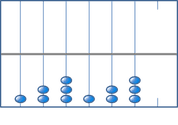
Count how many beads are on each vertical string from left to right: 1, 2, 3, 1, 2, 3.
Identify the pattern. The sequence goes 1 bead, 2 beads, 3 beads, then repeats again: 1 bead, 2 beads, 3 beads. This is a repeating pattern of 1, 2, 3.
Since the last string shows 3 beads, the pattern should start over from the beginning. The next string should have 1 bead. Eliminate wrong answers. Choice C shows 4 beads, which breaks the pattern since we never go above 3. Choice B shows 2 beads, which would skip the start of the repeating cycle. Confirm the correct answer. Choice A shows 1 bead, which perfectly continues the repeating pattern of 1, 2, 3.
The correct answer choice is A.
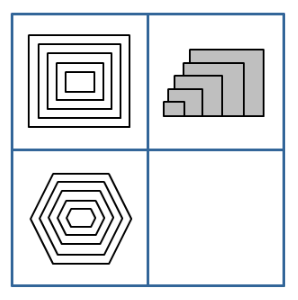
Choose the picture that belongs with the bottom picture in the same way the pictures on top belong together.
Correct!
Wrong
Wrong
Wrong
Wrong
The correct answer is A.
Let's break this down step by step
The top-left image shows a series of concentric squares, all centered, drawn as outlines and unfilled (white interior).
The top-right image shows several square shapes of the same outline as the top-left, but they are no longer concentric and centered. Instead they are repeated, each slightly translated to the right and stacked behind one another to create a layered staircase effect. The stacked shapes are filled with gray.
Moving from left to right in the top row: the single set of centered, concentric outlines is converted into multiple copies of the same basic shape, arranged in a rightward-staggered stack (offset copies), and the copies are filled gray. In short: concentric centered outlines -> multiple offset stacked shapes + fill change to gray.
The bottom-left figure shows concentric hexagons, centered and outlined (white interior), which is directly analogous to the top-left (concentric squares).
According to the rule from Step 2, we must produce multiple copies of this hexagon shape, offset to the right in a stacked arrangement, and filled gray.
Choice A shows hexagon shapes copied, offset to the right in a stacked arrangement, and filled gray. That matches the required transformation exactly.
Therefore choice A is the match.
A cognitive abilities assessment used by international and UK-curriculum homeschool families to inform academic planning and identify learning strengths.
Prep packs available for CAT4 Levels X–G (ages 6–17).
Choose the word that belongs in the same group as the first three words.
Author Scribe Poet
Correct!
Wrong
Wrong
Wrong
Wrong
The correct answer is A (Journalist).
Let's Break This Down Step by Step
Let's look closely at our three given words: author, scribe, and poet. What connects all of these together? Think about what each of these people does. An author writes books, a scribe writes down information or copies texts, and a poet writes poems. The common thread here is that all three of these professions involve writing as their primary activity. They're all jobs where writing is at the very heart of what they do!
Now that we've identified the pattern, we need to find another profession that fits this same category. We're searching for a job where writing is the main focus of the work, just like it is for an author, scribe, and poet.
Let's examine each option to see which one belongs in our writing-based group:
A. Journalist - This is an excellent fit! A journalist's main job is to write articles, reports, and news stories. Writing is the core of what journalists do every single day. This profession absolutely belongs with author, scribe, and poet.
B. Actor - While actors might read scripts and sometimes help develop dialogue, their primary job is performing and acting, not writing. Acting is about bringing words to life through performance rather than creating or writing them down.
C. Doctor - Doctors do write prescriptions and medical notes, but writing isn't their main purpose. Their primary job is diagnosing illnesses and treating patients. The writing they do is just a small part of their medical work.
D. Architect - Architects do draw plans and write specifications, but their main focus is designing buildings and structures. The creative work is more about spatial design and engineering than it is about writing.
E. Mechanic - Mechanics work with their hands to repair vehicles and machinery. While they might write up repair reports, their primary skill is fixing things mechanically, not writing.
Journalist is the perfect choice because it shares the same essential characteristic as author, scribe, and poet. All four of these professions center around writing as their fundamental activity. A journalist writes to inform people about news and events, just as an author writes to tell stories, a scribe writes to record information, and a poet writes to express ideas and emotions. They all belong to the same group of writing-based professions!
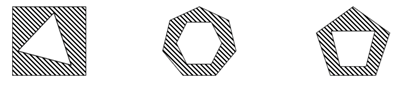
Choose the option that fits together with the three given images.
Wrong
Wrong
Wrong
Wrong
Correct!
The correct answer is E.
Let's Break This Down Step by Step
First, let's look carefully at what all three figures at the top have in common. Each one shows two shapes: an outer shape that is filled with diagonal line patterns, and an inner shape that is plain white. This combination of a patterned outer shape and a plain inner shape is something we need to find in our answer choices.
Now, let's count the number of sides on both the outer and inner shapes in each of the three figures. In the first figure, the outer shape is a square with 4 sides, and the inner shape is a triangle with 3 sides. In the second figure, the outer shape is a hexagon with 6 sides, and the inner shape is a pentagon with 5 sides. In the third figure, the outer shape is a pentagon with 5 sides, and the inner shape is a square with 4 sides. Do you notice a pattern here?
Great job if you spotted it! In every single figure, the inner shape has exactly one fewer side than the outer shape. The square has 4 sides and the triangle has 3, the hexagon has 6 sides and the pentagon has 5, and the pentagon has 5 sides and the square has 4. This is the key rule that connects all three figures together.
Option A shows a plain outer rectangle with a patterned inner pentagon. This doesn't match our pattern because the outer shape should be patterned and the inner shape should be plain, not the other way around. So option A doesn't fit.
Option B shows a patterned outer square with a plain inner triangle. The arrangement looks right, but let's count the sides. The square has 4 sides and the triangle has 3 sides, so the inner shape does have one fewer side. Wait, that seems correct! However, looking more closely, the inner shape in option B is actually a quadrilateral (4 sides), not a triangle. Since both shapes have the same number of sides, this breaks our rule. Option B doesn't work.
Option C shows a patterned outer triangle with a plain inner parallelogram. Let's count: the triangle has 3 sides and the parallelogram has 4 sides. This means the inner shape has more sides than the outer shape, which is the opposite of what we need. Option C doesn't follow the pattern.
Option D shows a plain outer hexagon with a patterned inner pentagon. Just like option A, this has the pattern reversed with the inner shape being patterned instead of the outer shape. This doesn't match our rule, so option D is not correct.
Option E shows a patterned outer hexagon with a plain inner pentagon. The outer shape is patterned with diagonal lines and the inner shape is plain white, which matches perfectly! Now let's count the sides: the hexagon has 6 sides and the pentagon has 5 sides, so the inner shape has exactly one fewer side than the outer shape. Option E follows both rules beautifully and is exactly like the three figures at the top, making it the correct answer!
This membership gives homeschool parents the tools to prepare children for these exams while also building long-term academic skills needed for middle school, high school, and beyond.
Homeschool parents want more than test prep. They want real learning, strong foundations, and tools that support academic growth beyond a single exam. This membership delivers all three. Unlike individual Prep Packs, this membership allows families to prepare for multiple tests, across grades, under one account.
Each PrepPack is built by experienced educators and includes guided practice that shows students exactly what to work on next.
Lessons are broken into small, focused sections so learning stays productive, not overwhelming.
Parents see strengths, gaps, and growth clearly, making it easier to adjust instruction.
Students can repeat quizzes, drills, and full test simulations as often as needed to build confidence and mastery.
Many of us grew up dreading standardized tests. They felt stressful, intimidating, and disconnected from real learning. But in homeschooling, testing serves a completely different purpose, and experienced homeschool parents consistently find it to be one of their most valuable tools.
Homeschooling is about meeting children where they are and letting them learn at their natural pace, not forcing them into rigid grade-level boxes.
Parents use testing to:
Testing is not about comparison. It is about understanding your child's learning journey.
One of the biggest questions homeschool parents ask is, "Am I doing enough?"
Standardized testing answers that question objectively by:
Test results help parents:
Example: One mom saw her son's reading scores were low, focused on reading for a year, and he jumped to above grade level. Another saw her daughter excel in language and reading but struggle in math, allowing her to tailor instruction instead of guessing.
Testing turns uncertainty into clear action.
Seeing results that show:
…is incredibly motivating for students. Parents report that their children experience boosts in self-esteem when they see their progress and realize, "Yes, I am learning, and I am doing well."
Homeschool testing does not have to be rigid or overwhelming. Families choose:
Testing happens at the kitchen table, not in a crowded classroom, reducing anxiety and increasing accuracy.
Different families choose different tests based on what they value most:
There is no single "best" test. There is only the best test for your homeschool.
Standardized testing provides:
Even in states where testing is not required, many families test annually because these records are so valuable.
Parents emphasize that:
The real value is not the number. It is the trend over time.
Many parents feel intimidated at first. Then they do it once and realize:
Standardized testing familiarizes students with:
Regular practice with standardized tests removes the mystery and anxiety, so when students face high-stakes exams for college admissions or advanced placement, they're already comfortable with the format and expectations. This preparation is especially valuable for homeschooled students who may have limited exposure to traditional testing environments.
Standardized testing in homeschooling is not about fear, failure, or forcing children into boxes. It is about progress, planning, confidence, peace of mind, and proof that homeschooling works.
This membership gives homeschool parents the tools to prepare children for these exams while also building long-term academic skills needed for middle school, high school, and beyond.
Many homeschool students take standardized tests such as:
More tests used for K-12 or general academic progress/placement and academic & school-level assessments include:
You can create up to three learner profiles, each with:
Whether one child is working on reading comprehension and another is building math fluency, each receives a personalized learning path that fits your homeschool goals.
Everything stays organized in one place, making test prep simple, structured, and stress-free.
You can begin in just a few minutes:
Create your Homeschool Family Membership
Add the PrepPacks you want
Start practicing with your children at home, at their pace
One of the greatest strengths of this membership is that skills transfer across subjects and tests:
Reasoning skills built through CogAT and CAT4 practice strengthen performance on gifted and admissions exams.
Math practice from MAP, STAR, and i-Ready builds core curriculum skills used across grade levels.
Reading and vocabulary development improve naturally when students rotate between MAP, i-Ready, and STAR reading materials.
This layered approach allows homeschool parents to reinforce skills from multiple angles, leading to faster progress and stronger academic confidence.
Whenever you need guidance, our team of experts and customer-support specialists are available to help you choose the right PrepPacks for your child.
Instead of purchasing individual programs, you receive unlimited access to hundreds of learning resources for one yearly price. Families with two, three, or four children often save hundreds of dollars per year.
Additional benefits homeschool parents love:
This membership gives homeschool families the flexibility to fill gaps, strengthen foundations, and extend learning without buying additional materials.
Since 1992, TestPrep-Online has supported families preparing students for gifted programs, admissions exams, and school benchmarks.
Our mission remains the same: To help students grow as learners and help parents feel confident guiding them.
Homeschool families trust our materials because they are:
Many parents report not only improved test scores, but calmer, more confident learners.
It is a comprehensive online learning and test prep solution that supports up to four children under one yearly membership. Each child gets their own dashboard with access to practice tests, simulations, quizzes, and targeted learning activities.
Once you purchase your PrepPack, you will receive a confirmation email with a temporary password that you can use to log in to your account. After that, you will have complete access to all of the practice materials.
Yes. One of the biggest benefits is flexibility. You can work across grade levels to reteach concepts or offer advanced challenges as your child progresses.
The membership includes PrepPacks for MAP, CogAT, CAT4, STAR, iReady, state assessments, admissions exams, and many other academic benchmarks commonly used by homeschool families.
Each PrepPack may include full-length practice tests, quizzes, drills, step-by-step explanations, study guides, videos, and interactive activities developed by experienced educators.
Yes. All practice tests, quizzes, and drills can be taken unlimited times, allowing students to learn from mistakes, improve accuracy, and reduce test anxiety.
You can start immediately. Create your membership, select your PrepPacks, and begin practicing the same day.
Absolutely. The skills developed through this program support long-term academic success, including reading comprehension, math reasoning, test-taking strategies, and independent learning habits.
Families with two or three children preparing for multiple tests often save hundreds of dollars compared to purchasing separate programs.
The Homeschool Membership Plan gives you everything you need to support learning, build confidence, and prepare your children for academic success, all in one place.
Money back guarantee
Since 1992, TestPrep-Online has helped individuals prepare for all kinds of tests. From entrance exams into gifted programs, to assessment tests, and graduate assessment and placement tests, TestPrep-Online can help you prepare and pass.