Cambridge Select Insight Practice Tests (CEM Select)
The CEM Select test, officially renamed Cambridge Select Insight in 2025, is a one-hour, computer-based entrance assessment used by selective independent schools, grammar schools and some partly selective state schools across the UK. It measures verbal, numerical and non-verbal ability across separately timed sections. Its defining challenge is not difficulty but speed: children are given roughly 15 to 25 seconds per question and are not expected to finish every section.
Our CEM Select practice pack gives your child two full-length simulations of 160 questions each, built to mirror the real assessment's timing and the on-screen question formats children will meet on test day.
CEM Select Test
Two full-length timed tests featuring questions on the following topics:
- Reading Comprehension
- Missing Words
- Anagrams
- Related Words
- Shuffled Sentences
- General Mathematics
- Non Verbal / Pictures
- Arithmetic
- Data Problems


What's Included in Our Cambridge Select Insight PrepPack
- 320 Cambridge Select Insight style questions across 2 mock tests
- Real exam timing for each section as in Cambridge Select Insight
- Computer-based practice, on-screen experience as test day
- Verbal ability questions including Reading Comprehension, Missing Words, Shuffled Sentences, Anagrams, Related Words
- Numerical ability questions including Arithmetic, General Mathematics, Data Problems
- Non-verbal ability problems including Pictures (figure matrices)
- Detailed answer explanations for every question
- Score report by section after each test
- Access: 3 months (Essential) or 6 months (Extended)
- Dedicated customer support: Our team is available to answer questions about the test and our preparation materials. You can contact us here.

See What's Inside the PrepPack™

Cambridge Select Insight (CEM Select) at a Glance

What Is the Cambridge Select Insight Test?
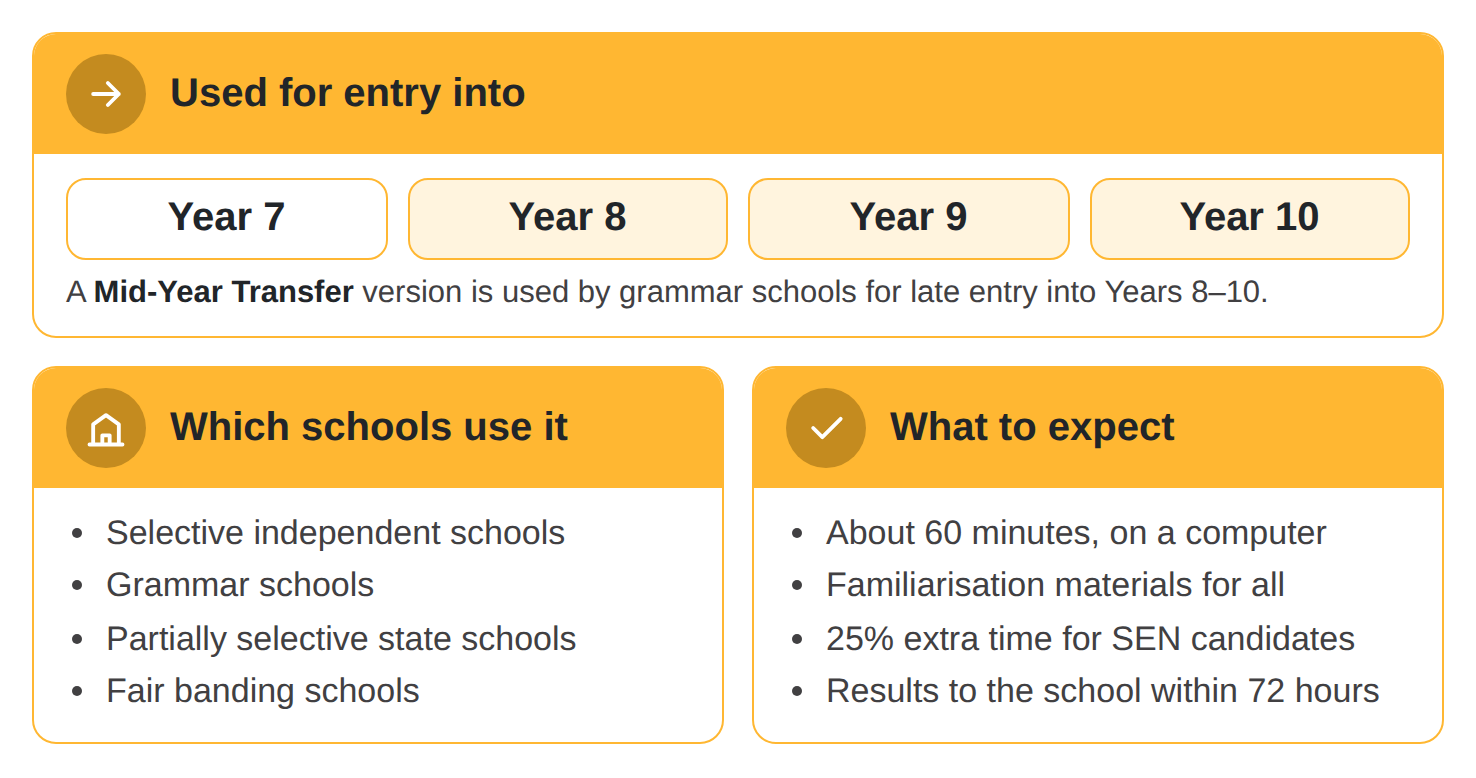
CEM Select is an admissions test that helps schools compare applicants fairly. It assesses verbal, non-verbal and maths skills, the foundations of further learning. The focus is on how well a child understands and applies these skills, not on how much they have memorised, which gives every child the chance to show their academic potential. Children take the test on a computer, following on-screen instructions.
Is CEM Select the Same as Cambridge Select Insight?
Yes, they are the same assessment. The test was created by the Centre for Evaluation and Monitoring (CEM) at Durham University. In 2019 CEM joined Cambridge University Press & Assessment, and in 2025 Cambridge renamed its assessments, so CEM Select became Cambridge Select Insight.
For parents this raises one practical question: is older material still valid? It is. The rebrand changed the name and the administering organisation, not the format, the skills assessed or the question styles. Preparation built around CEM Select remains entirely appropriate for Cambridge Select Insight.
Who Sits Cambridge Select Insight, and When?
Most children who take Cambridge Select Insight are in Year 6 and applying for a Year 7 place, but the test can also be used for places in Years 8 to 10. It is not only used by independent schools: grammar schools, some state schools with partly selective admissions and schools that use fair banding rely on it too. Each school decides when and where its candidates sit the test, so the school's own admissions page is the best place to confirm the details.
Why Time Pressure Is the Real Test
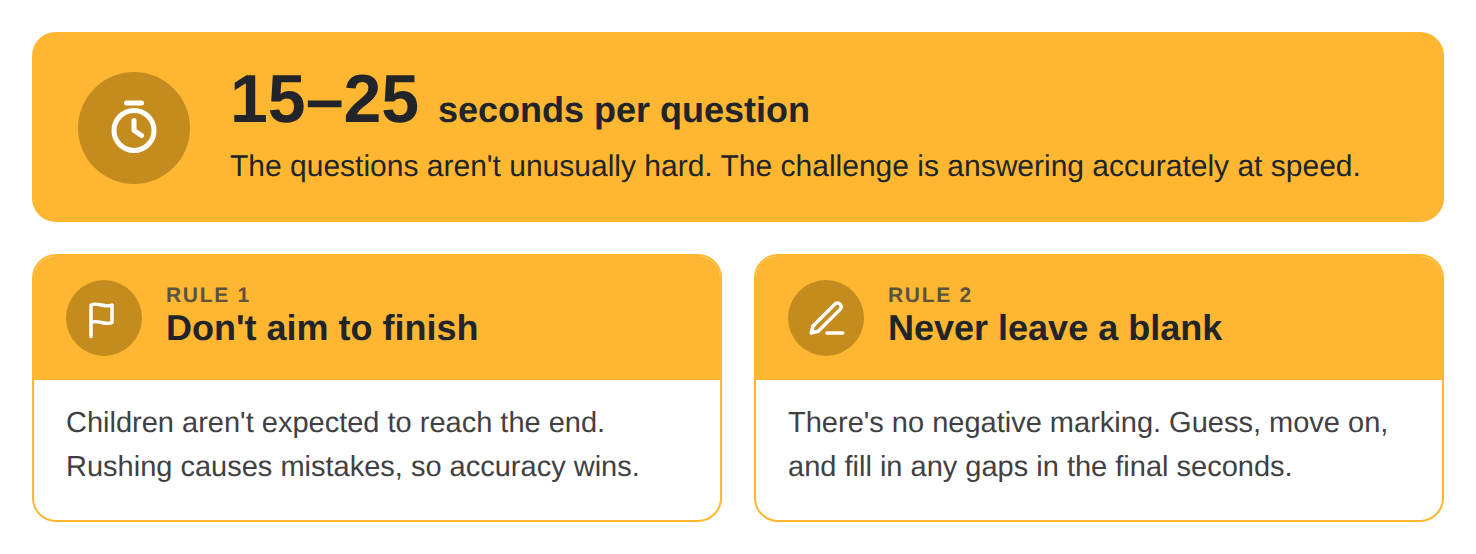
Taken one at a time, Cambridge Select Insight questions are not unusually hard. Most sit comfortably within the Key Stage 2 curriculum. The difficulty comes entirely from volume against the clock, and the test is designed that way: it separates candidates by how quickly and accurately they work, not by how much they know.
This has two practical consequences for your child: they are not expected to finish every section, and because there is no negative marking, they should never leave a question blank.

Cambridge Select Insight Question Types Explained
The assessment draws from a pool of question styles across three skill areas. Not every style appears in every sitting, so preparation should cover the full range rather than a favourite few.

How Is Cambridge Select Insight Scored? And Is there a Pass Mark?
There is no published national pass mark for Cambridge Select Insight, and no school publishes its own threshold. Each school sets its own standard, and that standard moves every year depending on how many places are available and how strong the applicant field is. Any specific figure you find quoted online is an estimate, not official data.
What is known about how the test is scored:
- Scores are age-standardised. A child's raw score is adjusted for their age in years and months at the time of testing, so a September-born child is not advantaged over a July-born one in the same year group.
- There is no negative marking. Wrong answers are not penalised, so guessing is always better than leaving a blank.
- The test is not adaptive. Unlike the ISEB Pre-Test, questions do not get harder or easier in response to your child's answers. Everyone sees the same questions in the same order.
- Results reach schools in about 72 hours and are not released to parents. You will not see a score, only the school's decision.
- The score is one input among several. Most schools weigh it alongside a school report, an interview and sometimes written papers, so it is rarely decisive on its own.
The practical implication is that there is no target number to aim at. The goal is to score as highly as your child comfortably can, which in a test built around speed means working accurately at pace rather than mastering harder content.

How to Prepare for Cambridge Select Insight
Cambridge states that the assessment is designed to be taken without coaching, and it's true that there is no syllabus to revise. But familiarity with the format, the interface and above all the pace is a genuine advantage. The most effective preparation combines six habits: practising on a computer, training pace, reading widely, building mental arithmetic, learning to guess smartly and taking full-length timed mock tests.
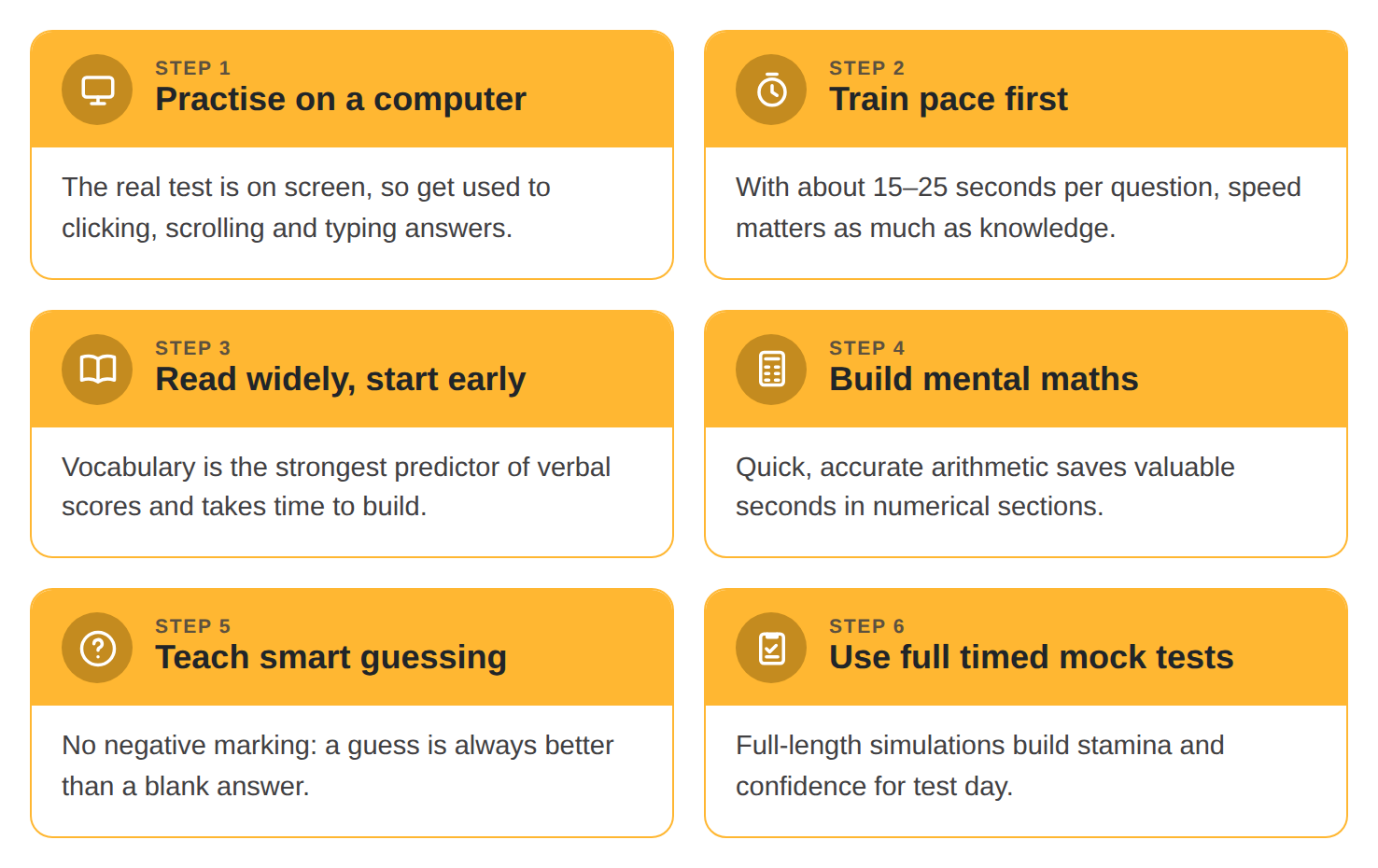

Figure Matrices Enrichment Pack
Need more Figure Matrices practice? Add our Figure Matrices Enrichment Pack at checkout. It includes 9 focused drills spanning elementary, intermediate, and advanced difficulty levels, with over 200 additional questions and detailed answer explanations.
The pack contains:
43 Elementary–Intermediate questions
45 Intermediate–Advanced questions
115 Extended Practice questions
Students can strengthen pattern recognition, visual logic, and matrix-solving skills through targeted, structured practice designed to build confidence and accuracy.
Best for: Students who want extensive Figure Matrices practice and targeted nonverbal reasoning training.
Duration: 6-month access.

Cambridge Select Insight: Frequently Asked Questions
Yes. CEM Select was renamed Cambridge Select Insight in April 2025 when the assessment moved to Cambridge University Press & Assessment. The format, skills tested and question styles are unchanged, so materials labelled CEM Select remain entirely relevant.
Approximately 60 minutes in total, divided into five or six separately timed sections. Each section has its own countdown, and once it expires the screen advances automatically and that section cannot be revisited.
No. Unlike the ISEB Pre-Test, CEM Select is not adaptive. Every child sees the same questions in the same order, and questions do not change difficulty in response to answers.
There is no syllabus to revise, and the assessment is designed to limit the advantage of coaching. But familiarity helps: knowing the section structure, the question types, and having experienced the pace all remove avoidable disadvantages on the day.
There is no published pass mark. Scores are age-standardised and each school sets its own threshold, which changes year to year with the number of places available and the strength of the applicant field. Any specific percentage quoted online is an estimate rather than official data.
That is expected. The sections are designed so that most children do not complete them, and finishing is not the goal. Working accurately through as many questions as possible scores better than rushing to the end. Because there is no negative marking, any remaining questions should be guessed rather than left blank.


