MAP 테스트 연습: 자녀의 학업 성공을 높이세요
MAP Growth 시험은 적응형·개인화 시험으로, 실시간으로 자녀의 답변에 맞춰 난이도가 조정되어 실제 학업 성장을 측정합니다.
MAP 유형의 자료를 개발하고 학생들이 효과적으로 대비하도록 돕는 경험을 여러 해 쌓아오면서, 시험에서 성공하기 위해 무엇이 정말로 중요한지 잘 알고 있습니다. 저는 MAP Growth 전문 강사인 아리아브 슐레징어(Ariav Schlesinger)입니다.
자녀가 MAP Growth 시험을 효과적으로 준비하도록 돕고 계시다면, 이 페이지가 완벽한 출발점이 될 것입니다. 여기에서 다음 내용을 확인하실 수 있습니다:
- 시험에 익숙해질 수 있도록 상세한 설명과 전략이 포함된 샘플 문항
- 시험 형식, 시간, 그리고 측정되는 능력에 대한 종합적 정보
- 점수 안내 및 교사들이 이를 통해 학생의 성장을 어떻게 지원하는지에 대한 설명
- 부모님이 자녀의 MAP Growth 준비를 지도하는 데 도움이 되는 실용적인 팁과 FAQ
아래 학년을 클릭하여 자녀의 학년 수준에 맞춘 무료 MAP Growth 스타일 문항을 확인해 보세요
Kindergarten | Grade 1 | Grade 2 | Grade 3 | Grade 4 | Grade 5 | Grade 6 | Grade 7 | Grade 8 | Grade 9 | Grade 10 | Grade 11 | Grade 12
Page Content
아래의 페이지 내용을 열어 MAP 시험에 대해 알아야 할 모든 정보를 확인해 보세요. 이 페이지에는 기본 정보와 함께 시작하는 데 도움이 되는 샘플 문항도 제공됩니다.
무료 MAP Growth 샘플 문항
이 MAP Growth 스타일 예시는 학생들이 시험에서 접하게 될 수 있는 읽기, 수학, 그리고 언어 사용 문항의 유형을 보여줍니다. 유치원(K)과 1학년의 경우 언어 사용 능력은 별도 영역으로 평가되지 않지만, 초기 언어 능력을 측정하는 샘플 문항을 포함하여 어린 학습자들이 요구되는 사고 방식을 익숙하게 하는 데 도움을 줍니다. 각 학년별로 무료 샘플 문항 세 문제가 제공되며, 추가 문항은 전용 학년별 연습 페이지에서 확인할 수 있습니다.
유치원 무료 MAP 시험 샘플 문항
MAP Kindergarten Math
00:00
00:00
Which of the following addition exercises has the same result as 8+7?
Wrong
Wrong
Correct!
Wrong
Let's Break This Down Step by Step
This question can be solved without any calculation, only by understanding an important concept: the commutative property of addition.
In this question, we are asked to find out which addition exercise gives the same result as 8 + 7. That means we need to first solve 8 + 7, and then look through the answer choices to see which one matches.
According to the commutative property of addition rule, when you add two numbers, you can switch their order and the sum will stay the same.
In symbols:
a + b = b + a
Since 8 + 7 = 15, switching the order to 7 + 8 will also equal 15.
Answer (A) is incorrect because 9 + 5 = 14 not 15
Answer (B) is incorrect because 8 + 8 = 16 not 15
Answer (C) is correct because 7 + 8 and 8 + 7 both equal 15.
Answer (D) is incorrect because 7 + 9 = 16 not 15
MAP Kindergarten Reading
00:00
00:00
Look at the picture of Sarah and her friends.
Which one of them is Sarah?
Wrong
Wrong
Correct!
Wrong
Let's Break This Down Step by Step
The question asks: “Which one of them is Sarah?”
To answer, we need to listen carefully to the story and match the description to the correct picture.
The story tells us that Sarah:
- Woke up in the morning and got dressed for school.
- She wore a purple shirt and a blue skirt. ← This is the most important clue!
Answer (A) is incorrect because the girl in this picture is wearing a yellow shirt and an orange skirt.
Answer (B) is incorrect because the girl in this picture is wearing a pink shirt and a pink skirt.
Answer (C) is correct because this is the only picture that presents a girl wearing a purple shirt and a blue skirt, just like the story tells.
Answer (D) is incorrect because the character in this picture is wearing a green shirt and green pants.
MAP Kindergarten Language Usage
00:00
00:00
Read the following sentence and answer the question below:
What is your teachers's name
What sign should come after the end of the sentence?
Wrong
Wrong
Wrong
Correct!
Let's Break This Down Step by Step
“What is the name of your teacher”
The sentence begins with the word “What”, which is a question word. It is asking for information (the teacher’s name), not giving information.
- A question sentence always ends with a question mark (?).
- A statement ends with a period (.), but this is not a statement.
- An exclamation mark (!) shows strong feelings or excitement, which is not the case here.
- A comma (,) is used inside a sentence to separate ideas, not at the very end.
Since this is a question, the correct punctuation mark is (?) and the correct answer is (D).
1학년 무료 MAP 시험 샘플 문항
MAP Grade 1 Math
00:00
00:00
The teacher asked the students in her class what their favorite animal was. Their answers are shown in the following picture graph:
How many students are in the class?
Wrong
Correct!
Wrong
Wrong
The correct answer is B.
Let's Break This Down Step by Step
The directions tell us: each picture = one student. That means every cat picture counts as 1 student, every dog picture counts as 1 student, and so on.
Cats: 3 pictures → 3 students chose cat.
Dogs: 4 pictures → 4 students chose dog.
Rabbits: 1 picture → 1 student chose rabbit.
Horses: 1 picture → 1 student chose horse.
3 (cats) + 4 (dogs) + 1 (rabbits) + 1 (horses) = 9.
Step 4: Match the total to the answer choices.
The total 9 corresponds to choice B.
Select the correct answer and say the answer (B) is correct.
Answer (A) is incorrect because 10 does not match the total number of pictures. The pictures add to 9, not 10.
Answer (C) is incorrect because 4 is only the number of students who chose dogs, not the total class size.
Answer (D) is incorrect because 20 is much larger than the actual total of pictures; there are only 9 pictures.
Listen to the word "possible":
00:00
00:00
Addindg "im" to the beginning of the word "possible" changes the meaning of the word.
What is the new meaning?
Correct!
Wrong
Wrong
Wrong
Let's Break This Down Step by Step
The question asks us to take the word possible and then add the prefix “im–” at the beginning. When we add letters to the beginning of a word, that group of letters is called a prefix. Prefixes change the meaning of the original word.
The prefix “im” means “not.” So, whenever we see “im” at the beginning of a word, it usually gives the word an opposite or negative meaning.
The original word is “possible”, which means that something can be done.
When we add “im,” it becomes “impossible,” which means “not possible.”
Answer (A) is correct because “impossible” means “not possible.” This follows the rule of the prefix “im–,” which changes a word to mean its opposite.
Answer (B), “Very possible,” is incorrect because the prefix “im” doesn’t mean “very.”
Answer (C), “Might be possible,” is incorrect because the prefix “im” doesn’t mean “might.”
Answer (D), “More possible,” is incorrect because the prefix “im” doesn’t mean “more.”
Teacher Tip: When you see a prefix, stop and ask yourself: What does this prefix mean? Learning a few common prefixes (like im- = not, pre- = before, re- = again) will help you figure out the meaning of many new words.
MAP Grade 1 Language Usage
00:00
00:00
Listen to the following text:
China is a country in East Asia.
It has 14 neighboring countries.
It is the country with the largest number of people in the world.
It is a very interesting country.
Which sentence in the text is an opinion?
Wrong
Correct!
Wrong
Wrong
The correct answer is B.
Let's Break This Down Step by Step
A factual sentence states something that can be checked with evidence or reliable sources.
An opinion expresses a personal feeling, belief, or judgment and cannot be proven right or wrong.
“China is a country in East Asia.” — you can check a map or geography source. This is provable, so it is a fact.
“It has 14 neighboring countries.” — you can count the countries that share a land border with China. This is provable, so it is a fact.
“It is the country with the largest number of people in the world.” — you can check population statistics. This is provable, so it is a fact.
“It is a very interesting country.” — this expresses a judgment. Different people could disagree. You cannot prove it true or false, so this is an opinion.
Therefore select the option that matches that sentence.
The answer (B) is correct. The sentence “It is a very interesting country” cannot be proven true or false.
Different people may agree or disagree based on their own feelings. One person may find China interesting, while another might not. Since it depends on personal thoughts, it is an opinion.
Why the other options are incorrect
Answer (A) is incorrect because the statement “It is the country with the largest number of people in the world” can be checked using population data, so it is a fact.
Answer (C) is incorrect because “China is a country in East Asia” can be verified on a map or in geography sources, so it is a fact.
Answer (D) is incorrect because “It has 14 neighboring countries” can be verified by counting the countries that share a land border with China, so it is a fact.
2학년 무료 MAP 시험 샘플 문항
MAP Grade 2 Math
A marathon runner ran for six hours. Select all the measurements that are equal to six hours.
Wrong
Correct!
Correct!
Wrong
Correct!
Wrong
Let's Break This Down Step by Step
In this question you are asked to find which of the answer choices are equal to 6 hours.
This means you need to convert hours → minutes and hours → seconds.
Let’s first think about how many minutes are in one hour. You probably know that one hour always has 60 minutes. Now, if the runner ran for 6 hours, that means we need to multiply 60 by 6.
6 × 60 = 360 minutes
So now we know that 6 hours equals 360 minutes.
Each minute has 60 seconds in it. Since we just found that 6 hours is 360 minutes, we now need to see how many seconds are in 360 minutes. That means we need to multiple 360 by 60.
Since we are dealing with big numbers, here’s a little trick to make it easier:
Instead of multiplying 360 by 60 all at once, think of 60 as “6 × 10.”
- First multiply 360 × 6. If you follow this step, you get 2,160.
- Then, because there is still that extra 10 left in 60, you add a zero to the end of the number, which gives you 21,600.
So, 360 × 60 = 21,600 seconds.
Answer (A) is incorrect because 21,000 seconds is less than the 21,600 seconds in six hours.
Answer (B) is correct because 21,600 seconds equals six hours:
6 × 60 minutes × 60 seconds = 21,600 seconds
Answer (C) is incorrect because 10,300 seconds is far less than six hours; it’s less than three hours.
Answer (D) is incorrect because 300 minutes is only five hours, not six.
Answer (E) is correct because 360 minutes equals six hours:
6 × 60 = 360 minutes
Answer (F) is incorrect because 180 minutes is only three hours, not six.
Teacher Tip: When you face a problem like this, don’t panic about all the numbers. Just remember:
- Hours → minutes: multiply by 60.
- Minutes → seconds: multiply by 60 again.
Taking it step by step makes big numbers feel much easier.
MAP Grade 2 Reading
Read the passage:
Today was a wonderful day. In the morning, all the kids in our school went to help out in the community. One class went to help tidy up the town library, another class went to plant flowers in a public garden, and my class went to help serve lunch in a home for the elderly. When we got back to school, the principle spoke to us and said it's great that we can be a meaningful part of society from an early age.
After school, I went to my friend Jenna's place. She's our neighbor. Her big brother made pizzas for us, and we ate them in a tent they put up in the living room. It was such a fun day.
Which of the following statements is true?
Wrong
Wrong
Correct!
Wrong
Let's Break This Down Step by Step
The narrator is the person using the word “I” in the passage. That means we need to pay attention to what this person’s class actually did.
The text says: “my class went to help serve lunch in a home for the elderly.”
This tells us directly what the narrator’s class did.
Answer (C) says: “The narrator’s class served food to the elderly.”
This matches exactly with what we underlined in the passage → ✔ Correct.
Answer (A),“All of the kids in the school cleaned the library,” is incorrect because only one class went to the library. Other classes planted flowers or served food. Not everyone did the same job.
Answer (B), “The narrator of the story planted flowers” is incorrect because the narrator clearly said another class planted flowers.
Answer (C) is correct because the narrator (the person telling the story) says in the third sentence, “...my class went to help serve lunch in a home for the elderly” .
Answer (D), “Jenna made pizza after helping out in the community,” is incorrect because Jenna did not make the pizza. The passage says “Her big brother made pizzas for us.” Also, the story never says Jenna helped in the community.
MAP Grade 2 Language Usage
Which of the following sentences is grammatically correct?
Wrong
Wrong
Correct!
Wrong
Let's Break This Down Step by Step
All of the answer choices begin with the word “there.” In grammar, there is often used as a pronoun to introduce something. After there, we usually see a helping verb such as is, are, was, or have. That helping verb must agree with the subject that comes later in the sentence.
- If the subject is singular, the helping verb must also be singular.
- If the subject is plural, the helping verb must also be plural.
Answer (A) is incorrect because the subject “several new houses” is plural, so the verb should be “are,” not “is.” The correct sentence would be: “There are several new houses in my neighborhood.”
Answer (B) is incorrect because “many competitors” is plural, so the verb should be “have,” not “has.” The correct sentence would be: “There have not been many competitors in the last competition.”
Answer (C) is correct because the subject “a problem” is singular, and the verb “was” correctly matches it. The sentence “There was a problem with my new computer” is grammatically correct.
Answer (D) is incorrect because the subject “a new student” is singular, so the verb should be “is,” not “are.” The correct sentence would be: “There is a new student from Argentina in my class.”
Teacher Tip: When checking a sentence that begins with “there,” always find the subject (the noun after the verb). Then make sure the verb matches that subject, not the word “there.”
무료 MAP 시험 3학년 예시 문제
MAP Grade 3 Math
The diagram shows the top, front, and side views of a solid.
Wrong
Correct!
Wrong
Wrong
Wrong
Let's Break This Down Step by Step
- The top view shows what the shape looks like if you look straight down from above.
- The front view shows what it looks like from the front.
- The side view shows what it looks like from the side.
These are 2D “pictures” of the same 3D object.
The side view shows one column of three cubes stacked on top of each other.
This means the solid is only one cube deep.
Eliminate (A) and (E), because those solids are more than one cube deep.
The top view shows four cubes in a straight row.
This means that when looking from above, the cubes must all fit in a single line.
Eliminate (D), because you can see two rows of cubes from above.
The front view shows three cubes tall on the left, two cubes tall in the middle, and one cube tall on the right.
When you compare this to the answer choices, only (B) matches exactly.
The correct solid is (B) because it is one cube deep, four cubes across from above, and its front view matches perfectly.
Teacher Tip: When solving these problems, always use the side view first to check the depth. That usually helps you eliminate several wrong answers quickly.
MAP Grade 3 Reading
Read the paragraph.
Did you know that black tea and green tea come from the same plant? The only difference between them is the way the tea leaves are processed. Green tea is made from leaves that are dried soon after they are picked. This helps them keep their green color and delicate, fresh flavor. Black tea is made by crushing the tea leaves before they are dried, which helps them develop their dark color and _________ flavor.
The paragraph has a missing word.
Which word will best express the idea that black tea has a lot of flavor?
Wrong
Correct!
Wrong
Wrong
Let's Break This Down Step by Step
The question says black tea has “a lot of flavor.” That means we need a word that shows strong or powerful taste.
Green tea keeps a “delicate, fresh flavor.” Delicate means light/soft. The sentence about black tea says it gets a dark color and ______ flavor. So we expect the opposite of delicate which is a strong flavor.
Say the sentence out loud with each option: Answer (A), "gentle", expresses the idea of little flavor rather than a lot of flavor. Therefore, “…develop their dark color and gentle flavor” is incorrect.
Answer (B), "strong," expresses the ides of a lot of flavor. Therefore, “…develop their dark color and strong flavor” is correct.
Answer (C), "delicious", expresses the idea of a good flavor. Therefore, “…develop their dark color and delicious flavor” is incorrect.
Answer (D),"special," expresses the idea of a different flavor. Therefore, “…develop their dark color and special flavor” is incorrect.
MAP Grade 3 Language Usage
Which of the sentence is written in future tense?
Wrong
Wrong
Wrong
Correct!
Let's Break This Down Step by Step
1 liter = 1,000 milliliters
Because liters are bigger than milliliters, moving from milliliters to liters should make the number smaller.
So we divide by 1,000 (not multiply):
365 ÷ 1,000 = ? Liters
- 10 moves the decimal 1 place left
- 100 moves it 2 places left
- 1,000 moves it 3 places left
Let’s write 365 as 365.0, so we can clearly see the decimal. Now let's move the decimal three places left:
- Move one place: 36.50
- Move two places: 3.650
- Move three places: 0.365
So, 365 milliliters = 0.365 liters.
Answer (A) 365,000 is incorrect because this is what we would get in milliliters for 365 liters it is much too big. That would mean we multiplied instead of divided.
Answer (B) 3,650 is incorrect because this is what we would get in milliliters for 365 liters
Answer (C) 3.65 is incorrect because it is still too big.
3.65 L = 3,650 mL, which is ten times bigger than 365 milliliters.
Answer D (0.365) is correct.
365 milliliters is 0.365 liters.
One liter = 1,000 milliliters, so since 365 < 1,000, it must be less than 1 liter.
연습에서 성과로
우리는 실제 시험 환경, 난이도, 그리고 점수 정확도와 동일한 전체 길이의 MAP 모의고사로 여러분이 진정한 성장과 결과를 얻도록 준비시켜 드립니다.
 다운로드하다 MAP Test Prep Guide PDF.
무료 MAP 시험 4학년 예시 문제
MAP Grade 4 Math
In his science lesson, Jong measured out 365 millimeters of ethanol into a beaker for an experiment.
How much is this in liters?
Wrong
Wrong
Wrong
Correct!
Let's Break This Down Step by Step
Think about the metric system: it’s very organized. We know that 1 liter is the same as 1,000 milliliters. That means liters are the bigger unit, and milliliters are the smaller unit. If you have a certain number of milliliters and you want to know how many liters that is, you need to make the number smaller, because you’re moving to a larger unit.
We are starting with 365 milliliters. To change this into liters, we divide by 1,000, because there are 1,000 milliliters in every liter. So the problem becomes:
365÷1,000365 \div 1,000365÷1,000
Dividing by 10 once moves the decimal point one place to the left. Dividing by 100 moves it two places. Dividing by 1,000 moves it three places to the left.
Let’s write 365 as 365.0, so we can clearly see the decimal. Now we move the decimal three places left:
- Move one place: 36.50
- Move two places: 3.650
- Move three places: 0.365
So, 365 milliliters = 0.365 liters.
Answer (A) is incorrect because 365,000 is much too big. That would mean we multiplied instead of divided.
Answer (B) is incorrect because 3,650 is also too big.
Answer (C) is incorrect because 3.65 is still too big; that would mean 3,650 milliliters.
Answer (D) is correct: 0.365 is exactly what we found.
Teacher Tip: A quick way to check yourself is to think: “Am I converting to a bigger unit or a smaller unit?” If you’re converting to a bigger unit (like liters), the number should get smaller. If your number got larger, you probably went the wrong way.
MAP Grade 4 Reading
Passage 1
Corn is a type of plant. Corn was first domesticated by native peoples in Mexico about 10,000 years ago. Since the introduction of corn into Europe by Christopher Columbus and other explorers, corn has spread to all areas of the world suitable for its planting.
Passage 2
Corn is called maize by most countries. This comes from the Spanish word "maiz." There are over 3,500 different uses for corn products, with the most popular being popcorn. Popcorn is seeds of corn that are heated until they burst, becoming light, white balls that are usually eaten with salt and butter or a sweet covering on them. As of 2012, the United States produces 40% of the world's total corn harvest.
What are the two passages mainly about?
Wrong
Wrong
Correct!
Wrong
Let's Break This Down Step by Step
The question asks about the main idea that both passages share. Ask: What is the topic they both share? Ignore details that only appear in one passage. The correct answer will usually be the bigger idea they have in common.
Passage 1 explains the history of corn; how it was first domesticated in Mexico and later spread worldwide.
Passage 2 explains what corn is called in other countries, its many uses (especially popcorn), and how much is produced globally.
Both passages focus on corn: its history, names, uses, and importance.
Answer (A) is correct because both passages are mainly about corn:
- Passage 1 covers its origin and spread;
- Passage 2 covers its names, uses (like popcorn), and production.
Answer (B) is incorrect because “plants” is too broad. Both passages focus on one specific plant: corn, not on plants in general.
Answer (C) is incorrect because “Spanish” is only a small detail in Passage 2 (the word “maiz” comes from Spanish) and isn’t discussed in Passage 1. The shared main idea of both passages is corn—its history, names, and uses—not the Spanish language.
Answer (D) is incorrect because “popcorn” is just one use of corn mentioned in Passage 2 and isn’t the focus of Passage 1. It’s a detail, not the shared main idea.
MAP Grade 4 Language Usage
Which of the following is an incomplete sentence?
Wrong
Correct!
Wrong
Wrong
Let's Break This Down Step by Step
A complete sentence needs two things:
- A subject (who or what the sentence is about).
- A predicate (what the subject is doing, or more information about it).
Most importantly, it must express a complete thought.
“After you finally take the English test.”
This option starts with the word “After”, which is a connecting word.
Words like “after,” “because,” and “although” usually introduce a dependent clause (a group of words that cannot stand alone).
Here, the thought feels unfinished. After you take the test… what happens? The sentence leaves us hanging.
This means that answer (B) presents an incomplete sentence (a fragment).
Answers (A), (C), and (D) are incorrect because they present a complete thought:
- Answer (A), “Stephen waited for the bus all morning” has a subject (Stephen) and predicate (waited).
- Answer (C), “The jackal was howling all night” has a subject (jackal) and predicate (was howling).
- Answer (D), “I thought about you yesterday” has a subject (I) and predicate (thought).
Answer (B) is the only incomplete sentence, as it does not express a complete thought. The word "after" usually connects between a dependent clause and an independent clause. In this case, there is only a dependent clause, so the sentence does not express a complete thought. Therefore, the correct answer is (B).
The only incomplete sentence is presented in answer (B). All the other options express full ideas.
무료 MAP 테스트 5학년 샘플 문제
MAP Grade 5 Math
What is the value of the 5 in 35,367,009 as a power of ten?
Wrong
Correct!
Wrong
Wrong
Wrong
Let's Break This Down Step by Step
The number is 35,367,009.
We read it as thirty-five million, three hundred sixty-seven, nine.
Saying it out loud helps us notice the size of each digit.
The digit 5 is in the millions place. This means that it stands for five million. Written out, that is: 5,000,000
This is a 5 with six zeroes after it.
We can also think of this as five batches of one million:
5 × 1,000,000
This makes it clear that the 5 is being multiplied by the unit of one million.
To match the answer choices, we need to write one million as a power of ten. The quickest way is to count the zeroes. Since 1,000,000 has six zeroes, it equals 10⁶.
Let’s be sure:
106 = 10 x 10 x 10 x 10 x 10 x 10 // simplify the first two numbers
106 = 100 x 10 x 10 x 10 x 10 // simplify the first two numbers
106 = 1,000 x 10 x 10 x 10 // simplify the first two numbers
106 = 10,000 x 10 x 10 // simplify the first two numbers
106 = 1,000,000
So, 10⁶ is the same as one million.
The value of the 5 in 35,367,009 is:
5 × 10⁶
Answer (A) is incorrect because 5 × 105= 500,000. The 5 in 35,367,009 stands for 5,000,000 (millions), not five hundred thousand.
Answer (B) is correct because the 5 is in the millions place, so its value is 5,000,000.
That’s:
5 × 1,000,000
and
1,000,000 = 10 × 10 × 10 × 10 × 10 × 10 = 106
Answer (C) is incorrect because 5 × 107= 50,000,000. That would put the 5 in the ten-millions place, which it isn’t.
Answer (D) is incorrect because 5 × 108= 500,000,000. That would be the hundred-millions place—much too large.
Answer (E) is incorrect because 5 × 109= 5,000,000,000. That’s the billions place—far too large
MAP Grade 5 Reading
Read the paragraph:
Peanuts may cause allergic reactions such as itchiness, sneezing, and asthma. The allergy to peanuts causes the immune system to overreact, which is the body’s method of self-defense against potential harm. It is recognized as one of the most severe food allergies because of how common, persistent, and severe the reaction to it can be.
This passage is mainly about:
Wrong
Wrong
Correct!
Wrong
Let's Break This Down Step by Step
The question asks for the main idea. Ask yourself: What is this passage mostly about?
- The main idea is not just one detail.
- It’s the big topic that connects all the sentences together.
- The first sentence introduces peanuts and says they can cause allergic reactions like itchiness, sneezing, and asthma.
- The next sentence explains why; because the immune system overreacts when someone is allergic to peanuts.
- The last sentence explains that peanut allergy is one of the most severe food allergies because of how common and dangerous it can be.
Notice that every sentence in the paragraph is really about peanut allergies, not just about one symptom or one detail.
Answers (A) and (B) present examples of reactions, but the passage is not mainly about them. They are details, not the main idea. This leaves out most of the paragraph.
Answer (C) matches perfectly. The whole passage talks about peanut allergies: what symptoms they cause, how the body reacts, and why they are considered severe. This answer includes all the information in the passage without leaving anything out or exaggerating.
Answer (D) is misleading because the passage says peanut allergies are “one of the most severe.” That doesn’t mean they are worse than all other allergies. This choice is too strong and inaccurate.
Reading strategy reminder
When looking for the main idea:
- Check the first and last sentences.
- Look for repeated words or ideas.
- Ask yourself: “If I had to explain this paragraph to a friend in one sentence, what would I say?”
MAP Grade 5 Language Usage
After the first spring rain falls, the field near my house turns green and many people visit it to absorb some fresh air and beautiful views.
Which of the following is the infinitive in this sentence?
Wrong
Wrong
Wrong
Correct!
Let's Break This Down Step by Step
An infinitive is a grammatical structure in which a verb is used in its simple form without being in any specific tense, such as past, present, or future. The most common usage of an infinitive is when a simple verb follows the word "to." For example, in the sentence "I want to go outside," "to go" is an infinitive. The verb "go" is not past, present, or future, but rather speaks about the idea of going. (This is not to be confused with an imperative, in which a verb is used without being in a specific tense in order to instruct, such as, "Go outside.")
The infinitive in this sentence is "to absorb." Any time you see a simple verb following the word "to," it is an infinitive.
Answer (D) is the only one with "to" followed by the base form of the verb "absorb." Thus, this is the correct answer.
Answer (A) is incorrect as it does not contain any form of verb.
Answer (B) is incorrect as there is no "to" before the word "falls," and also because the base form of this verb should be "fall."
Answer (C) is incorrect as there is no "to" before the word "turns," and also because the base form of this verb should be "turn."
*Note that sometimes infinitives look like “to + verb,” but other times they follow special verbs or modals without “to.”
무료 MAP 시험 6학년 예시 문제
MAP Grade 6 Math
Hua was building an elaborate work of art made up of several pieces with precise angles. When measuring one of the crucial pieces seen below, his protractor broke before he could measure the final angle. Luckily, Hua was able to determine on his own the precise measurement.
What was the measurement of the angle?
Wrong
Wrong
Wrong
Correct!
Wrong
Let's Break This Down Step by Step
Angles in a triangle add to 180 degrees. To find a missing angle in any triangle, find the total of the two angles given and subtract this from 180.
We are given two angles in the triangle:
- One angle is 25°
- Another angle is 42°
25° + 42° = 67°
Since all three angles must equal 180°:
180° – 67° = 113°
Answers (A), 23°, and (B), 67°, come from confusing addition and subtraction.
Answer (C) ,98°, could come from subtracting incorrectly.
Answer (D) is correct. The missing angle is 113°. Always double-check: if your missing angle is bigger than 180° or smaller than 0°, something went wrong. Angles in a triangle can only be between 0° and 180°.
Answer (E), 293°, is impossible; a triangle angle can’t be greater than 180°.
MAP Grade 6 Reading
I was so disappointed in that art museum. I was sure it was going to be eclectic, but there were only paintings and they were all from the medieval era. That was not what I was looking forward to.
Based on the sentences, what it the meaning of the word eclectic?
Wrong
Wrong
Correct!
Wrong
Let's Break This Down Step by Step
The speaker thought the museum would be eclectic, but it only had medieval paintings.
- The word “but” signals a contrast.
- The disappointment comes because there was no variety.
- This means eclectic must be the opposite — it must mean a mix of different things.
Answer (A) is incorrect because the passage never mentions humor or amusement; the issue is variety, not whether the art is funny.
Answer (B) is incorrect because the speaker isn’t judging quality; even high-quality medieval paintings wouldn’t fix the lack of variety.
Answer (C) is correct because it matches the speaker’s expectation of many different kinds of art.
Answer (D) is incorrect because “loud and boisterous” describes noise/behavior, which is irrelevant here; the passage is about types and time period of art.
MAP Grade 6 Language Usage
People wear hats for many reasons, including to express themselves, protection from the sun, wearing a uniform, and as part of their religion. Different cultures have a variety of traditions of hat-wearing, including countless styles for both men and women. Do you like to wear hats?
Which of the following is the best revision of the first sentence?
Wrong
Wrong
Wrong
Correct!
Let's Break This Down Step by Step
A list of the same ideas can be written correctly in several ways, as long as it maintains parallel structure so that every item in the list is written as the same part of speech (i.e. noun, infinitive, gerund).
Answer (A) is incorrect because it breaks parallel structure. "To express" and "to protect" are infinitives, but "practicing" is a gerund.
Answer (B) is incorrect because it breaks parallel structure. "Self-expression" and "protection" are nouns, but "to practice" is an infinitive.
Answer (C) is incorrect because it breaks parallel structure. "Self-expression" is a noun, "protecting" is a gerund, and "to practice" is an infinitive.
Answer (D) is correct because it writes a list using parallel structure. When a list is written in parallel structure, all the items in the list are written using the same part of speech. For example, every item in a list could be a noun, an infinitive ("to___"), or a gerund ("___ing"). In this answer, all the elements in the list are nouns: self-expressions, protection, and practice. Note that there is still parallel structure even though two of the items in the list end in "ion" and one does not.
Solving tip: There can often be several correct ways to write the same list in a sentence. Here is the same list written three different ways:
Noun
People wear hats for many reasons, including self-expression, protection from the sun, and religious practice.
Infinitive
People wear hats for many reasons, including to express themselves, to protect themselves from the sun, and to practice their religion.
Gerund
People wear hats for many reasons, including expressing themselves, protecting themselves from the sun, and practicing their religion.
지금 바로 MAP 성공 스토리를 시작하세요
저희 시험 대비 과정은 전체 길이 모의고사, 단계별 난이도 문제, 자세한 해설, 집중 연습, 전략 팁을 통해 지속적인 자신감을 길러주며, 학생들이 기술을 완벽히 익히고 최고의 성과를 내도록 도와줍니다.
다운로드하다 MAP Test Prep Guide PDF.
무료 MAP 시험 7학년 예시 문제
MAP Grade 7 Math
The value x = 2 is a solution to one of the equations or inequalities below. Which answer is correct?
Wrong
Correct!
Wrong
Wrong
Let's Break This Down Step by Step
We are told that x = 2 is a solution. This means that we need to insert the number 2 into each option and see which one gives us a correct statement.
Absolute value measures the distance of the expression inside it from zero in the number line.
- If the number inside is positive, we can remove the bars without changing it.
- If the number inside is negative, we drop the minus sign to make it positive.
Keep this in mind as we check the options.
Answer (A) is incorrect because if you substitute x = 2, you get:
2 – 4 = 3(2 – 2)
–2 = 0
This is not a correct statement.
Answer (B) is correct because if you substitute x = 2, you get:
2 x 2 – 7 < 4 x 2 – 10
4 – 7 < 8 – 10
–3 < –2
Answer (C) is incorrect because substituting x = 2 gives as a result:
|4 x 2 – 11| > 3 x 2 – 1
|8 – 11| > 6 – 1
|– 3| > 5
3 > 5
This is not a correct statement.
Answer (D) is incorrect because if you substitute x = 2 you get:
|5 – 6 x 2| = 12 x 2 – 15
|5 – 12| = 24 – 15
|–7| = 9
7 = 9
This is not a correct statement.
MAP Grade 7 Reading
Read the passage
The famous Greek philosopher Plato was the first to tell the legend of Atlantis—an island subcontinent with a very advanced civilization—in 330 B.C. Nowadays, Atlantis is often idealized as a peaceful utopia; however, in Plato's fable, it was very militaristic and sophisticated. The Atlanteans attacked Greece, a powerful attack which Greece managed to repel; then Atlantis fell out of favor with the gods and sank into the ocean, never to be heard from again.
There is no other evidence, except for Plato's writings, that a place such as Atlantis has ever existed; it makes sense that other writers would tell of such a wondrous and remarkable place, but Plato was the only one. Therefore, most scholars assume Atlantis is a legendary place. However, this has not stopped many voyagers from trying to find the long-lost island. Many books have been written on the subject, and many people who named themselves experts have located Atlantis all around the world: the Atlantic Ocean, Malta, Antarctica, Germany, etc. According to Plato's writings, Atlantis was located in the Atlantic Ocean close to the Mediterranean Sea, but it has never been found. Furthermore, it is scientifically impossible that a large land surface such as Atlantis sank into the ocean the way Plato describes it.
How does the author develop the idea that Plato merely invented Atlantis as a plot device, rather than telling of a true place?
Correct!
Wrong
Wrong
Wrong
Let's Break This Down Step by Step
We are asked how the author builds the argument that Atlantis was likely a story device (not a real place).
- Paragraph 1: Tells the readers about the legend of Atlantis.
- Paragraph 2: Explains why it’s unlikely to be real
Answer (A) is correct because the passage first retells Plato’s fable of Atlantis — describing the story of a powerful island that later sank into the sea. After presenting the fable, the author explains why it is very unlikely to be true: no other writers mentioned it, scholars view it as a legend, explorers never found it, and science shows such sinking is impossible.
Answer (B) is incorrect because explaining that it is scientifically impossible is one of the ways the author uses to disprove the theory; they are not two separate techniques.
Answer (C) is incorrect because explaining why Atlantis was a utopia does not develop the idea that it never existed. Furthermore, the author states that Atlantis was not a utopia, even though nowadays it is often portrayed as such.
Answer (D) is incorrect because the author does not give evidence that Atlantis was real.
MAP Grade 7 Language Usage
A molecule is approximately one million times smaller than a grain of sand.
Which word is modified by the adjective "smaller"?
Correct!
Wrong
Wrong
Wrong
Let's Break This Down Step by Step
An adjective is a word that describes or modifies a noun or a pronoun. It usually tells us about the qualities or characteristics of someone or something.
In “A molecule is approximately one million times smaller than a grain of sand,” the adjective is “smaller.”
The word “smaller” tells us about the size of the molecule compared to a grain of sand.
Answer (A) is correct because the adjective "smaller" modifies the noun "molecule." You can figure this out by asking "What is smaller?" It is the molecule that is smaller.
Answer (B) is incorrect because the adjective "smaller" does not modify the verb "is." An adjective can only modify a noun or pronoun. An adjective cannot modify a verb.
Answer (C) is incorrect because the adjective "smaller" does not modify the noun "times." It does not tell us anything about "times" in the sentence. Rather, "times" is part of an adverbial phrase - "approximately one million times" - that modifies the adjective "smaller," indicating specifying how much smaller.
Answer (D) is incorrect because the adjective "smaller" does not modify the noun "grain," as it is not telling us anything about the grain of sand directly. It is the molecule that is said to be "smaller" than the grain, not the grain that is said to be smaller than the molecule.
무료 MAP 시험 8학년 예시 문제
MAP Grade 8 Math
What is the value of the expression?
(z x 2)(y – 2) if z = 3 and y = 5?
Wrong
Wrong
Wrong
Correct!
Let's Break This Down Step by Step
The first thing we need to do when evaluating an expression is to substitute the values that are given.
If z = 3 and y = 5, the expression becomes:
(3 × 2)(5 – 2)
This expression contains exponents, parentheses, and multiplication. To solve it correctly, we need to follow the order of operations. Remember the acronym PEMDAS, which stands for:
- Parentheses
- Exponents
- Multiplication/Division
- Addition/Subtraction
This means we always begin by calculating what is inside the parentheses first.
3 × 2 = 6
5 – 2 = 3
So the expression becomes:
(3 × 2)(5 – 2) = 6³
The expression 6³ is read as “six to the power of three” or “six cubed.”
This means:
6³ = 6 × 6 × 6
First, 6 × 6 = 36
Then, 36 × 6 = 216
If multiplying 36 × 6 feels difficult, you can break 36 into 30 and 6:
30 × 6 = 180
6 × 6 = 36
180 + 36 = 216
Both methods give the same answer – 216 (choice D).
MAP Grade 8 Reading
Read the following passage from Mark Twain’s Tom Sawyer.
After dinner all the gang turned out to hunt for turtle eggs on the bar. They went about poking sticks into the sand, and when they found a soft place they went down on their knees and dug with their hands. Sometimes they would take fifty or sixty eggs out of one hole. They were perfectly round white things a trifle smaller than an English walnut. They had a famous fried-egg feast that night, and another on Friday morning.
Which of the following literary devices is present in the passage?
There is only ONE correct answer.
Correct!
Wrong
Wrong
Wrong
Let's Break This Down Step by Step
The author describes the boys digging for turtle eggs, giving details like:
- “soft place… dug with their hands”
- “fifty or sixty eggs out of one hole”
- “perfectly round white things a trifle smaller than an English walnut”
- “a famous fried-egg feast”
The description is vivid and appeals to the senses; you can almost see, feel, and imagine the eggs.
- Imagery: used to help the reader better visualize what things look like, and it is accomplished through descriptive language of appearances.
- Hyperbole: Extreme exaggeration.
- Metaphor: A direct comparison (saying one thing is another).
- Allegory: An extended narrative with a hidden symbolic meaning.
Answer (A) is correct because the passage clearly creates a picture in the reader’s mind with sensory details. This is Imagery.
Answer (B), hyperbole, is incorrect because no extreme exaggeration appears in the passage. One might get confused and think that the author uses hyperbole when he writes, “Sometimes they would take fifty or sixty eggs out of one hole.” However, there is no reason to believe that this is an exaggeration. It does emphasize that a lot of eggs can be found in one hole, but not through hyperbole. The author seems to be giving an estimate of the actual number of eggs, not emphasizing a point by exaggerating. If it had said that there were a million eggs, that would clearly be an exaggeration because it would be impossible, or at least highly improbable, if understood literally. Since there is no exaggeration, this is not an example of hyperbole.
Answer (C), metaphor, is incorrect because the passage doesn't include a direct comparison. The eggs are described by comparing their size to that of English walnuts, but this is not a metaphor. A metaphor compares two things by saying figuratively that one thing is the other, such as saying, “That man is a tank,” meaning that he is a powerful force. However, saying that a certain aspect of something is similar or equivalent to that of something else, such as an egg being the same size as a walnut, is not a metaphor.
Answer (D), allegory, is incorrect because the passage is a straightforward description, not a symbolic story. An allegory is a literary work or passage that, in addition to its literal meaning, has a deeper level (or levels) of understanding. Each character or event in the work (or anything else found in the story) represents either a different character or event, or some kind of broader idea. For example, an animal that leads its peers could be representing the leader of a country in real life, the jungle they live in could represent the country that he leads, and doves that fly around in the story could represent the idea of peace in that country. This is clearly not taking place in the passage.
MAP Grade 8 Language Usage
Which phrase of the following sentence functions as an adverb?
"To end that ridiculous quarrel between you two, each one of you is going to sit at a different desk and write a two-hundred-word essay about why quarreling in my class is a bad idea," said Mr. Thomas angrily.
Correct!
Wrong
Wrong
Wrong
Let's Break This Down Step by Step
An adverb is a part of speech that modifies a verb and describes how, why, when, or where the action was done. An adverb may be one word only (e.g. fast, slowly, happily, etc.) or it may be an adverb phrase, which consists of a group of words that function as an adverb.
"To end that ridiculous quarrel between you two, each one of you is going to sit at a different desk…"
- The phrase “to end that ridiculous quarrel between you two” tells the purpose of the action.
- Since it explains why the students must sit apart, it acts like an adverbial phrase of purpose.
Therefore, the correct answer is (A).
Answer (B) is incorrect because “each one of you is going to sit at a different desk” is a complete independent clause, not a phrase that modifies another word. It states an action rather than functioning as an adverb.
Answer (C) is incorrect because “why quarreling in my class is a bad idea” is a noun clause. It serves as the object of the word “about” in the sentence (“an essay about why quarreling…”), so it does not function as an adverb.
Answer (D) is incorrect because while the word “angrily” is an adverb, the full phrase “said Mr. Thomas angrily” is a reporting clause, not an adverbial phrase modifying the main action.
무료 MAP 시험 9학년 예시 문제
MAP Grade 9 Math
Inside a box are ten balls of different colors: three yellow, five green, and two red.
Three balls are chosen randomly from the box without replacement.
What is the probability that none of them is yellow?
Correct!
Wrong
Wrong
Wrong
Let's Break This Down Step by Step
To solve this question, start by finding the probability that one non-yellow ball is chosen. Since the balls are chosen without replacement, the probabilities change after each draw. The strategy is to compute the probability for the first draw, then for the second (given the first was non-yellow), and then for the third. Finally, multiply them together.
Since there is a total of 10 balls in the box (3 yellow + 5 green + 2 red = 10) and three yellow balls, the probability to randomly choose a ball that is not yellow is:
7÷10 (number of non-yellow balls ÷ total number of balls).
After one (non-yellow) ball is chosen, the box still has 9 balls, 3 of which are yellow. The probability of choosing another ball that is not yellow is: 6÷9=2÷3
After two non-yellow balls are chosen, the box still has 8 balls, 3 of which are yellow. The probability of choosing another ball that is not yellow is:
5÷8
Finally, multiply all the probabilities you have found together to discover the probability that none of the chosen balls from the box is yellow:
(7÷10) x (2÷3) x (5÷8)= (7x2x5) ÷ (10x3x8)= 70÷240= 7÷24
Therefore, (A) is the correct answer.
Answer B. is incorrect because it only accounts for the probability of the first draw being non-yellow (7/10) and does not continue with the second and third draws.
Answer C. is incorrect because it assumes the draws are made with replacement
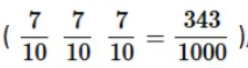
but the problem clearly says no replacement.
Answer D. is incorrect because it uses the ratio of non-yellow to total balls only once (7/10), instead of multiplying for three separate draws.
MAP Grade 9 Reading
One of my favorite dishes to cook is stew. There are so many different kinds, and they can each serve as an entire meal. Why would you hire a composer, lyricist, writer, and lead actor for a play when Lin Manuel Miranda can do all those things by himself? In most stews, you have a built-in protein, carb, and vegetable, so you only really need the one dish.
The protein is traditionally some kind of meat, generally beef, but poultry is used as well. Choosing the right meat is one of the most important factors in making the stew; the meat can really decide if your stew is awful, average, or excellent. However, it is not as simple as “the better quality the meat, the better quality the stew.” I have a friend who put premium entrecote in his stew, and it ruined both the meat and the stew. Using entrecote in a stew is like getting Shaquille O’Neal to shoot your free-throws or hiring Arnold Schwarzenegger to sing at a party. The right meat for a stew is one that can withstand long slow-cooking and that breaks down over time, such as “chuck” meat.
The carb is usually potatoes and/or some kind of grain. I like using barley because it absorbs a lot of the liquid and flavor. Multiple vegetables are normally added, ones that become sweeter after being cooked and that add a lot of flavor. Onions, carrots, and celery are some of the most common vegetables used for stew.
My favorite way of cooking a stew is in a slow-cooker. Cooking it on low heat over a long period of time really brings out the flavor. The longer you cook it, the better and more mature it will taste. However, stew can become overcooked, even on low heat, so don’t leave it on too long, or it will end up looking as burnt as 1871 Chicago. On the other hand, if you take it out too early, you won’t get the optimal flavor. So, keep an eye on it and make sure there is still enough liquid in there. I once noticed my stew starting to burn, so I added more water and managed to save it. Once the mixture of foods has had enough time to break down and release all of its flavors, you will be left with a true masterpiece of a meal.
Which of the following statements accurately describes how the author utilizes allusions to affect the tone of the passage?
There is only ONE correct answer.
Correct!
Wrong
Wrong
Wrong
Wrong
Let's Break This Down Step by Step
- Allusion: a brief reference to a well-known person, event, or work (book, movie, song) without explaining it.
- Tone: the feeling or mood the writing creates (e.g., formal/informal, serious/playful, welcoming/detached).
The author references well-known people and events such as Lin-Manuel Miranda, Arnold Schwarzenegger, Shaquille O’Neal, and the Chicago Fire of 1871 without pausing to explain them. These are allusions.
By bringing in familiar, pop-culture and historical references, the author makes an informational piece feel more informal, colorful, and welcoming, rather than strictly formal or dry.
You need a choice that (1) accurately describes the allusions (references to famous people/events) and (2) correctly names the tone effect (how the mood shifts).
Answer (A) is correct because the author makes references to artists and actors such as Lin-Manuel Miranda and Arnold Schwarzenegger, athletes such as Shaquille O’Neal, and historical events such as the Chicago Fire of 1871. These are allusions since they are references to well-known people and events. By including them, the author lightens the mood and prevents the passage from sounding overly formal or dry. Instead, the tone becomes more informal, engaging, and welcoming, drawing the reader in through familiar and entertaining references.
Answer (B) is incorrect. The first part of the sentence gives an accurate description of how the author uses allusions, but the second part does not tell us how they affect the tone, only that the passage is made more interesting. “Interesting” is not a type of tone. It means that the passage attracts the reader’s attention, but it does not tell us what type of feeling it creates, such as formal or informal, happy or sad, angry or excited, silly or serious. Any one of those feelings can be interesting or uninteresting.
Answer (C) is incorrect because the sentence does not properly address allusions or tone. While all of the allusions made in the passage are also analogies (as they compare something about the stew to the thing that is being referenced), it is not the comparison that the question asks about but rather the reference itself. In other words, the author utilizes two devices each time he mentions one of the famous people or events: He uses allusion when he references them, and he uses analogies when he compares something to them. This question asks how allusion is used, so the explanation is inaccurate if it only mentions the analogies made but not the fact that references were made.
The second part of answer (C) states that these analogies were made “in order to make the text easier to understand.” This has nothing to do with the tone of the passage. This addresses how clear the passage is, but it says nothing about the mood or feeling of the passage. For these reasons, option C is not the correct answer.
Answer (D) is incorrect because the first part of the sentence does not accurately describe allusions. It refers to the analogies made but not the references, and as addressed in the explanation for C, this is not the same thing as the allusions.
Answer (E) is incorrect. While the second part of the sentence accurately describes the effect on the tone of the passage, the first part does not address the allusions. Allusions are references to known events, not personal stories. Allusions may be expressed as stories, but the ones in this passage are not. There are two personal stories in this passage, and neither one contains an allusion to a known event, figure, or work. Seeing as the question asks how allusions are used to affect the tone, not how stories are, this cannot be the correct answer
MAP Grade 9 Language Usage
Julia was thirteen years old last week. Julia is too young to attend the local arts school. The school only accepts 14-year-olds or older. Julia's last name is Smith.
Which is the best way to combine the sentences above?
Correct!
Wrong
Wrong
Wrong
Let's Break This Down Step by Step
The question gives us four short sentences about Julia that include the following information:
- Julia was thirteen years old last week.
- Julia is too young to attend the local arts school.
- The school only accepts 14-year-olds or older.
- Julia’s last name is Smith.
Answer (A) includes every fact that is given to us: her name (Julia Smith), her age (just turned 13), the problem (too young), and the rule (school accepts 14+). The sentence flows smoothly and is clear. Therefore, it is the correct answer
Answer (B) is incorrect because it consists of awkward grammar. The phrase “but only accepts” does not connect logically and makes the sentence confusing.
Answer (C) is incorrect because it adds an idea that was not in the original sentences: “Julia would like to go to the school”. The task is to combine the sentences, not to rewrite them into a new one.
Answer (D) is incorrect because it is missing a key fact: it does not tell us that Julia just turned 13 last week.
무료 MAP 시험 10학년 예시 문제
MAP Grade 10 Math
George sells cars for a monthly wage of 2,000 dollars, plus a 1% commission on his total sales. He also needs to pay a 15% income tax on his total wage.
Which equation represents George's monthly income after taxes (I), and based on his sales (s)?
Wrong
Correct!
Wrong
Wrong
Let's Break This Down Step by Step
George's commission on his total sales is 1%. Percentages are parts out of a hundred, meaning that one percent is one out of a hundred: 1% =1/100=0.01
If George earns a monthly wage of 2,000 dollars, plus 1% of his total sales, it means that before the tax reduction, he earns 2000 + 0.01s.
George pays a 15% tax on his total wage (Note: 15% = 0.15). He needs to reduce 15 out of 100 percent of his total wage (which is 2000 + 0.01s) and is left with 85% (100 - 15 = 85), which is 0.85. His monthly income after tax is therefore 0.85(2000 + 0.01s). The correct answer is (B) because it represents this exact equation.
Answer (A) would have been correct if George's commission on his sales was 10% 10%=10/100=0.1.
Answer (C) is incorrect because the 15% reduction excludes the tax on George's commission.
Answer (D) is incorrect because the s(sales) component is missing.
MAP Grade 10 Reading
Which of the following words has the same root as the word micromanagement?
Wrong
Correct!
Wrong
Wrong
Let's Break This Down Step by Ste
The root of a word is the core that provides the most basic and crucial meaning, to which prefixes and suffixes may be added in order to modify that core meaning.
In the word “micromanagement,” the root is “manage,” which means to oversee arrangements or to be in charge of certain affairs. The suffix “ment” at the end of the word turns it into a noun, making the word refer to the idea of managing in general. The prefix “micro” refers to a very small version of something, or in this case, seeing to the smallest details of something.
Answer (A) is incorrect. “Microcosm” is incorrect because it uses the same prefix of “micro,” but it does not share the same root.
Answer (B) is correct. “Manager” is the only word in the answer choices that also uses the root “manage.” It adds the suffix. “er” to the root, resulting in a word that refers to someone who manages something.
Answer (C) is incorrect. While “Unimaginable” does share common letters with “micromanagement,” it does not share any meaningful part of the word.
Answer (D) is incorrect. “Engagement” is incorrect because it uses the same suffix of “ment,” but it does not share the same root.
MAP Grade 10 Language Usage
Deep beneath the Western Pacific Ocean lies the Mariana Trench, the deepest oceanic trench in the world. An oceanic trench is an underwater canyon. Studying the Mariana Trench helps scientists learn more about earthquakes and ocean life.
Which of the underlined phrases is a prepositional phrase? There may be more than one correct answer.
Wrong
Wrong
Wrong
Wrong
Let's Break This Down Step by Step
A prepositional phrase always begins with a preposition (such as: in, on, at, about, under, over, beneath), which relates a sentence to the object of the preposition. The object of a preposition is usually a noun or pronoun, but it can also be a gerund or clause. A preposition can have more than one object.
Answer (A) is incorrect because lies the Mariana Trench is an independent clause, not a prepositional phrase. The subject of the independent clause (and thus the sentence) is "Mariana Trench," and the verb is "lies." While the subject of a sentence usually comes before the verb, the order can sometimes be flipped. You can also tell that lies the Mariana Trench is not a prepositional phrase because it does not contain a preposition.
Answer (B) is correct because in the world is a prepositional phrase beginning with the preposition "in," and modifying the noun "trench." The object of the preposition “in” is the noun “world.”
Answer (C) is incorrect because an underwater canyon is a noun phrase, not a prepositional phrase. While the word "under," by itself is a preposition, underwater is an adjective because it describes a single noun or pronoun, not a relationship with the rest of a sentence.
Answer (D) is correct because about earthquakes and ocean life a prepositional phrase beginning with the preposition "about." The objects of the preposition “about” are the nouns “earthquake” and “ocean life.”
무료 MAP 시험 11학년 예시 문제
MAP Grade 11 Math
The current world population contains approximately \(7.8×10^9\) people.
The current population of California is approximately \(3.9×10^7\) people.
How many times greater is the world's population compared to California's population?
Wrong
Wrong
Wrong
Correct!
Wrong
Let's Break This Down Step by Step
Scientific notation is a particular way to express numbers, to ease the use of very big or very small values. A number in this form is written in two parts:
- Only the digits, with the decimal point placed after the first digit
- Multiply by 10 in the power that puts the decimal point where it belongs.
The exponent tells you how many places to move the decimal point. Positive powers move the decimal point to the right, whereas negative powers move it to the left.
In this question, you need to compare the relative magnitude of the two numbers expressed in scientific notation. It is relatively straightforward to compare numbers in this form since all you need to do is compare two small numbers expressed as decimals and then compare the exponents of ten, noticing that every addition of a unit to the exponent expresses multiple 10.
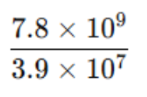
We want to compare the world population to California’s population:
Start the comparison between the population sizes with the decimal number. As you can see, 7.8 is twice as much as 3.9:
2 x 3.9 = (2 x 3 + 2 x 0.9 = 6 +1.8 = 7.8) -> 7.8/3.9 = 2
Focus on the exponents of the tens:
The world population number shows the decimal multiplied by 10 to the power of
9 (\(10^9\)).
The California population number shows the decimal multiplied by 10 to the power of
7 (\(10^7\))
To find how many times greater the world population is, simply divide using properties of exponents:

Do not forget that the decimal number before the exponent in the world population number is also twice as high as the California number, so it also needs to be multiplied by two: 2 × 100 = 200.
You can summarize all required calculations as follows:

MAP Grade 11 Reading
Read the following passage from A. A. Milne’s essay, "A London Garden," and answer the question below.
I have always wanted a garden of my own. Other people’s gardens are all very well, but the visitor never sees them at their best. He comes down in June, perhaps, and says something polite about the roses. “You ought to have seen them last year,” says his host disparagingly, and the visitor represses with difficulty the retort, “You ought to have asked me down to see them last year.” Or, perhaps, he comes down in August, and lingers for a moment beneath the fig-tree. “Poor show of figs,” says the host, “I don’t know what’s happened to them. Now we had a record crop of raspberries. Never seen them so plentiful before.” And the visitor has to console himself with the thought of the raspberries which he has never seen, and will probably miss again next year. It is not very comforting.
Give me, therefore, a garden of my own. Let me grow my own flowers, and watch over them from seedhood to senility. Then shall I miss nothing of their glory, and when visitors come I can impress them with my stories of the wonderful show of groundsel which we had last year.
In this passage, the author is writing from an ironic point of view. What does this change about the message of the passage that the reader is meant to understand, as opposed to its literal meaning?
Wrong
Wrong
Correct!
Wrong
Let's Break This Down Step by Step
This question asks you to figure out the difference between the literal meaning of the passage and the ironic meaning.
An ironic point of view is when an author writes as if they believe something, but they actually mean the opposite. The purpose is usually to mock that idea or show its flaws, much like satire or sarcasm.
To understand the irony in the passage, look at what the author pretends to believe versus what they actually mean.
- Literally, the passage suggests visitors always miss the best of the garden.
- Ironically, the real point is that garden owners always claim the best moments have already passed, even when that may not be true.
The owner says:
- “You ought to have seen them last year.”
- “Poor show of figs… Now we had a record crop of raspberries.”
- The visitor “will probably miss again next year.”
Answer (A) is incorrect because the author does not refer to a beautiful garden in an ironic way that is meant to imply that it is ugly. His point is about the tendency of the owners to believe that it is not at its best when visitors see it.
Answer (B) is incorrect because it states the literal meaning of the passage, not the message that the reader is actually meant to understand, as the question asks for. If this literal meaning were true, this would indeed be ironic because many people grow gardens for the very purpose of showing guests, but as explained above, to write from an ironic point of view does not simply mean to write about something that is ironic; it means to write from the perspective that you disagree with.
Answer (C) is correct. The author does not actually believe that gardens are worse when visitors come to visit them, but rather he is making fun of this tendency of gardeners by writing ironically as if it were true. Therefore, as explained in answer choice C, the message of the passage is that the gardeners always believe their gardens looked better before the visitors came, not that the gardens actually are worse when people visit, as the passage reads literally.
Anwer (D) is incorrect. The author’s point is not that growing his own garden will not ensure that he sees it at its best, but rather the very notion that the visitors never see it at its best is the ironic point of view.
MAP Grade 11 Language Usage
Which of the following is a compound-complex sentence?
Correct!
Wrong
Wrong
Wrong
Let's Break This Down Step by Step
A compound-complex sentence is a sentence with two or more independent clauses and at least one dependent clause.
Answer A. is correct. It consists of three clauses:
- We decided to go to a rock concert as a family.
- My wife did not join us.
- Who dislikes crowded places.
The first two clauses are independent—they can stand alone as a complete sentence—and are joined together by the coordinating conjunction "but." Therefore, the sentence is compound.
"Who dislikes crowded places" is a dependent clause, as it cannot stand on its own as a complete sentence. Therefore, the sentence is compound-complex.
Answer (B) is incorrect because the sentence is complex, but not compound. It consists of two clauses:
- My friend is now reading the most fascinating and well-written book.
- I have ever read.
The first clause is independent, as it can stand on its own as an independent sentence, whereas the second clause is dependent, as it cannot do so. Therefore, the sentence is complex.
Note that the word "and" connects only the two adjectives of the book and not two independent clauses. Therefore, it is not compound.
Answer (C) is incorrect because the sentence is complex, but not compound. It consists of two clauses:
- My dentist came back last week.
- Who had moved to another state a long time ago.
The first clause is independent, as it can stand on its own as a complete sentence, whereas the second clause is dependent, as it cannot do so. Therefore, the sentence is complex. Since there are no causes connected with a conjunction, it is not compound.
Answer (D) is incorrect because the sentence is compound, but not complex. It consists of three clauses:
- The child searched the busy, noisy street for hours.
- (Yet) his ball was nowhere to be seen.
- (And) finally he was forced to give up.
The clauses are joined by the coordinating conjunctions "yet" and "and." Therefore, the sentence is compound. All three clauses are independent, as they can stand on their own as complete sentences. Therefore, the sentence is not complex.
Teacher Tip: Remember there are exactly seven coordinating conjunctions, i.e. words that connect between two independent clauses to form a compound sentence: and, or, nor, for, yet, but, so.
무료 MAP 시험 12학년 예시 문제
MAP Grade 12 Math
You are offered to play a game with these rules:
- First, you roll a fair die (equal probability for each number).
- If the number that comes up is one or two, you lose.
- If it is larger than two (three or higher), you open a box containing six green balls and four red balls and take out one ball.
- If the ball is red, you lose. If it is green, you win.
What is the probability of winning the game?
Wrong
Wrong
Correct!
Wrong
Let's Break This Down Step by Step
The game has two separate parts:
- Roll a fair die (numbers 1–6, each with equal chance).
- If the result is 3, 4, 5, or 6, then you draw a ball from a box containing 6 green balls and 4 red balls.
To win, you must succeed in both stages: first roll 3–6, and then pick a green ball.
- Total possible outcomes when rolling a die = 6 (numbers 1–6).
- Favorable outcomes = 4 (numbers 3, 4, 5, 6).
- Probability = number of favorable outcomes ÷ total outcomes:
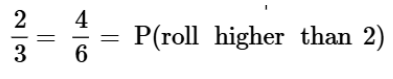
This means you have a two-thirds chance of getting to the second stage.
- Total balls in the box = 10 (6 green + 4 red).
- Favorable outcomes = 6 (green balls).
- Probability = number of favorable outcomes ÷ total outcomes:
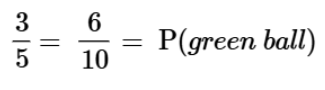
This means if you get to this stage, you have a three-fifths chance of winning.
Because you must succeed in both steps (roll higher than 2 and pick a green ball), you multiply the probabilities:
P(win) = P(roll higher than 2) x P (green ball)
Now substitute the numbers:
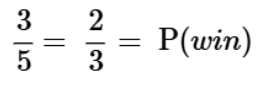
Multiply the numerators (2 × 3 = 6) and the denominators (3 × 5 = 15):
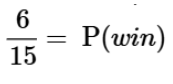
Simplify the fraction:
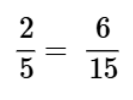
The probability of winning the game is:
2/5
MAP Grade 12 Reading
Read the following excerpts from the poem “Paul Revere’s Ride,” by Henry Wadsworth Longfellow, and answer the question that follows.
Listen, my children, and you shall hear Of the midnight ride of Paul Revere, On the eighteenth of April, in Seventy-Five: Hardly a man is now alive Who remembers that famous day and year.
He said to his friend, “If the British march By land or sea from the town to-night, Hang a lantern aloft in the belfry-arch Of the North-Church-tower, as a signal-light,— One if by land, and two if by sea; And I on the opposite shore will be, Ready to ride and spread the alarm
Through every Middlesex village and farm, For the country-folk to be up and to arm.”
…
Meanwhile, impatient to mount and ride, Booted and spurred, with a heavy stride, On the opposite shore walked Paul Revere.
…
But mostly he watched with eager search The belfry-tower of the old North Church, As it rose above the graves on the hill, Lonely and spectral and sombre and still. And lo! as he looks, on the belfry’s height, A glimmer, and then a gleam of light! He springs to the saddle, the bridle he turns, But lingers and gazes, till full on his sight A second lamp in the belfry burns!
A hurry of hoofs in a village-street, A shape in the moonlight, a bulk in the dark, And beneath from the pebbles, in passing, a spark Struck out by a steed that flies fearless and fleet: That was all! And yet, through the gloom and the light, The fate of a nation was riding that night; And the spark struck out by that steed, in his flight, Kindled the land into flame with its heat.
…
You know the rest. In the books you have read, How the British Regulars fired and fled,— How the farmers gave them ball for ball, From behind each fence and farmyard-wall, Chasing the red-coats down the lane, Then crossing the fields to emerge again Under the trees at the turn of the road, And only pausing to fire and load.
Which of the following is the best summary of the poem?
Correct!
Wrong
Wrong
Wrong
Let's Break This Down Step by Step
The best summary relates all of the most essential points in a clear and concise manner. All of the information must be accurate, only leaving out information that is not crucial to story, and certainly not adding false information that isn’t written in the story at all (though it does not need to relate the information in the same way that the text does, and the summary may also clarify things that aren’t explicitly written). The best summary relates the information in a straightforward and brief manner, even if the original text uses colorful language for dramatic effect, and it does not waste time on insignificant details or even repeat important points that have already been mentioned.
The poem tells about:
- Paul Revere asking his friend to signal with lanterns if the British approach (one if by land, two if by sea).
- Revere waiting, seeing the signals, and riding off to warn the villagers.
- His warning spreading quickly, symbolizing the start of the Revolution.
- The farmers fighting back and the British retreating.
Answer (A) is correct because it meets all of these criteria. Even though details such as the exact date and the name of the area (Middlesex) are left out, this is okay because we are still given a general idea of when and where it happened (in Colonial America in 1775). Even though the poem does not say that it took place in “Colonial America” and it does not specify that it was 1775, only writing “seventy-five,” this is not considered adding in information as it is implied in the text with basic background knowledge, and it is okay for a summary to provide important background information in a more explicit way than is done in the text.
Answer (B) is incorrect because it focuses more on insignificant details and less on important details. For example, it spends most of a sentence focusing on the imagery of Paul Revere riding through the villages, using phrases such as “a shape in the moonlight,” and “causing sparks to fly from the pebbles,” which tell us nothing about what happened practically and are only in the poem in order to make it more colorful and poetic. In contrast, the summary does not even specify how Revere’s friend signaled to him with the lanterns, one for land and two for sea, which is an important part of the story that the poem spends a lot of time describing. Additionally, the paragraph addresses the audience twice which is a literary technique and out of place in a summary. It is also misleading at the end when it seems to imply that this battle culminated with the winning of the war, which in actuality did not happen until several battles later.
Answer (C) is incorrect because it is unclear and not entirely accurate. For example, the first sentence does not properly explain what is happening, as it provides little context for the story and does not fully explain the situation. Also, it says that Revere saw “the light” and does not specify that he saw two, which meant that the British were coming by sea. This is unclear and even sounds more like the British were coming by land, which is inaccurate. Additionally, when it claims that Revere rode his horse “through the many villages of the colonies,” this sounds like he rode through villages throughout the colonies, which would be impossible to do in one night, and the poem states that he only rode through the villages of one county in one of the colonies.
Answer (D) is incorrect because it focuses disproportionately on certain details; it spends a lot of time describing some events while it rushes through other important parts. Two full sentences are devoted to describing Paul Revere seeing the lights, and while this is an important part of the poem, even important points can be related in a much more concise manner. In contrast, only half of one sentence is devoted to describing Paul Revere’s ride itself, which is just as important. This is clearly unbalanced and not representative of the poem. The summary is also very vague at times, even to the point of inaccuracy. For example, it never tells us that the British retreated, only that Revere was successful, and it asserts that Revere told his friend “to signal him if the British were coming by land or sea,” which is a very unclear statement that could be understood to mean that there was one signal for both options, or that they already knew the British were coming, just not how they were coming. It also claims that Revere rode through “the village of Middlesex,” when, in actuality, Middlesex is not just one village, but an entire county, and he rode through many villages in Middlesex.
MAP Grade 12 Language Usage
Read the following passage and determine which case each beginning letter of the words in the brackets should be.
Kelly entered the room with a bright smile on her face. Something unexpected had clearly gone in her favor in the meeting. “Just so you know,” she said with a flare of pride in her eyes, “[He/he] wanted to see me to offer me a promotion.”
“A promotion?” Jenn asked incredulously.
“You mean this wasn’t about your little outburst yesterday?” asked Megan.
Kelly threw her hair off to the side in feigned indifference and replied, “[Oh/oh], it was about that.” Her grin was discernable from behind even as she turned to walk toward her desk. “Mr. Burkes happens to think I showed guts yesterday in standing up for what I believe in. He says they need more people like me in the higher offices.”
Select the two correct answers:
Wrong
Correct!
Correct!
Wrong
Let's Break This Down Step by Step
Both “he” and “Oh” appear at the start of quotations that occur in the middle of the passage’s sentences.
The rule depends on whether the quoted word is at the beginning of the speaker’s sentence or in the middle of the speaker’s sentence — not on its position within the passage.
Even though “he” comes right after the quotation mark, it is not the start of Kelly’s sentence. The sentence was interrupted by the dialogue tag (she said), and the second quotation is just continuing the same sentence. Therefore, it stays lowercase: he.
In this case, “Oh” is the first word of Kelly’s spoken sentence. Even though it appears later in the passage, it begins her sentence, so it must be capitalized: Oh.
우리의 연습 번들이 오래 지속되는 능력을 키우는 방법
수천 개의 MAP 스타일 연습 문제를 개발한 후, 저희 전문가 팀은 실제 향상을 이끄는 요소를 설명하는 세 가지 핵심 인사이트를 발견했습니다:
- 시험의 논리를 이해하면 더 스마트한 답을 선택할 수 있습니다.
- 꾸준한 연습은 가을·겨울·봄 시험 간의 눈에 띄는 성장을 만들어냅니다.
- 무엇이 평가되는지 알면 학생들이 단순한 시험 기술이 아닌 진정한 성장을 보여줄 수 있습니다.
우리의 MAP 연습이 다른 점은 무엇인가요?
다른 사이트는 퀴즈만 제공하지만, 저희는 실제 시험의 구조·점수 방식·난이도 흐름과 동일한 **전체 길이 MAP 모의고사 학습 패키지**를 제공합니다.
다운로드하다 MAP Test Prep Guide PDF.
저희 시험 대비 자료에는 다음이 포함됩니다
운동과 비슷합니다. 매일 조금씩 하면 더 오래 지속되는 자신감을 키울 수 있습니다.
-
전체 길이 모의고사: MAP 시험의 길이와 구조를 그대로 반영해 학생들이 실제 시험에 대비할 수 있도록 합니다. 각 시험은 반복 사용이 가능해 무한 연습이 가능합니다.
-
단계별 연습 문제: 수학·읽기·언어에서 핵심 기술부터 복잡한 기술까지 단계적으로 발전합니다.
-
단계별 해설: 각 문제의 reasoning을 보여주어 문제 해결 능력과 시험 전략을 강화합니다.
-
집중 스킬 연습: 학년별로 가장 필요한 영역(어휘, 문법, 독해, 주요 수학 개념 등)에 집중한 연습입니다. 반복 활용이 가능해 무한 연습이 가능합니다.
-
전략 팁: 집중 유지, 시간 관리, 난이도 높은 문제 해결 등을 위한 실용적인 방법을 제공합니다.
-
학습 진행 추적: 연습 과정에서의 성장을 보여주어 학생과 학부모가 꾸준한 향상을 확인하고 학년별 기술 수준을 이해할 수 있도록 돕습니다.
학년별 MAP 시험에서 기대할 수 있는 내용
MAP Growth 시험은 학년별로 형태가 다르며, 적응형 구조로 인해 학생의 수준에 맞춰 질문이 조정됩니다. 때로는 동일 학년보다 높거나 낮은 학년의 문제가 포함되기도 합니다. 아래 간단한 가이드를 통해 각 단계에서 학생이 어떤 내용을 경험하게 되는지 확인해 보세요:
K–2
그림 중심의 문제와 기본 숫자·단어 능력이 포함됩니다. 연습의 목적은 편안함과 호기심을 키우는 것입니다.
3–5학년
더 긴 글과 다단계 수학 문제가 등장합니다. 학생들은 집중력과 시험 전략을 발전시키기 시작합니다.
6–8학년
더 추상적인 사고, 복잡한 정보 텍스트, 비례 사고가 포함됩니다.
9–12학년
고급 수학 문제, 고난도 독해 질문, 대학 준비와 직접 연결되는 문법 능력이 포함됩니다.
전문가 MAP 시험 팁 및 예시 문제
MAP Growth 시험이 학생 수준에 맞게 어떻게 적응하는지 알아보고, 여러 과목에서 성과를 높이는 실용적인 전략을 학습하세요.
MAP 점수를 의미 있게 만들기
MAP Growth 점수는 아이의 학습 여정을 더 입체적으로 보여줍니다. 현재 수준뿐 아니라 시간에 따라 어떻게 성장하고 있는지도 나타냅니다. 점수를 이해하는 간단한 설명은 다음과 같습니다:
RIT 점수: 학생의 학업 수준을 연속 척도로 나타내며, 점수가 높을수록 일반적으로 상위 학년에서 기대되는 더 고급 기술을 반영합니다.
백분위 순위: 학생의 RIT 점수가 기준 집단(규준 집단)과 비교해 어느 위치에 있는지를 보여줍니다. 예를 들어 75번째 백분위는 해당 집단의 75%보다 점수가 높다는 의미입니다.
성장 규준: 비슷한 수준에서 시작한 또래와 비교해 학생이 얼마나 성장했는지를 보여줍니다. 이러한 규준은 전국 데이터를 사용해 아이의 학습이 학년·과목별 일반 성장 속도와 얼마나 일치하는지 설명합니다.
MAP 점수와 그 의미에 대한 전체 설명은 MAP 점수 페이지를 방문하세요.
Ask Ariav

교육학 석사 학위를 보유한 공인 교사이자 MAP Growth 전문가로, 실제 시험의 난이도에 맞춘 MAP 정합 문제를 10년 이상 개발해 온 경험을 갖고 있습니다. Ariav는 이해도를 높이고 사고력을 강화하며 모든 아이가 MAP Growth 평가에서 최고의 성과를 낼 수 있도록 돕는 명확하고 자세한 해설 자료를 제작합니다.
자주 묻는 질문 (FAQ)
MAP Growth 시험은 NWEA가 개발한 컴퓨터 적응형 평가입니다. 학생의 응답에 따라 난이도가 조절되며, 정답을 맞히면 다음 문제가 조금 더 어려워지고, 틀리면 다음 문제가 더 쉽게 제공됩니다. 이를 통해 모든 학생의 실제 수준이 정확하게 측정되며, 이미 알고 있는 내용과 다음 단계에서 학습할 준비가 된 내용을 모두 보여줍니다.
아니요. MAP Growth 시험에는 엄격한 시간 제한이 없습니다. 대부분의 과목은 1시간 이내에 완료되지만, 어린 학생들은 더 빠르게 끝낼 수 있고, 고학년 학생들은 긴 독해 지문이나 다단계 수학 문제 때문에 더 오래 걸릴 수 있습니다.
문항 수는 과목과 학년에 따라 다르지만, 대부분의 MAP Growth 시험은 과목별 약 40–50문항으로 구성됩니다. 시험이 적응형이기 때문에 두 학생이 동일한 문제 세트를 보지는 않습니다.
시간 제한은 없지만, 대부분의 학교에서는 총 약 2~3시간을 배정하며, 보통 여러 세션으로 나누어 진행합니다. 이를 통해 학생들이 급하게 느끼지 않고 집중할 수 있는 시간을 확보합니다.
많은 학교에서는 MAP Growth 시험을 연 3회(가을, 겨울, 봄)에 실시합니다. 이러한 일정은 단일 점수에 의존하기보다 시간에 따른 성장을 측정할 수 있게 해줍니다.
MAP Growth 결과는 보통 성적표에 기재되지 않습니다. 대신 교사와 학교에서는 점수를 통해 학습 진행 상황을 추적하고, 학생들을 수업에 맞게 그룹화하며, 때때로 심화 과정이나 지원 프로그램 배치에 참고합니다.
RIT 점수는 아이의 학업 수행 수준을 연속적인 학습 척도에 표시한 숫자입니다. 등급(letter grade)과 달리 학년 수준에서 멈추지 않고, 연령이나 학년에 관계없이 시간에 따른 성장을 보여줍니다. 이를 통해 한 학기에서 다음 학기로 이어지는 학습 진행 상황을 보다 쉽게 확인할 수 있습니다.
“좋은” MAP Growth 점수는 아이의 학년과 과목에 따라 다릅니다. MAP Growth는 백분위 순위를 사용해 전국 규준 집단과 비교합니다. 예를 들어, 75번째 백분위는 아이가 전국 동일 학년 학생 중 75%보다 높은 점수를 받았다는 의미입니다.
네. MAP Growth는 학교에서 배운 내용을 평가하지만, 시험 형식에 익숙해지는 것만으로도 큰 차이를 만들 수 있습니다. 연습 문제와 전체 길이 모의고사는 시험 불안을 줄이고 자신감을 높이며, 학생들이 실제 실력을 보여줄 기회를 제공합니다. 저희 MAP 대비 패키지는 실제 시험과 유사한 구조로 제작되어 학년별 기술 향상 연습을 제공합니다.


